
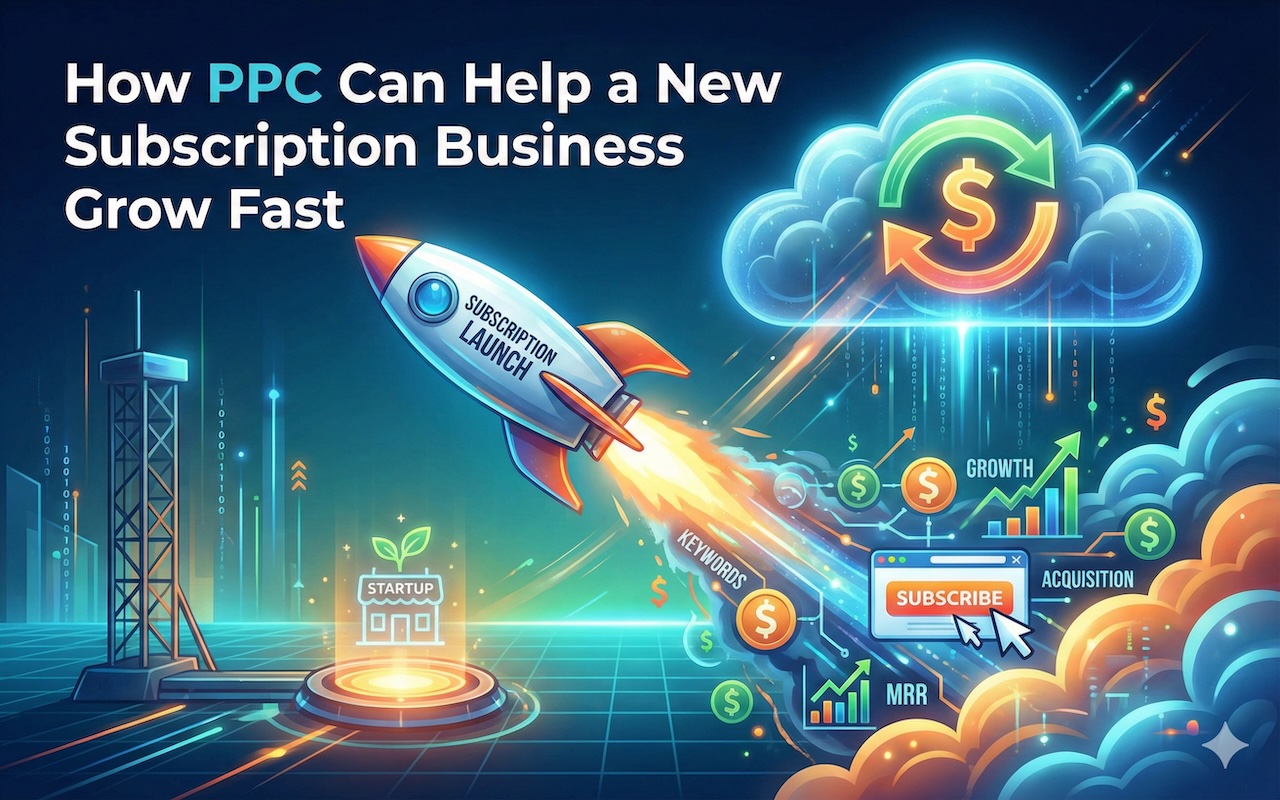
In a competitive digital landscape, new subscription businesses face a common problem: attracting attention quickly enough to build momentum. Unlike one-time purchases, subscriptions depend on a steady pipeline of qualified customers who are willing to commit and stay. Pay-Per-Click (PPC) advertising can be a powerful growth lever in these early stages because it delivers immediate visibility, measurable performance, and the ability to target high-intent audiences with precision.
When used strategically, PPC helps subscription brands validate messaging, generate trials or sign-ups faster, and scale acquisition in a controlled way—without waiting months for organic traffic to mature.
What PPC Is and Why It Fits Subscription Growth
PPC is a digital advertising model where you pay when someone clicks your ad. It gives new subscription brands the advantage of instant reach across platforms like Google Search, YouTube, Facebook, Instagram, and others. The real value is not just traffic—it is the ability to connect ads to specific outcomes such as free trials, demo requests, checkout completions, or paid memberships.
For subscription businesses, PPC management is especially useful because it can be optimized around long-term revenue metrics, not just short-term clicks. With proper tracking, you can measure what it costs to acquire a subscriber and whether that subscriber is likely to stay.
1. Get Fast Visibility While Organic Channels Ramp Up
New subscription brands often struggle with the “cold start” problem: no search presence, limited brand recognition, and little historical performance data. PPC solves this by putting your offer in front of people actively looking for solutions right now.
Instead of waiting for SEO to build authority, PPC can immediately drive traffic to landing pages and sign-up flows. This is critical in the early phase when you need feedback quickly—what offer works, what messaging converts, and what audience responds.
2. Target High-Intent Users Who Are Ready to Subscribe
One of PPC’s biggest advantages is precision targeting. Subscription businesses can reach users based on search intent, demographics, interests, devices, and behavior.
For example, search ads can capture users who are already problem-aware and ready to compare options. Shopping-style ads (where relevant) can show pricing and value upfront. Paid social can target people likely to engage with trials or “starter” offers, then retarget them with stronger conversion messaging.
This matters because subscription conversion depends heavily on intent. Broad traffic may be cheap, but it tends to produce low-quality sign-ups that churn quickly.
3. Control Acquisition Costs and Scale Predictably
Subscription brands need predictable unit economics. PPC supports this by allowing you to set budgets, adjust bids, and control spend based on performance.
As campaigns generate data, you can gradually scale the channels that produce subscribers at a sustainable cost. Instead of expanding blindly, you can increase budget where subscriber quality is highest—often measured through trial-to-paid conversion, early retention, or revenue per user.
This creates a clear path from “testing” to “scaling,” which is essential for subscription growth.
4. Use PPC to Build Brand Recognition and Shorten the Trust Gap
In subscription models, trust is a major conversion barrier. Many users hesitate because they worry about ongoing charges, cancellation difficulty, or product quality.
Even when users do not convert immediately, PPC still creates value through repeated exposure. Consistent messaging builds familiarity, which reduces friction when prospects come back later. Over time, awareness supports higher click-through rates, improved conversion rates, and lower acquisition costs.
This is especially important for new brands that have not yet built social proof or organic authority.
5. Improve Conversion Rates With Subscription-Focused Landing Pages
PPC performance is tightly linked to the landing page experience. Subscription businesses convert better when the landing page removes uncertainty and clarifies the offer immediately.
High-performing subscription landing pages typically explain the value proposition quickly, show what the subscriber gets, address pricing transparently, and include trust signals such as reviews, guarantees, cancellation clarity, and FAQs. The message should match the ad exactly so users feel they arrived in the right place.
Small improvements—clearer headlines, fewer form fields, stronger proof—can lift conversion rates enough to dramatically improve ROI.
6. Reduce Churn by Optimizing for Subscriber Quality, Not Just Volume
A common PPC mistake for subscription businesses is optimizing solely for the cheapest sign-ups. Low-cost sign-ups often churn quickly, which makes acquisition look good on paper but weak in revenue.
To grow sustainably, PPC should be optimized for subscriber quality. That means tracking beyond the first conversion and tying campaigns to downstream signals such as trial activation, onboarding completion, first renewal, or early retention. When you align PPC with those metrics, you typically get fewer sign-ups—but better subscribers.
7. Retargeting: Convert Warm Prospects Who Need More Time
Most subscription buyers do not convert on the first visit. Retargeting helps bring them back with the right message at the right time.
A smart retargeting sequence can highlight social proof, reinforce key benefits, answer common objections, and offer a low-risk entry point such as a trial, discount, or limited-time bonus. This is one of the fastest ways to improve conversion rates without increasing cold traffic budgets.
8. Track the Metrics That Matter for Subscription Businesses
Subscription PPC should be measured differently than ecommerce one-time purchases. Instead of focusing only on cost per click or cost per lead, subscription businesses should prioritize:
- Cost per trial or sign-up (early indicator)
- Trial-to-paid conversion rate (quality indicator)
- Cost per acquired subscriber (core acquisition metric)
- Retention and churn (business health metric)
- Lifetime value (LTV) and LTV:CAC ratio (scalability metric)
When PPC is connected to these metrics, it becomes a predictable growth engine rather than a short-term traffic tool.
Conclusion
PPC can help a new subscription business grow fast by delivering immediate visibility, capturing high-intent customers, and generating measurable acquisition results from day one. More importantly, PPC can be optimized not just for conversions, but for subscriber quality and retention—making growth sustainable instead of fragile.
When aligned with strong landing pages, retargeting, and subscription-specific metrics, PPC becomes one of the most effective ways to build early momentum and scale recurring revenue with control and clarity.
Featured Image generated by Google Gemini.
Share this post
Author

Read the latest articles from Kylie Miler
Artificial Intelligence in Business: Planning, Building, and Scaling AI Effectively

January 8, 2026
Artificial intelligence is reshaping how businesses operate, compete, and grow. From automating internal processes to enabling data-driven decision-making, AI has become a practical component of modern business strategy. However, successful adoption requires more than selecting tools or hiring developers. [...]
Learn moreHow Predictive Analytics Can Help Identify Fulfillment Process Bottlenecks

December 10, 2025
Next-generation analytics leverage scan data, records from warehouse and transport systems, and the timing of each process step to identify which receiving, picking, kitting, or shipping activities are underperforming. Standardized metrics and real-time dashboards across sites and shifts enable more effec [...]
Learn moreLeave a comment
All comments are moderated. Spammy and bot submitted comments are deleted. Please submit the comments that are helpful to others, and we'll approve your comments. A comment that includes outbound link will only be approved if the content is relevant to the topic, and has some value to our readers.
Comments (0)
No comment