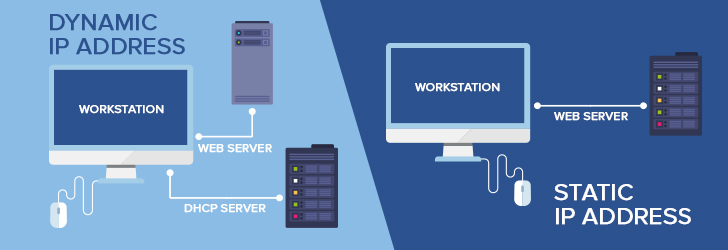
An IP address is an address assigned to a device on the Internet. A static IP address is a fixed IP address that never changes, and a dynamic IP address is an IP that is assigned by the DHCP server which may change over time.
A public IP address is an IP address that can be accessed over the Internet, and a private IP address is an IP address that is local to your private network. A public IP is a globally unique IP, while a private IP address can be reused in different networks.
Internet Protocol Version 6 (or IPv6) is a successor of IPv4 Address standard developed by IETF, which is designed to solve IPv4 address exhaustion problem. IPv4 uses a 32-bit numbering scheme to represent an IP address, which has an address space of 232 or 4.3 billion. IPv6, on the other hand, uses a 128-bit numbering scheme (2128) which has big enough address space for many decades to come. IPv6 is intended to replace the IPv4, but the introduction of the CIDR (Classless Inter-Domain Routing) allocation scheme in 1993 within the IPv4 prolonged lifespan of IPv4 Addresses. With the anticipation of smartphones, tablets, smart appliances, and other electronic devices joining the Internet every day, IPv4 address space will eventually exhaust. As of May 2014 per Google Statistics, 96% of Internet traffic is IPv4 and only 4% is represented by IPv6. IPv4 and IPv6 are not interoperable by design, so the transition from IPv4 to IPv6 requires a "transition mechanism" such as Stateless IP/ICMP Translation, Transport Relay, 6rd, and other IPv6 transition mechanisms to make them interoperable.
You have a private or public network with servers and workstations that are assigned static and dynamic IP addresses (either private or public IPs). You assigned them the static IP addresses due to NAT (Network Address Translation) or for public access, and dynamic IP addresses via the DHCP. Even if you kept a good record of those assigned IPs, there are times when you want to find all IP addresses of networked devices. The following procedure may be used to determine IP addresses of networked devices that are connected to your network.
IP Spoofing is a technique used to gain unauthorized access to machines, whereby an attacker illicitly impersonates another machine by manipulating IP packets. IP Spoofing involves modifying the packet header with a forged (spoofed) source IP address, a checksum, and the order value. Internet is a packet switched network, which causes the packets leaving one machine may be arriving at the destination machine in different order. The receiving machine resembles the message based on the order value embedded in the IP header. IP spoofing involves solving the algorithm that is used to select the order sent values, and to modify them correctly.
Ipconfig is a MS-DOS command-line tool used to display and manage the network settings of your computer. Ipconfig is available on Windows machines, and it displays the current network connection details and DHCP client settings.
MAC, Media Access Control, address is a globally unique identifier assigned to network devices, and therefore it is often referred to as hardware or physical address. MAC addresses are 6-byte (48-bits) in length, and are written in MM:MM:MM:SS:SS:SS format. The first 3-bytes are the ID number of the manufacturer, which is assigned by an Internet standards body. The second 3-bytes are serial numbers assigned by the manufacturer.
The Internet Protocol Address (or IP Address) is a unique address that computing devices such as personal computers, tablets, and smartphones use to identify themselves and communicate with other devices in the IP network. Any device connected to the IP network must have a unique IP address within the network.