
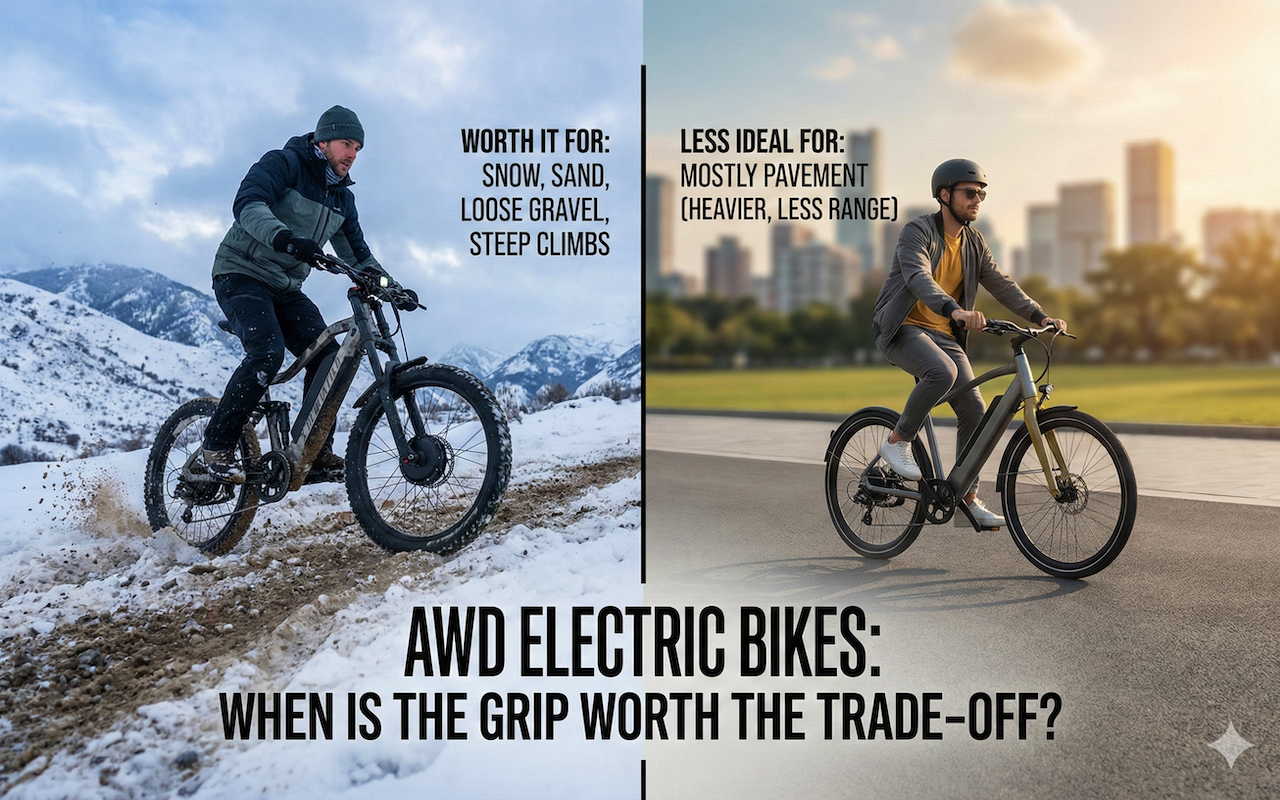
An AWD electric bike is worth it for riders who regularly deal with snow, sand, mud, loose gravel, steep dirt climbs, or slick driveways where a rear tire likes to spin. For mostly pavement riding, all wheel drive (AWD) often costs more while giving you less range and more weight than you want.
An AWD electric bike can still deliver long-distance riding when it’s paired with a large battery. For example, the Tesway X7 long range electric bike comes with a 52V 60Ah battery and lists a claimed maximum range of up to 200 miles per charge.
What AWD Feels Like on Real Roads and Trails
A normal e-bike pushes from the rear. An AWD e-bike adds a powered front wheel, so the bike can pull and go at the same time. On loose ground, that front pull makes the bike feel more planted, especially at low speed. The starts get calmer, the climbs get steadier, and the rear wheel is less likely to kick to the side.
On smooth city streets, the difference can feel small. You still roll forward, still cruise, still brake the same way. The most significant change is the bike’s heavier feel and the way the battery drains faster at higher assist levels.
Where AWD Truly Helps
AWD shines in places where traction is the limiting factor.
In winter commuting, AWD helps you get moving off the line without the rear wheels slipping. On packed snow, slush, and gritty ice patches, the bike can feel more controlled because both tires share the work.
On sand and other soft surfaces, an AWD electric bike improves forward traction and reduces rear-wheel slip. Compared with rear-wheel drive alone, power distributed to both wheels helps maintain momentum and limits drive force loss from wheelspin, resulting in more stable low-speed progress through loose terrain.
On steep, loose climbs, AWD helps most at low speeds, where riders usually stall. Instead of one tire breaking loose and killing your speed, both tires carry part of the load.
For heavier riders and cargo, AWD can feel more stable on gravel roads, dirt access paths, and uneven terrain where traction changes every few feet.
Range, Weight, and Complexity
AWD usually means two motors and more electrical parts. That often leads to three practical downsides.
First, the range often drops. Two motors draw more power, and AWD bikes are commonly heavier. Cold weather also reduces battery performance, so winter riders feel the hit even more.
Second, weight goes up. That matters when lifting the bike stairs, loading a car rack, or maneuvering in tight spaces.
Third, complexity goes up. More wiring and more components can mean more troubleshooting later. A sound AWD system can still be reliable, but the ownership experience is rarely as simple as a single-motor setup.
AWD vs Rear Hub vs Mid-Drive
Here is the cleanest way to compare what you get in daily use.
| Feature | AWD (front + rear hubs) | Rear hub | Mid-drive |
|---|---|---|---|
| Loose surface traction | Best | Good with the right tires | Good, depends on tires and rider input |
| Snow and sand starts | Best | The rear wheel can spin | Strong feel, traction still matters |
| Battery efficiency | Lower | Best | Often very good with smart shifting |
| Weight | Higher | Medium | Medium |
| Maintenance feel | More electronics | Simple | More drivetrain wear over time |
| Best fit | Winter, sand, mixed rough terrain | City, paths, everyday rides | Hills, long rides, natural pedal feel |
A strong mid-drive can climb very well because it uses the bike’s gears. AWD still wins on traction-limited surfaces because it spreads the work across two tires. The rear hub wins on simplicity and efficient commuting.
What to Look for Before Buying an AWD
A good AWD bike needs smooth power delivery. Abrupt front pull can feel odd at the bars, especially during slow turns. Better tuning feels steady and predictable.
Front-end strength matters too. A front hub motor puts extra forces into the fork and front wheel. A solid fork, quality axle setup, and strong wheel build are non-negotiable.
Tires are just as crucial as AWD. AWD plus bad tires still slips. 2WD plus great tires often beats AWD on the wrong rubber. For snow or loose gravel, tread and pressure are where grip starts.
Who Should Skip AWD
Riders who mainly ride on pavement usually get better value from a quality rear hub or mid-drive. You keep a better range, lower weight, and a more straightforward setup.
Riders who prioritize long distance per charge also tend to prefer 2WD. AWD can do long range with a big battery, but the price climbs quickly.
Bottom Line
AWD electric bikes are worth it when your rides include real traction problems you face often, like winter streets, sandy paths, muddy access roads, or steep, loose climbs. The extra grip can make riding feel safer and more controlled, especially at low speeds. For mostly city pavement, AWD is usually a premium feature that gives you less range and more weight than you need, so a strong 2WD e-bike is the better buy.
 FAQs
FAQs
It can improve traction during starts and climbs on slippery ground. It does not replace good tires and careful braking.
In many cases, yes. Two motors and extra weight often reduce range, especially in cold weather.
Most riders do fine with 2WD on pavement. AWD becomes valuable when traction is a daily problem.
Featured Image generated by Google Gemini.
Share this post
Author

Read the latest articles from Thomas Lore
Nano Banana Pro API Integration Guide for Image Editing and Generation
April 23, 2026
Image workflows become difficult to maintain when editing and generation remain disconnected from the rest of the production process. Many teams can test an endpoint once, get a result, and call that success. Real integration starts later, when image requests repeat, output has to move through review, and the wor [...]
Learn moreTurning Raw IP Logs into Insights

April 16, 2026
Every second, servers across the internet generate millions of log entries—cryptic lines of text documenting every connection, request, and error. For network administrators, security analysts, and digital forensics investigators, these IP logs contain invaluable intelligence about traffic patterns, security th [...]
Learn moreLeave a comment
All comments are moderated. Spammy and bot submitted comments are deleted. Please submit the comments that are helpful to others, and we'll approve your comments. A comment that includes outbound link will only be approved if the content is relevant to the topic, and has some value to our readers.
Comments (0)
No comment