
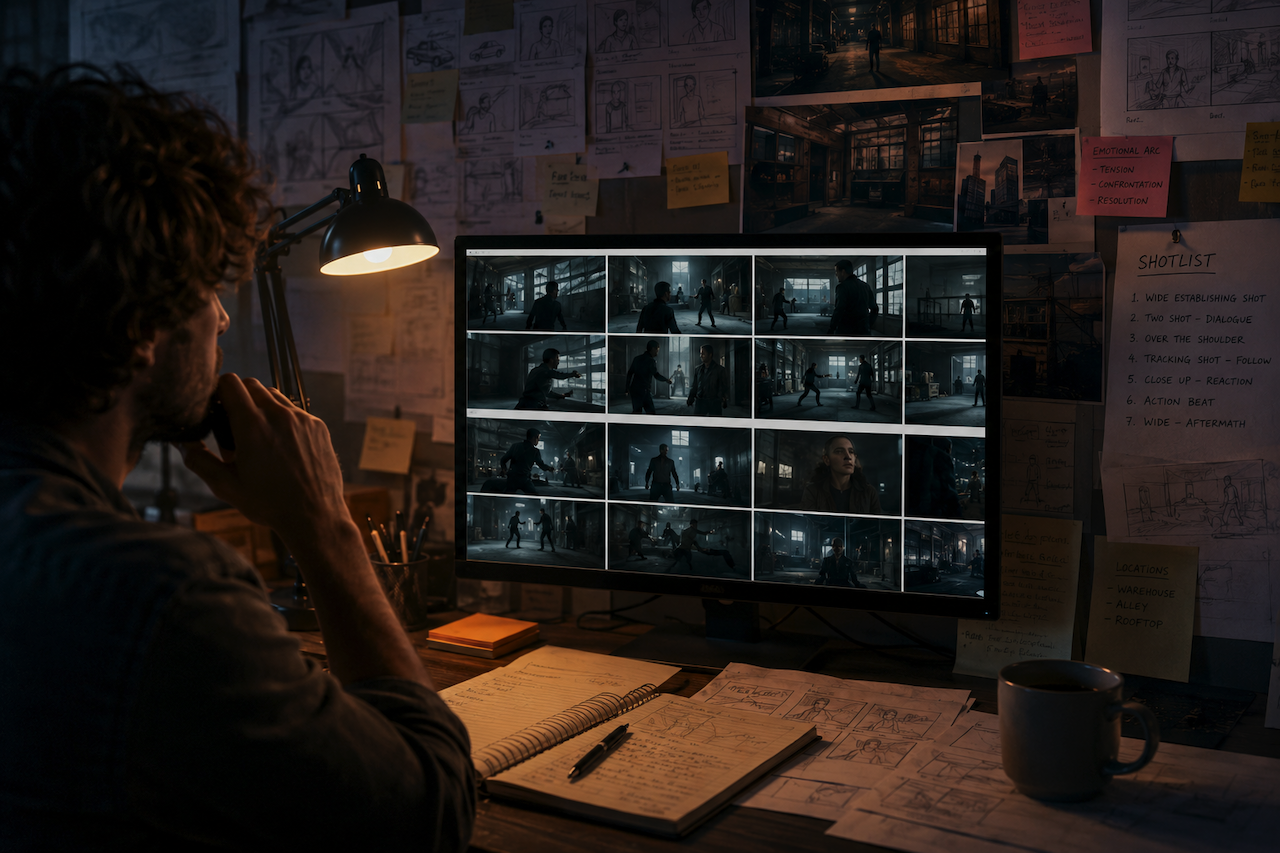
Filmmaking is, at its core, a problem of translation. You have a scene in your head — the blocking, the light, the emotional texture, the way the camera needs to move to make the moment land — and you need to get that scene out of your head and onto a screen in a way that survives the chaos of an actual production day.
On a major studio film, that translation is managed through layers of pre-production: storyboards, animatics, and pre-visualization sequences produced by dedicated previz teams who build rough 3D versions of every complex shot before the cameras roll. The director arrives on set with a clear picture of what needs to happen because someone has already mapped it out in detail.
On an independent film, that infrastructure often does not exist. The director shows up with storyboard sketches if they are organized, a shot list if they are disciplined, and a mental image of the scene that they hope will survive contact with the actual location, the actual actors, the actual light, and the reality that every production day costs money, whether or not the shots are working.
That gap between what indie filmmakers need from pre-production and what they can afford has always been one of the structural disadvantages of working outside the studio system. AI video generation is beginning to close some of that gap, and the implications for how independent films get made are becoming increasingly significant.
What Previz Actually Does for a Production
The value of pre-visualization (previz) is not aesthetic. The rough 3D sequences that previz teams produce are not meant to be beautiful. Their value is operational. They answer specific questions before those questions become expensive: Does this camera move work with this blocking? Can you actually see the actor's face in this lighting setup? Does the sequence of shots communicate the scene's emotional arc clearly, or does the edit feel choppy and disorienting? Is the schedule realistic, given what the scene actually requires?
Answering those questions on set, in real time, with a crew waiting and a location clock running, is expensive and stressful. Answering them in pre-production, in front of a laptop, with the ability to change anything without consequence, is what previz enables. The production day becomes an execution problem rather than a discovery problem, and execution problems are manageable in ways that discovery problems are not.
Independent filmmakers who have done any amount of production work understand this distinction viscerally, because they have experienced the alternative: arriving on set with an unclear plan, spending the first hour of a shooting day figuring out what the scene actually needs, and watching the schedule collapse before lunch.
Where AI Video Generation Enters the Pre-Production Process
New AI video generation tools, including Veo 4, are making a form of previz possible without requiring a full 3D animation pipeline or a dedicated previz team. A director working from a script can generate rough cinematic sequences from text descriptions and reference images — location photographs, concept art, or stills from other films that represent the visual reference for the scene — and use those sequences to answer the same operational questions that traditional previz workflows address.
The output is not photorealistic and is not meant to be. Its purpose is to test the scene, to see whether the shot sequence communicates what it needs to communicate, whether the pacing feels right, and whether the blocking concept works spatially. A director watching an AI-generated sequence of a complex scene can identify problems that may not have been apparent in the storyboard and decide how to address them before production day arrives.
Some independent directors describe using AI-generated visual sequences for the scenes they are most uncertain about, then using those sequences to pressure-test their shot plans before committing to a schedule. The process does not replace the storyboard or the shot list; it supplements them with something closer to moving footage, which reveals different kinds of problems.
The Complex Scene Problem
The scenes that benefit most from this kind of previz treatment are the complex ones — action sequences, scenes with intricate blocking across large spaces, emotionally demanding sequences where the camera's relationship to the actors determines whether the scene works or falls flat. These are exactly the scenes that most frequently go wrong on independent productions, and they go wrong in specific ways that better pre-production could prevent.
An action sequence that has not been thoroughly prevized tends to result in a shooting day where the director is making fundamental choreography decisions in real time, which almost always means the sequence gets simplified down to whatever can be executed quickly enough to stay on schedule. The ambitious version of the scene in the script is replaced by a functional version that can be shot within the available time.
AI-assisted previz workflows can reclaim some of that testing time. Generating multiple versions of a complex sequence, trying different approaches to blocking, camera positioning, and edit rhythm, can often be done more quickly than traditional previz methods, allowing filmmakers to refine scenes before production begins.
Communicating Vision to Collaborators
There is another dimension of pre-production where AI-generated sequences are proving useful for indie filmmakers: communication with collaborators. A director who can show their cinematographer a rough sequence generated to convey how a scene should feel, including the camera movement, the spatial relationship between camera and subject, and the quality of light they are working toward, is giving that collaborator something more useful than a written description or a reference still.
The same applies to conversations with production designers about what a location needs to look like, with actors about the physical space their character inhabits in a scene, and with editors about the intended rhythm of a sequence. Generated sequences create a shared visual reference that can make those conversations more specific and productive.
For first-time directors working with experienced crew members who may have strong opinions about how scenes should be shot, having a clear visual document of intent can also help maintain creative alignment throughout production. During pre-production planning, some filmmakers also compare factors such as workflow compatibility, rendering quality, and pricing structures across AI-assisted previz tools, including examples such as Veo 4 pricing.
What This Doesn't Replace
It is worth being clear about what AI-generated previz tools do not do in this context, because the limitations are real and matter for how these tools fit into a production workflow.
Generated sequences cannot tell you how a scene will feel with actual actors in an actual location. The chemistry between performers, the specific quality of light in a real space at a particular time of day, and the unexpected details that appear in frame when real cameras are in real locations are not fully capturable through generation.
What AI-generated previz can help answer is the structural question: does this shot sequence communicate the scene clearly? The experiential question of whether the scene actually works with these people in this space still has to be answered on set.
The most effective use of AI previz treats it as one layer of a broader pre-production process rather than a replacement for other layers. Filmmakers still conduct location scouts, blocking rehearsals, and actor discussions. What changes is the ability to test and refine the structural plan of a scene earlier in the process.
The Longer Implication for Independent Film
Pre-production quality is one of the clearest predictors of production quality in independent filmmaking, and pre-production quality has historically been tied closely to time and money, two resources that independent productions are often short on.
Tools that expand what is achievable during pre-production without proportionally increasing costs may help reduce some of those structural disadvantages. Directors who integrate AI-assisted previsualization into their workflow may arrive on set with clearer plans and fewer unresolved structural questions.
That can mean fewer shooting days lost to uncertainty, more time spent working with actors instead of solving logistical problems in real time, and stronger alignment between the intended scene and the finished film.
As AI-assisted production tools continue evolving, they are becoming part of broader conversations around accessibility, efficiency, and experimentation in independent filmmaking.
Conclusion
AI-assisted previsualization is not replacing traditional filmmaking workflows, but it is changing how independent filmmakers approach pre-production. By allowing directors to test shot sequences, pacing, blocking, and visual ideas earlier in the process, AI-generated previz can help reduce uncertainty before production begins.
For independent productions working with limited budgets and tight schedules, that additional preparation can make a meaningful difference. As AI video generation tools continue evolving, they are likely to become another practical layer in the broader filmmaking workflow rather than a replacement for the creative and collaborative realities of production itself.
Featured Image generated by ChatGPT.
Share this post
Author

Read the latest articles from Olivia
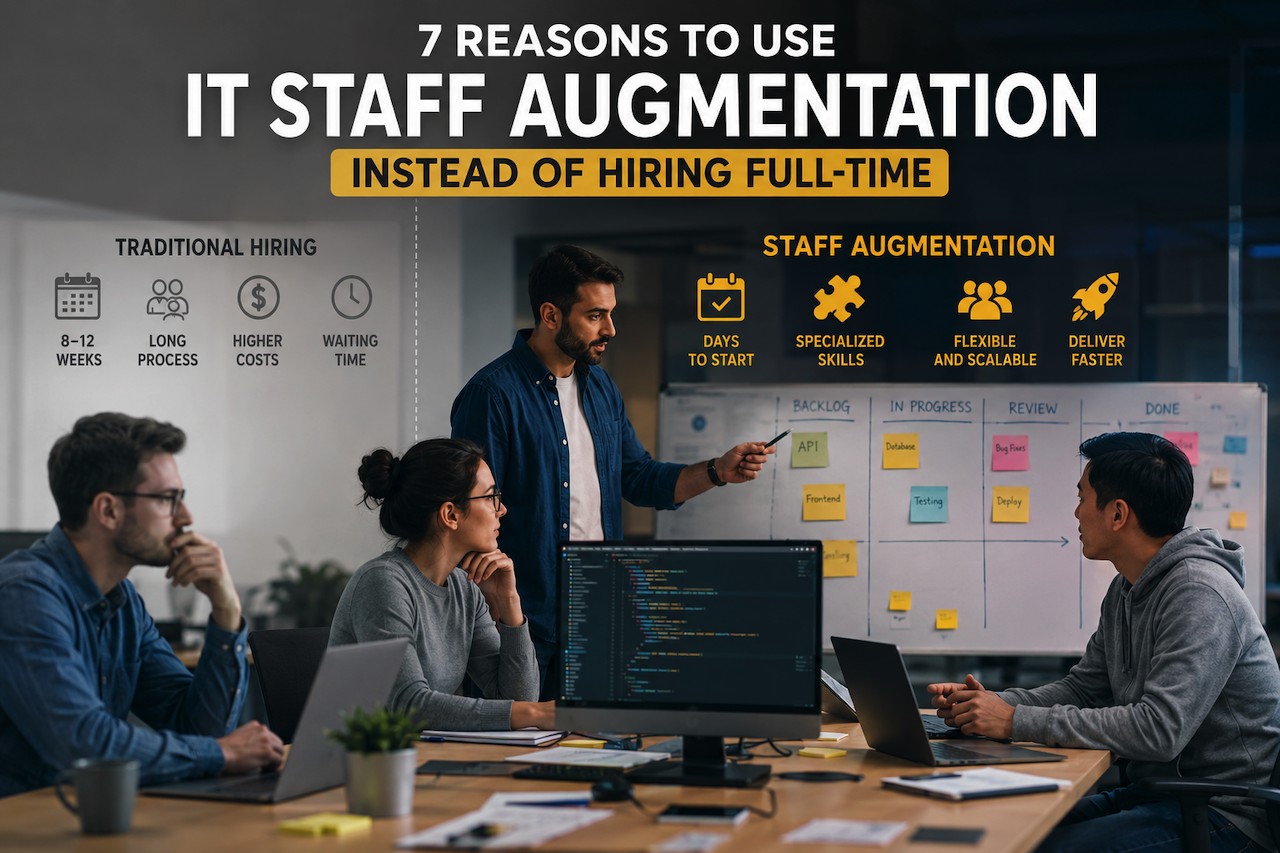
7 Reasons to Use IT Staff Augmentation Instead of Hiring Full-Time
May 7, 2026
Every growing tech team hits the same wall at some point. A deadline is closing in, the sprint is half-staffed, and the two engineers who could handle the problem are already overloaded. The instinct is to open a job requisition, but a standard hiring cycle takes eight to twelve weeks on a good run, and the proje [...]
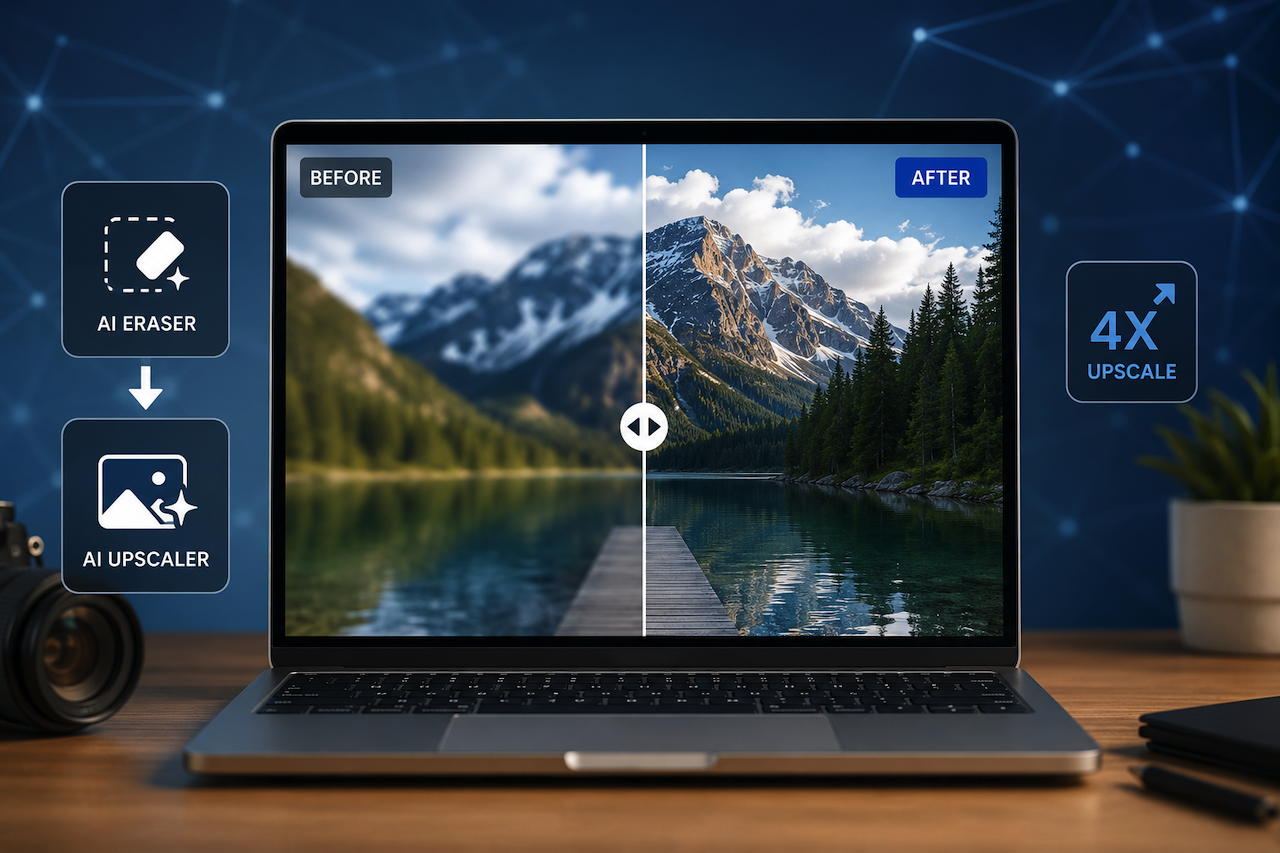
Learn moreHow to Fix Blurry Images After Removing Text with an AI Upscaler in 2026
May 6, 2026
In the fast-paced world of e-commerce and social media content creation, editing images is a daily necessity. You might need to erase a distracting mark from a product photo, remove a stray price tag from a screenshot, or clean up unwanted text overlays from a banner. AI-powered eraser tools make object r [...]
Learn moreLeave a comment
All comments are moderated. Spammy and bot submitted comments are deleted. Please submit the comments that are helpful to others, and we'll approve your comments. A comment that includes outbound link will only be approved if the content is relevant to the topic, and has some value to our readers.
Comments (0)
No comment