

7 Reasons to Use IT Staff Augmentation Instead of Hiring Full-Time
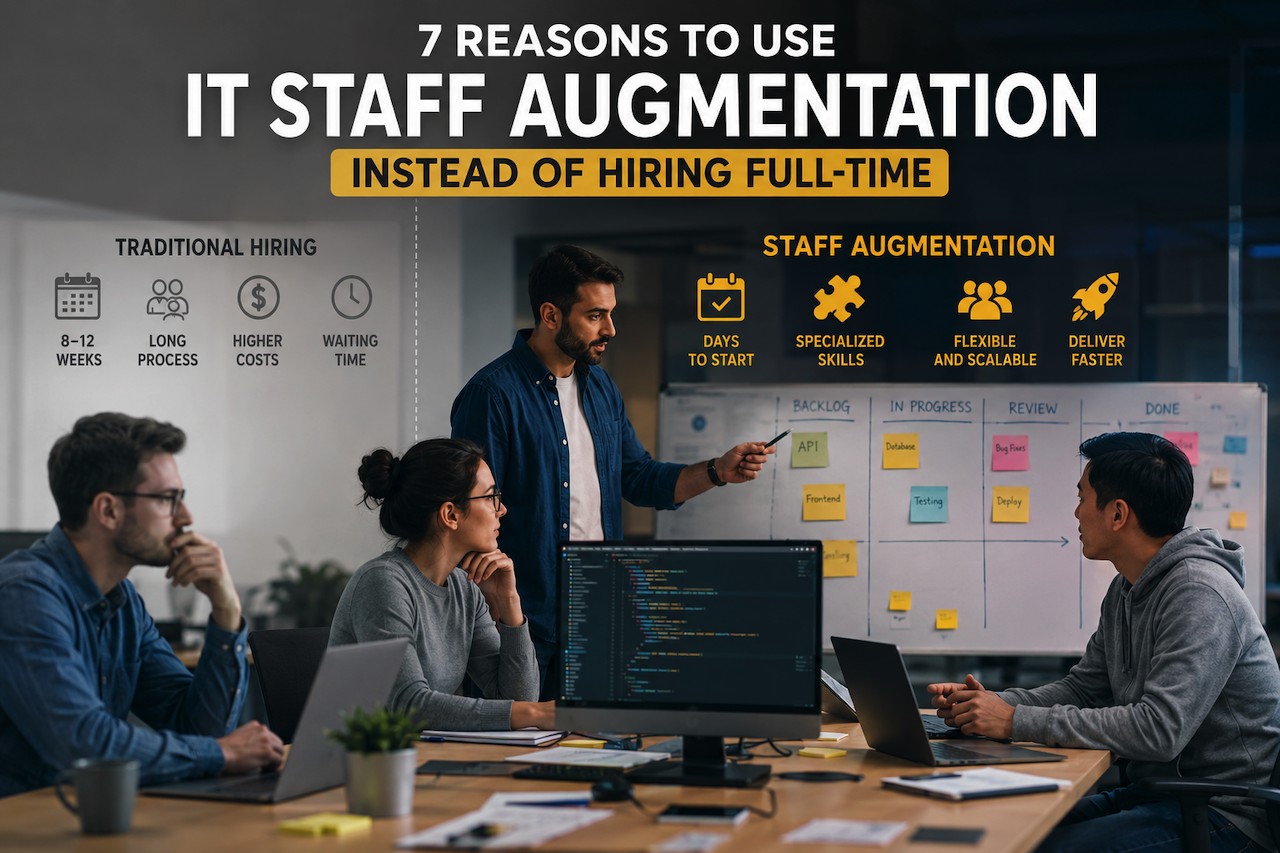
Every growing tech team hits the same wall at some point. A deadline is closing in, the sprint is half-staffed, and the two engineers who could handle the problem are already overloaded. The instinct is to open a job requisition, but a standard hiring cycle takes eight to twelve weeks on a good run, and the project cannot wait that long.
Staff augmentation offers a different answer: bringing in vetted specialists through staff augmentation services who integrate directly into the existing team, work inside the existing tools and workflows, and can start contributing within days rather than months. Below are seven concrete reasons why augmentation often outperforms full-time hiring under a specific and very common set of circumstances.
1. The Role Does Not Justify Permanent Headcount
Not every skills gap is a permanent one. A backend engineer to migrate a monolith to microservices, a DevOps specialist to build out the CI/CD pipeline, or a QA lead to push a major release through testing are all time-bounded needs. Hiring a full-time employee for a six-month gap creates a problem on the back end: what does that person work on once the project is done, and how do you handle the conversation if the answer is nothing?
Permanent hires carry a cost beyond salary. Benefits, onboarding, equipment, desk space, management attention, and eventual offboarding if the role no longer fits all add up quickly on a headcount that was always going to be temporary. Staff augmentation matches the duration of the engagement to the duration of the need, so the company pays for expertise while it is needed and stops when it is not.
The cleaner the scope, the better augmentation fits. A defined project, a known skill requirement, and a specific delivery window are exactly the conditions where a contract specialist can outperform a permanent hire on both speed and total cost.
- No long-term employment obligations for short-term capacity needs
- Cost ends when the engagement ends
- Faster internal approval compared to adding permanent headcount
- Scope flexibility as project requirements evolve
2. The Hiring Timeline Does Not Match the Project Timeline
Eight to twelve weeks is an optimistic estimate for a senior engineering hire. Writing the job description, posting it, screening candidates, conducting technical interviews, negotiating the offer, and waiting through the notice period often pushes the timeline much closer to three or four months before the person actually starts.
For a product team with a delivery commitment, that timeline frequently does not work.
Staff augmentation compresses this process significantly. In many cases, specialists who have already been technically evaluated can integrate into an existing engineering workflow within days rather than months.
This matters most in two situations: when a project is already behind and adding capacity is the most direct lever, and when a key engineer resigns mid-project and the team cannot absorb the gap internally. In both cases, augmentation helps bridge the problem in a timeframe that traditional hiring often cannot match.
- Placement in days rather than months
- Reduced internal screening overhead
- Eliminates lengthy notice-period delays
- Can support projects while permanent hiring continues in parallel
3. The Skill Is Too Specialized to Find Locally
Some technical skills are difficult to hire for in any given local market. Cloud security specialists, mobile engineers with deep Flutter experience, and developers who understand legacy stacks well enough to modernize them safely are examples of roles where a local job posting may produce a very limited pipeline.
Staff augmentation opens the search to a broader talent pool. For work that is inherently remote, such as writing code, reviewing pull requests, attending stand-ups, and collaborating through distributed workflows, geography is often less important than expertise.
This is especially relevant for companies building in niche stacks, working on products with specific compliance requirements, or adopting emerging technologies where demand has outpaced the available local talent pool.
- Access to specialists regardless of location
- Easier access to niche technical expertise
- Faster matching for difficult-to-fill roles
- Flexible time-zone overlap through scheduling and workflow planning
4. The Team Needs to Scale for a Launch Without Growing Permanently
Product launches tend to follow a predictable pattern: the final sprint before release is significantly more intensive than steady-state development. More engineers are working in parallel, QA coverage expands, and support capacity increases around go-live. Then the launch passes, the backlog stabilizes, and the team returns to a more sustainable pace.
Building permanent headcount around the peak period means carrying that cost long after the work has normalized.
Staff augmentation allows teams to scale capacity alongside the project curve. A team of five can temporarily expand to eight during a release cycle and return to its original size once the launch stabilizes.
This approach also works for seasonal businesses facing predictable spikes in demand, such as e-commerce platforms entering peak retail periods or travel companies preparing for seasonal traffic increases.
- Scale capacity up during launch periods
- Add QA, development, or DevOps support temporarily
- Reduce team size cleanly after peak demand passes
- Useful for both seasonal and project-driven spikes
5. The Internal Team Needs Specific Expertise, Not More Generalists
There is a version of hiring that adds people without adding the capability the project actually needs. A generalist engineer who can contribute across the stack is valuable for steady-state product work, but projects involving performance optimization, architecture redesign, security auditing, or machine learning integration often require specialists with direct experience solving those exact problems.
Staff augmentation allows organizations to bring in targeted expertise for the duration of the challenge.
The knowledge-transfer benefit is significant as well. Specialists working directly inside the team, participating in code reviews, architecture discussions, and retrospectives, often leave the internal team more capable after the engagement than before it.
- Target the exact skill the project requires
- Faster delivery with fewer false starts
- Knowledge transfer through direct collaboration
- Reduced ramp-up time for domain-specific work
6. The Budget Is Fixed but the Scope Needs to Move
Fixed-budget projects create tension when requirements shift midstream. Stakeholders change priorities, technical constraints emerge late, and market conditions force pivots. The options are usually to cut scope, extend timelines, or add capacity.
Staff augmentation provides flexibility in a way that permanent hiring or fixed-price agency engagements often cannot. Teams can temporarily add or reduce technical capacity as workstreams expand or close.
For engineering leaders working within tight budget constraints, this flexibility is operationally significant because resourcing decisions can track the actual state of the project rather than the assumptions made months earlier.
- Predictable per-resource cost structures
- Easier adjustment of team composition during active projects
- Flexible scaling without major contract restructuring
- Greater alignment between budget and active workload
7. The Existing Team Is Stretched and Starting to Show It
There is a cost to overloading an engineering team that does not appear immediately in sprint metrics. Code reviews become rushed, tests get skipped, documentation is deferred, and technical debt accumulates quietly in the background.
Underneath all of this, the engineers carrying the heaviest load are often the most likely to leave when the pace stops feeling sustainable.
Staff augmentation can relieve that pressure relatively quickly. Additional engineers can share review load, help clear backlogs, and free senior engineers to focus on the work that genuinely requires their level of experience.
Sometimes a single additional engineer at the right seniority level is enough to stabilize a team during a difficult period.
- Reduces overload before burnout affects retention
- Improves backlog coverage and review quality
- Frees senior engineers for higher-impact technical work
- Prevention is often less costly than recovery after turnover
When Staff Augmentation Is the Right Call
The seven scenarios above share a common pattern: the need is immediate, the timeline is tight, and the traditional hiring process does not align with the pace of the project.
Staff augmentation models are commonly used across software development, mobile engineering, cloud infrastructure, QA, and design workflows. Some organizations use augmentation models such as DotCode to help integrate additional technical capacity into existing teams while maintaining continuity across active projects and delivery timelines.
The success of augmentation often depends on how well the additional specialists integrate into the existing team structure. Augmentation tends to work best when specialists operate like full team members, attending stand-ups, contributing to architecture discussions, reviewing code, and collaborating directly within established workflows.
Staff augmentation models are commonly used across software development, mobile engineering, cloud infrastructure, QA, and design workflows. In many cases, the focus is on integrating additional technical capacity into existing teams while maintaining continuity across active projects and delivery timelines.
Conclusion
Staff augmentation is not a replacement for building a strong long-term engineering team, but it can be an effective way to solve short-term capacity and expertise gaps without slowing down delivery timelines. Whether the challenge involves scaling for a launch, filling a specialized technical role, or reducing pressure on an overloaded team, augmentation provides flexibility that traditional hiring often cannot match.
As software development cycles continue accelerating and technical demands become more specialized, many organizations are using staff augmentation to adapt more quickly to changing project requirements while maintaining continuity across engineering workflows.
Featured Image generated by ChatGPT.
Comments
Comments are moderated to keep the discussion useful and respectful. Spam, automated submissions, and low-value promotional comments are removed. Comments with outbound links may be approved when the link is relevant to the article and genuinely helpful to readers.
No comments have been published yet.