
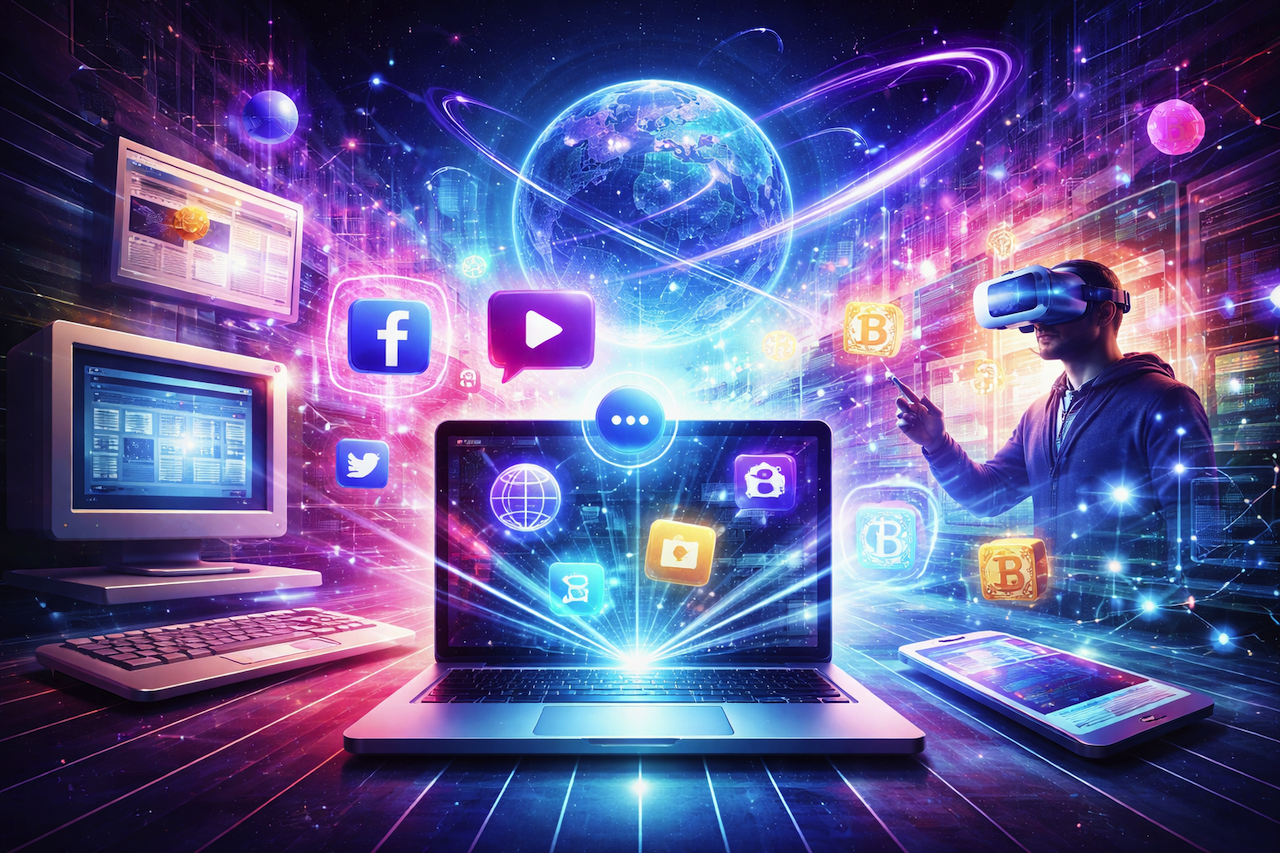
The Simple Background: Web 1.0 - Read Only Reality
The first version of the internet was a mere digital library. In 1989, when Tim Berners-Lee created the World Wide Web, pages were static, meaning they were coded by hand in HTML, served up on a server, and passively consumed by whoever happened to stumble upon them. You were able to read, but not to interact. You might go window shopping, but you could not interact.
This was the period of Web 1.0, roughly between the late 1980s and the early 2000s. Websites were, in a way, one-way brochures, updated only when a programmer had to push new code. It was a very similar experience: you entered a URL, a page opened, you read it, and you went. No comments were made, no feeds, no personalization. Websites did not know anything about you, and, to be honest, they did not need to.
But in this bareness, the effect was tremendous. For the first time in the course of human history, the information could reach the whole world within several seconds. Encyclopedia Britannica had an unexpected competitor and it was free.
The Social Revolution: Web 2.0 The Read-Write Web
In the middle of the 2000s, there was a significant shift. The web ceased being a destination and became a conversation.
Web 2.0, which Tim O’Reilly popularized in 2004, is not an upgrade, but a philosophical upgrade. The user was no longer merely an audience; they became a participant, a creator, and a publisher. MySpace, Facebook, YouTube, Wikipedia, and Blogger provided ordinary people with the means to define the web itself.
The page suddenly came to life. Comments began appearing below articles. The millions of photos were uploaded. Strangers discussed, worked with, and networked. Algorithms would silently study your preferences and present you with content tailored to you. AJAX technology enabled pages to change dynamically without reloading, a small technical feature that made the web feel in a whole new way. It felt fast. It felt responsive. It felt human.
The app economy was also born during this period. Desktop software started to be replicated in web applications. Google Docs provided the ability to collaborate in a browser. Gmail changed the appearance of email—the distinction between a website and software began to be permanently erased.
Web 2.0 had its dark side, however. The concentration of power increased as the number of platforms grew. A few corporations have become the controllers of information, attention, and data across the globe. Walled gardens silently replaced the open and decentralized dream of the early web.
The Mobile Shift: The Web Goes Everywhere
The web had to move beyond the desktop before it could evolve further.
When the iPhone was launched in 2007, and the Android revolution followed, it did not simply change the way people were accessing the web; it actually changed when and how people accessed the web. The web was made ambient, something to carry around in pockets, to place on tables, in beds. Then all of a sudden, a site that had been so beautiful on a 1440px screen was not readable on a 320px screen.
This gave rise to a completely new science: responsive design. Today, many web development platforms and agencies help businesses adapt to mobile-first design principles and optimize performance across devices, with providers such as Mokoweb offering practical examples of how these approaches are implemented. Designers and developers were required to reason in fluid grids, flexible images, and breakpoints. The idea of a mobile-first design was born: design for the smallest screen and scale up, rather than down. Performance was made a moral requirement. A desktop-based page that loaded in four seconds could take much longer over slower mobile connections. The internet had become a global medium, and its developers needed to consider the entirety of humanity, not just those with high-speed connections and powerful computers.
The Smart Swivel: AI Gets into the Browser
The web was smart in the narrow sense, in that it could keep a record of your tastes, suggest items, and provide targeted advertisements. This was pattern matching, but not intelligence. The system did not know you; it was following you.
It began to change with the emergence of machine learning at scale. Recommendation engines grew frighteningly accurate. Search was transformed into semantic understanding. Keyword matching gave way to Google BERT and MUM, which started to understand the meaning behind a query rather than the words themselves. The web began providing the answers instead of listing links.
Next, there was the big language model revolution. Soon sites were able to have conversations. Customer service bots ceased being frustrating. The content platform began to produce personalized summaries. Code editors began to work with developers on code. Creativity tools had begun to transform a sentence into a picture and a paragraph into a video.
The web was no longer merely retrieving information; it was creating it contextually, on the fly, on behalf of each user.
The New Design Paradigm: From Destinations to Experiences
The web has also undergone a silent revolution as a visual and interactive language.
The early websites were page-based. Contemporary digital products are experience-based journeys, flows, and moments of delight. Micro-animations lead the eye. Scroll-triggered transitions make the story. Voice interfaces solicit verbal communication. Haptic feedback on mobile bridges between digital and physical.
In this evolving landscape, businesses are focusing on building modern, responsive, and intelligent web experiences that align with today’s user expectations.
Today’s Progressive Web Applications (PWAs) have further blurred the distinction between websites and native applications. You can install a PWA on your home screen, use it offline, receive push notifications, and access device hardware without ever going to an app store. The browser has effectively emerged as an operating system.
Previously, accessibility was considered an afterthought, but it became one of the leading design principles. It became clear that the web's potential as the most accessible source of information was empty without considering people with disabilities, slow connections, or outdated devices.
Web3 and the Decentralization Dream
In parallel with the revolution in AI, there was another movement: Web3, a perception of a decentralized web based on blockchain technology. It was an enticing promise: own your data, censorship-resistant applications, and digital property.
Its implementation has been sloppier. Cryptocurrencies fell and rose. NFTs created a cultural phenomenon and then became controversial. Decentralized applications (dApps) were truly innovative but faced usability and scalability challenges.
Whether Web3 is the next chapter of the web or an exciting diversion remains to be seen. What it did achieve, however, was to rekindle a fundamental question: who owns the web? A question posed loudly enough like that is likely to drive the whole ecosystem in the right direction, even though blockchain may not be the vehicle itself.
The Spatial Frontier: AR, VR and the Immersive Web
The most radical development of the web, maybe, is yet to be experienced: the jump into three dimensions.
AR and VR are expanding the definition of browsing. The new standard, WebXR, enables immersive 3D content to be accessed through the browser without any special software. The idea of a page is evolving into a space you can walk through, objects you can touch, and spaces that respond to your actions.
Apple's Vision Pro and the generation of mixed-reality headsets are betting on the future of the web, where you do not view the web but live in it. The implications for education, business, social relationships, and creative expression are immense and largely unexplored.
What Has Remained Constant
With all the revolutions, from the era of stagnant HTML to the AI-created experiences, some truths have been preserved.
The finest websites have never acted as obstacles to their customers. The most enduring digital products have always been built on trust. The technologies that have been diffusing the most have always been those that reduce barriers rather than increase them.
And the web is an inherently human venture, created by humans, serving humans, to minimize the gap between what one knows and what one wants to know. Each technical stratum, each fashion of design, each new paradigm has been simply another effort to keep that first promise.
Looking Ahead
The web is reaching a point where it no longer just reacts to input; it predicts, adjusts, and works together, with interfaces not created but generated dynamically on a case-by-case basis. At the border between tool, assistant, and environment, it is fruitfully ambiguous.
The web is not a place to visit anymore. It is following you more and more everywhere, learning, developing, and encountering you there.
The web is not a narrative with a conclusion; it is evolving from a static system born in a physics lab into an intelligent, immersive, and omnipresent layer of human experience. It is among the most far-reaching current experiments in human communication history and we are all, conscious or not, its subjects as well as its authors.
Conclusion
The evolution of the web is not a finished story but an ongoing transformation. From static pages to intelligent, immersive experiences, each phase has expanded what the web can be and who it serves.
What began as a simple system for sharing information has become a dynamic, adaptive environment that learns, responds, and interacts in real time. Yet, despite these advancements, its core purpose remains unchanged: to connect people with knowledge, with each other, and with new possibilities.
As the web continues to evolve, the challenge is not just technological, but human: to ensure that progress remains inclusive, accessible, and aligned with the needs of those it was built to serve.
Featured Image generated by ChatGPT.
Share this post
Author

Read the latest articles from Aiyla Eylül
Topical Authority vs Backlinks: What Actually Wins on Google Search Today?
April 13, 2026
Over time, the SEO world has been governed by a simple gospel: more backlinks, higher rankings. Create links, gain links, purchase links (if you were willing to take that route), and watch your pages move up the search results. It was a straightforward, transactional relationship between effort and outcome. Howev [...]
Learn moreBest LinkedIn Automation Tools in 2026 (Ranked by Real Results)

April 6, 2026
Every B2B sales rep, founder, and agency owner knows the feeling. You open LinkedIn, start manually working through a list of prospects, and two hours later, you have sent maybe 15 messages. Half of them are the same templated copy with a name swapped in. The reply rate reflects it.
Learn moreLeave a comment
All comments are moderated. Spammy and bot submitted comments are deleted. Please submit the comments that are helpful to others, and we'll approve your comments. A comment that includes outbound link will only be approved if the content is relevant to the topic, and has some value to our readers.
Comments (0)
No comment