

Topical Authority vs Backlinks: What Actually Wins on Google Search Today?
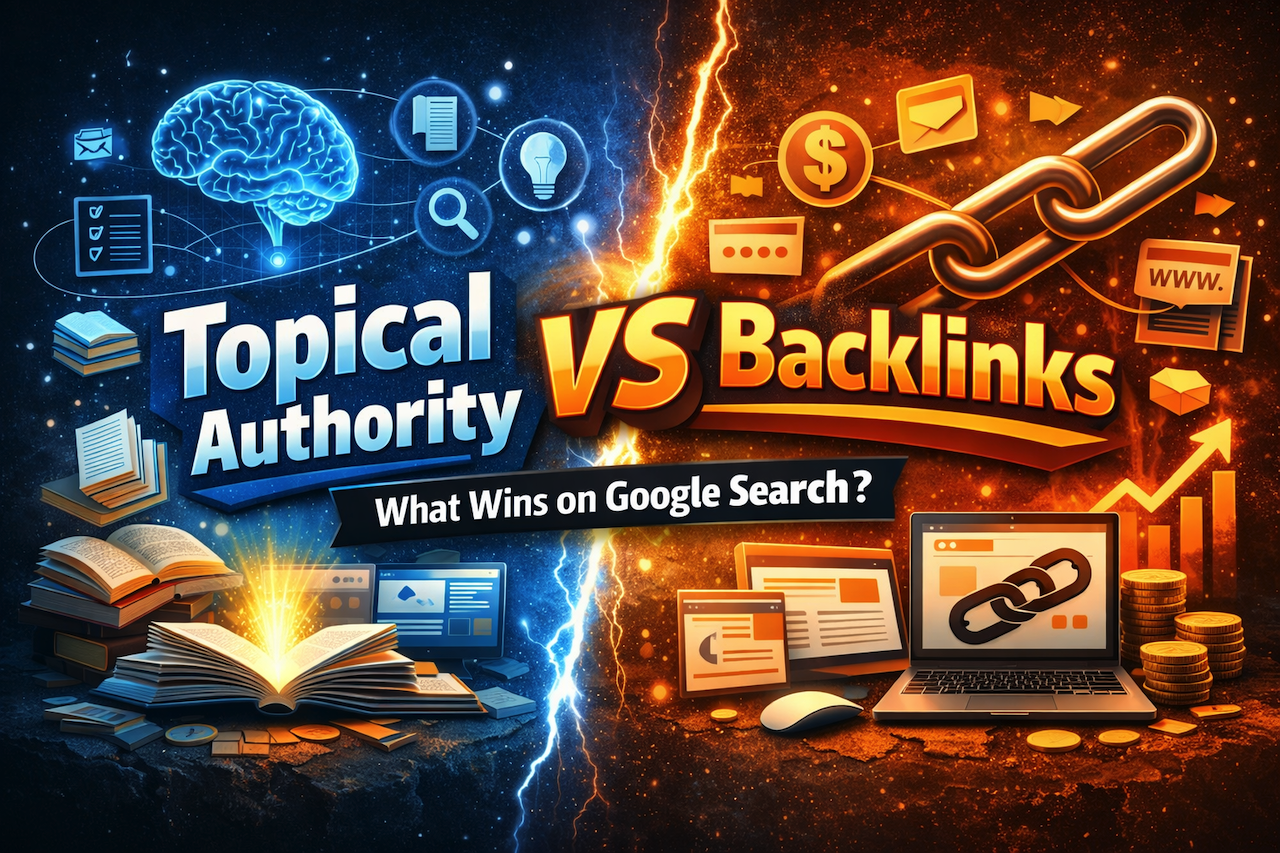
Over time, the SEO world has been governed by a simple gospel: more backlinks, higher rankings. Create links, gain links, purchase links (if you were willing to take that route), and watch your pages move up the search results. It was a straightforward, transactional relationship between effort and outcome. However, things are changing. Sites with smaller link profiles are now ranking above established authority domains. Content-rich sites with broad topical coverage are capturing SEO keywords they traditionally would not have ranked for under the old model. So what exactly is happening within Google’s ranking systems today, and what truly moves the needle?
The Old Regime: Why Backlinks Reigned
The genius behind Google was backlinks. The algorithm Larry Page and Sergey Brin created for the Stanford search engine, PageRank, treated links as votes. By default, a page that received numerous links from reputable sources was considered trustworthy and authoritative. This logic remained incredibly effective for over two decades. Entire SEO industries were built around link building, and the results were often undeniable.
However, manipulation became a growing issue. Guest post farms, private blog networks, paid link schemes, and reciprocal linking diluted the reliability of this signal. Google responded with updates like Penguin, along with manual penalties and more advanced spam detection systems. Still, even a clean and legitimate backlink profile tells only part of the story. A link shows that someone trusted your page at a point in time, but it does not necessarily mean your site has true depth or mastery of the topic.
Enter Topical Authority
Topical authority is how Google evaluates your site as a comprehensive and reliable resource within a specific subject area. It is not about a single high-quality article; it is about demonstrating consistent, in-depth coverage across an entire topic cluster.
Consider this: the opinion of a cardiologist on heart disease carries more weight than that of a general practitioner, regardless of the number of credentials on their résumé. Google is increasingly attempting to recognize and scale this kind of domain expertise.
This shift is driven by Google’s Helpful Content System and its evolving definition of E-E-A-T: Experience, Expertise, Authoritativeness, and Trustworthiness. These are not just guidelines for human quality raters; they are signals Google is working to measure algorithmically. A site that addresses a topic from multiple angles—how-to guides, in-depth analysis, FAQs, comparisons, and case studies—sends strong structural signals that it is a comprehensive resource capable of fully satisfying user intent.
What the Evidence Tells Us
This question has been tested by the SEO community over the last two years, and the trend that has emerged is subtle but clear. Backlinks still matter, especially for competitive, high-stakes keywords in industries such as finance, law, health, and e-commerce. A thin link profile will hold you back, even with well-researched content, if you are trying to rank for terms like “best mortgage rates” or “personal injury lawyer.”
Long-tail queries and emerging topic areas, however, have made topical authority the most important factor in informational niches. Sites that publish systematically around a central topic—establishing internal linking systems, exhaustively covering sub-topics, and regularly updating content—are climbing the rankings beyond what their backlink profiles alone would suggest. Signals of genuine subject-matter investment appear to be rewarded by Google’s systems.
This has been demonstrated in several case studies by independent SEO researchers, where new websites with zero referring domains have outranked established sites on certain SEO keywords simply because their content architecture showed stronger topical coverage. It is something that would have been very difficult to predict five years ago.
The Interaction of the Two
This is where the truth becomes clear: topical authority and backlinks do not work against each other; they reinforce one another. A well-established topical authority site is more likely to earn organic backlinks, as it becomes a resource people naturally turn to within its sector. Publishers tend to reference the most complete and reliable source they can find. Building topical depth not only improves rankings but also creates a foundation where quality links accumulate naturally.
At the same time, links from relevant, topically aligned domains carry significantly more weight today than those from generic or unrelated sources. An endorsement from a reputable cooking magazine is far more valuable to a food blog than a link from a general news aggregator. Relevance acts as a multiplier on link value.
What Do You Really Need To Do?
If you are developing or expanding a site in 2026, the strategic response is clear: build topical authority first, then support it with targeted link building.
Start by mapping your topic cluster. Identify the main topic your site needs to dominate, then create content that covers all meaningful sub-topics—pillar pages alongside focused, supporting articles. Use internal linking to connect them in a way that reflects a logical subject hierarchy. This structure itself signals to Google that your site is a cohesive, authoritative resource rather than a collection of isolated pages targeting individual keywords.
Then approach link building with discernment, not volume. A small number of contextually relevant, editorially earned backlinks from authoritative sources in your niche will outperform dozens of low-relevance links from domain authority farms.
The Bottom Line
Google has become far more effective at understanding what a website represents and whether it genuinely serves users in a given space. Backlinks remain a signal of trust, but they are no longer sufficient on their own. In many query types, they are no longer the primary ranking factor. Topical authority reflects Google’s shift toward rewarding real expertise over manufactured popularity
Featured Image generated by ChatGPT.
Related Articles

July 25, 2025
Improve Google Ranking with Quality Content & Backlinks
In today’s digital age, ranking on Google is very important as you all probably know. But why is that? Because Google is the most used search engine across the world. And if you ar...
Read More
May 9, 2025
How Quality Backlinks Can Boost Your Website’s Authority
Backlinks are one of the most important factors in increasing your website's authority and search engine ranking. When reputable websites link to your content, search engines recog...
Read More
July 14, 2023
Unleashing the Power of Topical Authority: Boost Your SEO Rankings and Dominate the Search Results
Have you ever wondered how some websites effortlessly slay on top of SEO, while others are left in the dark corners of the search results? Well, it's all about the magical concept...
Read More
Comments
Comments are available to signed-in users and are moderated to keep the discussion useful and respectful. Spam, automated submissions, and low-value promotional comments are removed. Outbound links may be approved when they are relevant and genuinely helpful to readers, but they are displayed as plain text rather than clickable hyperlinks.
No comments have been published yet.
Please sign in to submit a comment.