
Bank statements have been regarded as trustworthy sources of information on financial transactions, serving as the cornerstone of the entire process of accounting and reporting. Nevertheless, even minor mistakes in bank statements may lead to major problems, such as misrepresentation of finances or incorrect decision making based on financial information. In the business world driven by data, the importance of having accurate bank statement data is evident; however, some firms overlook the potential of mistakes appearing in this type of data when it goes through different processes of extraction and translation.
The Role of Bank Statements in Financial Reporting
The bank statement can be used as a reference point for verifying and auditing transactions since it acts as the basis for verifying and auditing the cash flows and accounting balances. Bank statements are crucial for analyzing financial flows, ensuring compliance with accounting policies and practices, and preparing tax returns. Consequently, even minor inaccuracies in the bank statement can affect an entity’s financial status and conclusions about its financial performance.
Why Errors in Bank Statements Often Go Unnoticed
Nevertheless, mistakes in the bank statement often remain undetected for extended periods due to several reasons. The data provided in a bank statement seems highly structured and reliable upon cursory examination. Furthermore, numerous transactions contained in a bank statement make the verification process rather tedious and labour-intensive. Therefore, when the bank statement is processed using software or manually, some errors can pass undetected until they compound into significant issues.
1. Missing Transactions in Extracted Data
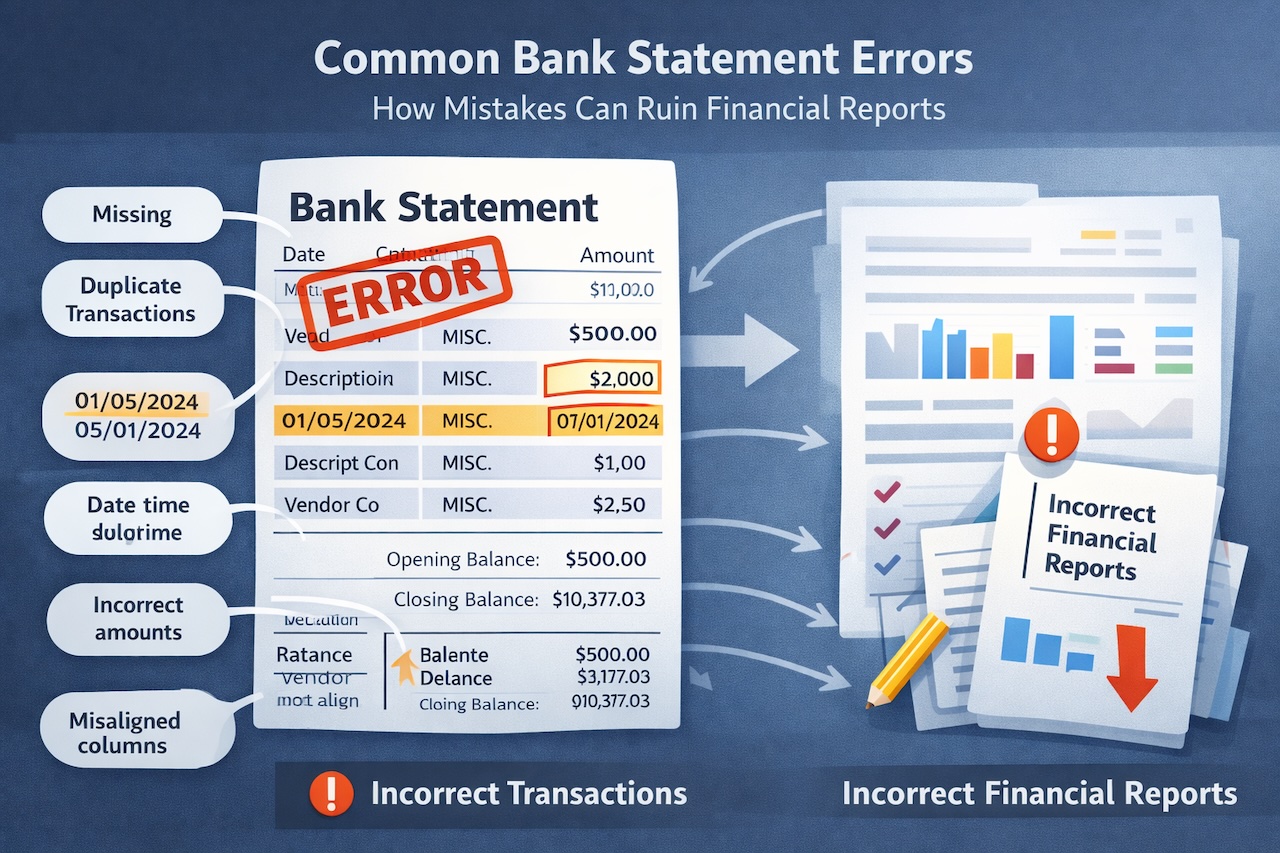
One of the problems that is common in the process is the omission of certain transactions. The problem arises whenever financial documents such as bank statements, which are usually available in PDF format, are being transformed into spreadsheets. In the process, there may be some data omission resulting from discrepancies with the format, among other factors. Omission causes errors in financial documents because certain transactions fail to reflect actual situations.
2. Duplicate Transactions and Their Impact
Another problem that poses a risk to organizations is duplication of transactions. There may be some cases where the same data file is extracted more than once or an extraction tool identifies repeating transactional sequences as duplicates. This error causes distortion in expenses reported and also makes it difficult to compute profits. Bank statement PDF always comes with messy data, and messy transactions. One should get the bank statement to csv to analyse the data with extracted clean transactions. It’s always recommend in CSV or Excel format than PDFs, but always double check with duplications in the conversion.
3. Incorrect Date or Amount Formatting
Format errors are another common source of misunderstandings. The interpretation of dates varies according to regional standards, and numerical values may differ because of differences in decimal points and thousands separators. For instance, the entry “01/05/2024” can mean either January 5th or May 1st, depending on the format of the software. Another number, “1,000,” may also be misunderstood if there are differences in the format settings. These errors affect proper alignment of dates and the accuracy of financial computations.
4. Merged or Misaligned Columns During Conversion
The process of transforming the bank statement into a workable form causes merging or shifting of columns, thereby making the data fall into different categories. For example, the information entered in the amount column will fall under the description column, and vice versa. This issue causes difficulties in interpreting the data, and hence there is a possibility that errors will occur during the importation process.
5. Inconsistent Descriptions Across Transactions
The description of a transaction is very significant for the analysis of finances since this will make it easier to categorize the transactions. The problem is, however, that there might be inconsistencies in the way that the description is written down. It is possible that different transactions might mention the same vendor, but using a different spelling. As a result, transactions will be difficult to analyze.
6. Opening and Closing Balance Mismatches
Another sign of an issue with the balance is the difference between the starting balance and the final one. This discrepancy might be caused by a variety of reasons. It could be that some transactions are either missing or repeated. Furthermore, the calculations might have been done incorrectly or during data extraction.
7. Errors Caused by Manual Data Entry
Manual data entry continues to be one of the most common methods used in several companies, especially in cases where there is no standardization in the bank statements. Nevertheless, manual data entry is associated with a lot of human errors that might lead to inaccurate data entries. Such errors may include typos, wrong values, and even placement of data. Human errors are more common in large amounts of data entry.
How These Errors Affect Financial Reports and Decision-Making
Financial reports based on erroneous information from bank statements will have negative implications for any business organization. Such errors may lead to wrong conclusions drawn from the financial information that is available. The management may make wrong decisions concerning the future operations of the business because of the erroneous financial report. For instance, overstatement of income may give the impression that the business is profitable.
How to Detect Errors in Bank Statement Data
Error detection needs both a structured approach and analytical skills. One of the best ways to detect errors is by reconciliation of bank statement. This means comparing the data in the bank statement against internal records and looking out for inconsistencies. Other ways include validating data using automated rules to detect anything unusual such as duplicate entries or an incorrect account balance.
Best Practices to Prevent Bank Statement Errors
To prevent errors, it is important to have procedures in place to manage the data in bank statements. Some of the steps involve having a standard format and a template to be used while extracting and converting the bank data. Using automated software to validate and clean up the data will limit any human error.
Moving Toward More Reliable Bank Data Workflows
In this regard, there is a steady trend towards making information more dependable and processable. Modern technology can help extract, validate, and integrate data with accounting software seamlessly. These technological advancements allow reducing human error during work and keeping data consistent and accurate. By taking advantage of these technologies, companies will manage to raise the quality level of their financial data.
Conclusion
Although the errors related to bank statements might not be too serious on the surface, they have a lot of implications for financial data accuracy. From missed transactions to data formatting mistakes, these examples show how important proper financial data management is. Learning how to avoid these common mistakes will help prevent possible problems in the future. Accurate financial information is crucial for business success in the long run.
Featured Image generated by ChatGPT.
Share this post
Author

Read the latest articles from Ryan Dawal
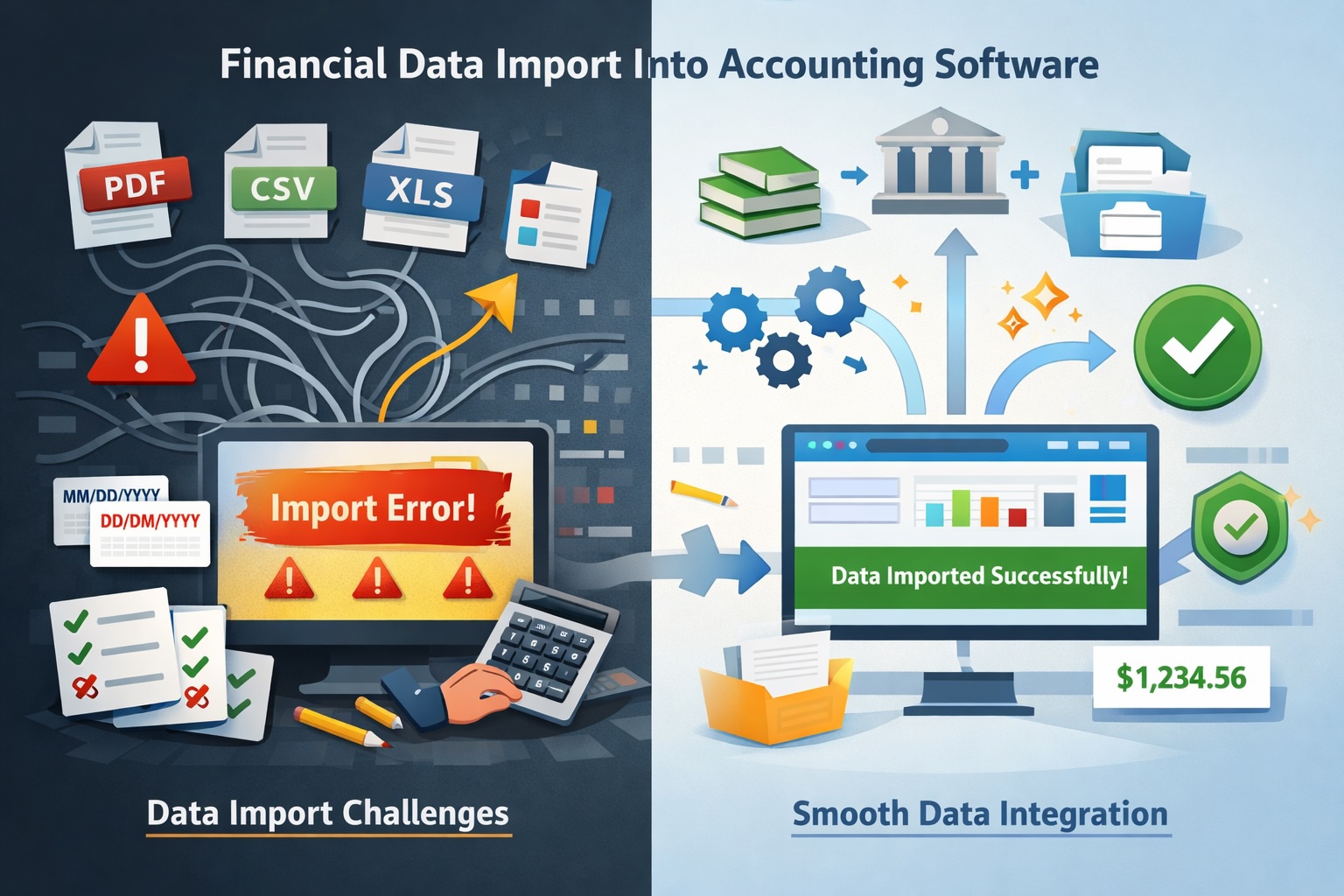
Challenges of Importing Financial Data into Accounting Software
April 18, 2026
In today’s world, where business processes are automated to a great extent, one would expect that the task of feeding financial data into accounting software would be a smooth procedure. However, many companies are experiencing problems when trying to transfer information from outside databases into their own i [...]
Learn moreAltStore PAL & How to Install Delta Emulator with AltStore PAL.

June 25, 2024
You probably already know that Delta Emulator is being used if you enjoy playing classic iPhone games like Mario, Super Mario, and others. Delta Emulator is the most renowned brand in flawless and flawless iPhone emulation of NES, SNES, N64, and Game Boy games.
Learn moreLeave a comment
All comments are moderated. Spammy and bot submitted comments are deleted. Please submit the comments that are helpful to others, and we'll approve your comments. A comment that includes outbound link will only be approved if the content is relevant to the topic, and has some value to our readers.
Comments (0)
No comment