
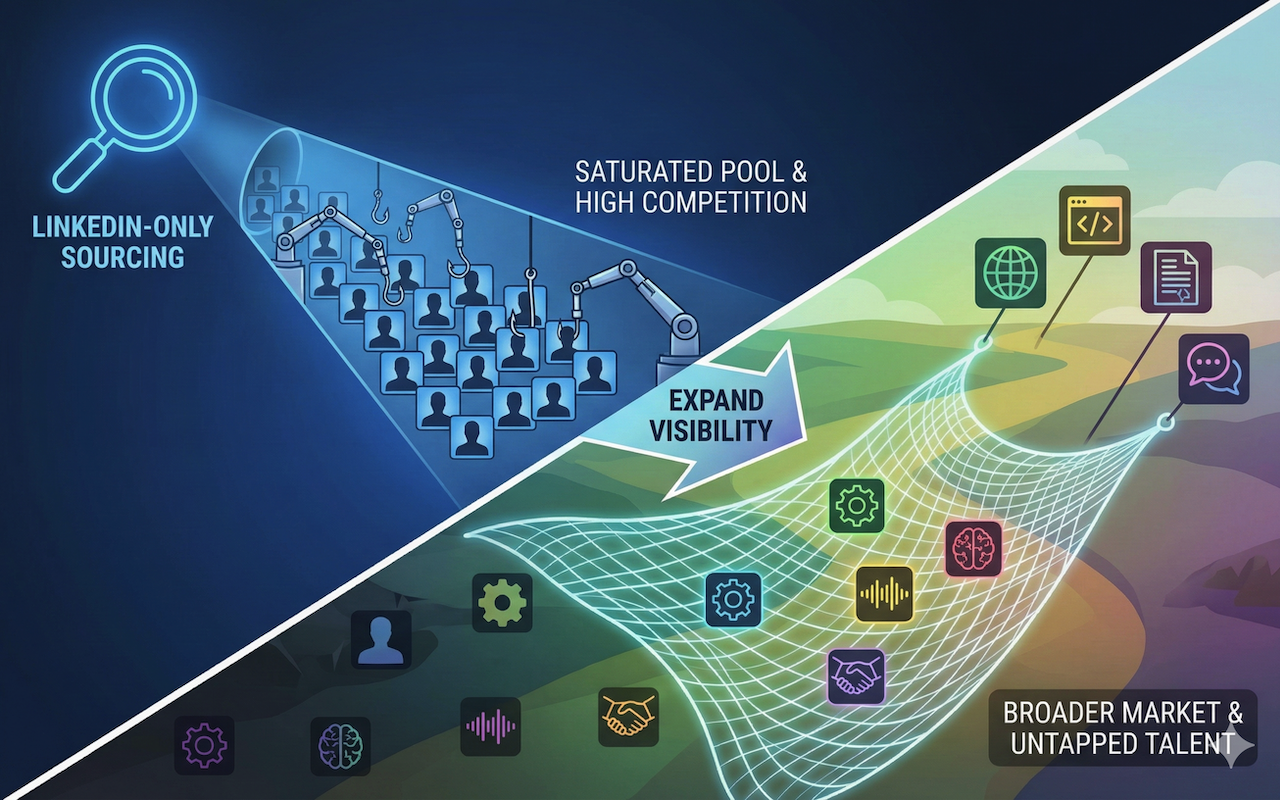
For years, LinkedIn has been the primary sourcing tool for recruiters. It brought structure to hiring, made profiles searchable, and allowed teams to scale outbound recruiting quickly. Over time, though, what started as an advantage turned into a habit that few teams questioned.
Today, the symptoms are familiar: lower reply rates, the same profiles appearing in every search, and heavy competition for candidates who are already being contacted daily. These problems are often blamed on a “tight market,” but in reality, they come from looking in the same place over and over again.
The Limits of a LinkedIn-Only Sourcing Model
LinkedIn shows who is visible, not who is realistically reachable. The platform favors people who update profiles, engage with content, and actively manage their professional presence. That creates a skewed picture of the talent market.
Many strong professionals don’t play that game. Some keep profiles minimal. Others stopped updating years ago. In specific roles and regions, avoiding professional networks is a deliberate choice, not a lack of experience.
To address this gap, many teams supplement LinkedIn with broader sourcing approaches, including automated candidate sourcing by Signalhire, which aggregates candidate information from multiple public and professional sources rather than relying solely on a single platform’s internal ranking and visibility signals.
LinkedIn Systematically Underrepresents
Some candidate groups are consistently harder to find on LinkedIn, no matter how advanced the search setup is. These gaps are structural, not the result of poor sourcing techniques.
You often miss:
- Senior specialists who are stable in their roles and not signaling change
- Engineers and researchers focused on output, not self-promotion
- Candidates in regulated or privacy-conscious industries
- Professionals in markets where LinkedIn adoption is low
- Operations, infrastructure, and backend roles with minimal online presence
When these profiles don’t appear in sourcing, pipelines become narrower without recruiters realizing it.
Algorithmic Visibility Distorts Candidate Quality Signals
LinkedIn search is shaped by activity and engagement, not by depth of expertise. Profiles with frequent updates, endorsements, and keyword density surface faster, regardless of actual performance on the job.
As a result, recruiters often evaluate candidates who are easy to find instead of those who are best suited. Meanwhile, highly qualified professionals with simple or outdated profiles stay hidden.
Over time, this creates a false sense of market saturation, even though the same small segment is being recycled.
The Real Cost of Competing in the Same Candidate Pool
When most recruiters search in the same place, outreach overlaps heavily. Candidates receive similar messages within days, sometimes hours, of each other. Attention drops quickly.
This leads to a few predictable outcomes:
- Outreach volume increases while response rates fall
- Recruiters spend more time chasing disengaged candidates
- Companies without strong brand recognition struggle to stand out
At the same time, equally qualified professionals outside this pool receive little or no outreach.
Passive Candidates Behave Differently From What LinkedIn Suggests
A large share of successful hires comes from passive candidates. These are people who are not actively applying and often don’t maintain polished online profiles.
They are more likely to engage through:
- Industry-specific communities
- Technical publications or research work
- Open-source contributions
- Conferences and closed professional circles
- Direct recommendations rather than public profiles
A LinkedIn-only strategy rarely captures these signals, leading teams to underestimate the number of viable candidates.
Data Freshness Is a Growing Sourcing Risk
Another issue is accuracy. Many LinkedIn profiles lag behind reality. Titles, responsibilities, and locations are often outdated, especially for people who are not looking for a job.
This creates practical problems:
- Outreach based on incorrect assumptions
- Missed timing when candidates are more open to conversations
- Inaccurate segmentation inside hiring pipelines
Recruiters then compensate with manual checks and follow-ups, increasing effort without improving results.
Why Modern Sourcing Strategies Emphasize Breadth
Strong recruiting teams increasingly treat LinkedIn as one channel, not the foundation of sourcing. The focus shifts from refining searches inside a single platform to expanding overall visibility.
This usually means:
- Discovering profiles across multiple platforms
- Enriching contact data automatically
- Using public professional signals beyond resumes
- Reducing dependence on keyword-heavy profile searches
The outcome is not more noise, but a healthier distribution of outreach.
Outreach Quality Improves When Competition Drops
One of the most significant advantages of broader sourcing is reduced competition for attention. Candidates who are not flooded with messages are more likely to read them carefully.
Recruiters sourcing outside saturated platforms often see:
- Higher response rates with fewer messages sent
- More thoughtful initial replies
- Less need for aggressive follow-up sequences
This improves both recruiter efficiency and candidate experience.
Visibility Is Not the Same as Availability
The core mistake behind LinkedIn dependency is equating visibility with openness to new roles. In reality, availability depends on context, timing, and how the opportunity is presented.
Less visible candidates often evaluate opportunities more seriously once approached. Reaching them requires methods that go beyond a single professional network.
Seeing More of the Talent Market
LinkedIn remains useful, but it was never meant to represent the whole talent market. As competition increases, relying on a single platform limits reach rather than expanding it.
Recruiters who expand sourcing don’t work harder; they see more of what actually exists. The difference is not the number of messages sent, but access to candidates others never reach.
Featured Image generated by Google Gemini.
Share this post
Author

Read the latest articles from Taras Tymoshchuk
AI-Enhanced Selfies: Fake Identity or Authentic Self-Expression?

May 27, 2026
Taking a selfie in the past and taking it now are two wildly different things. Before, it was enough to point a camera at yourself, snap a picture, and share it with your friends and family. Today, a lot of people use a ton of filters to adjust lighting, smooth their skin, change their hairstyles, and so on.
Learn moreHow to Build an Unbreakable Industrial Network in 2026

April 23, 2026
A three-minute network outage on an automated production line used to be an IT problem. Now, it costs millions of dollars in lost productivity and triggers severe safety hazards. When the connection drops, teleoperated machinery stops.
Learn moreLeave a comment
All comments are moderated. Spammy and bot submitted comments are deleted. Please submit the comments that are helpful to others, and we'll approve your comments. A comment that includes outbound link will only be approved if the content is relevant to the topic, and has some value to our readers.
Comments (0)
No comment