
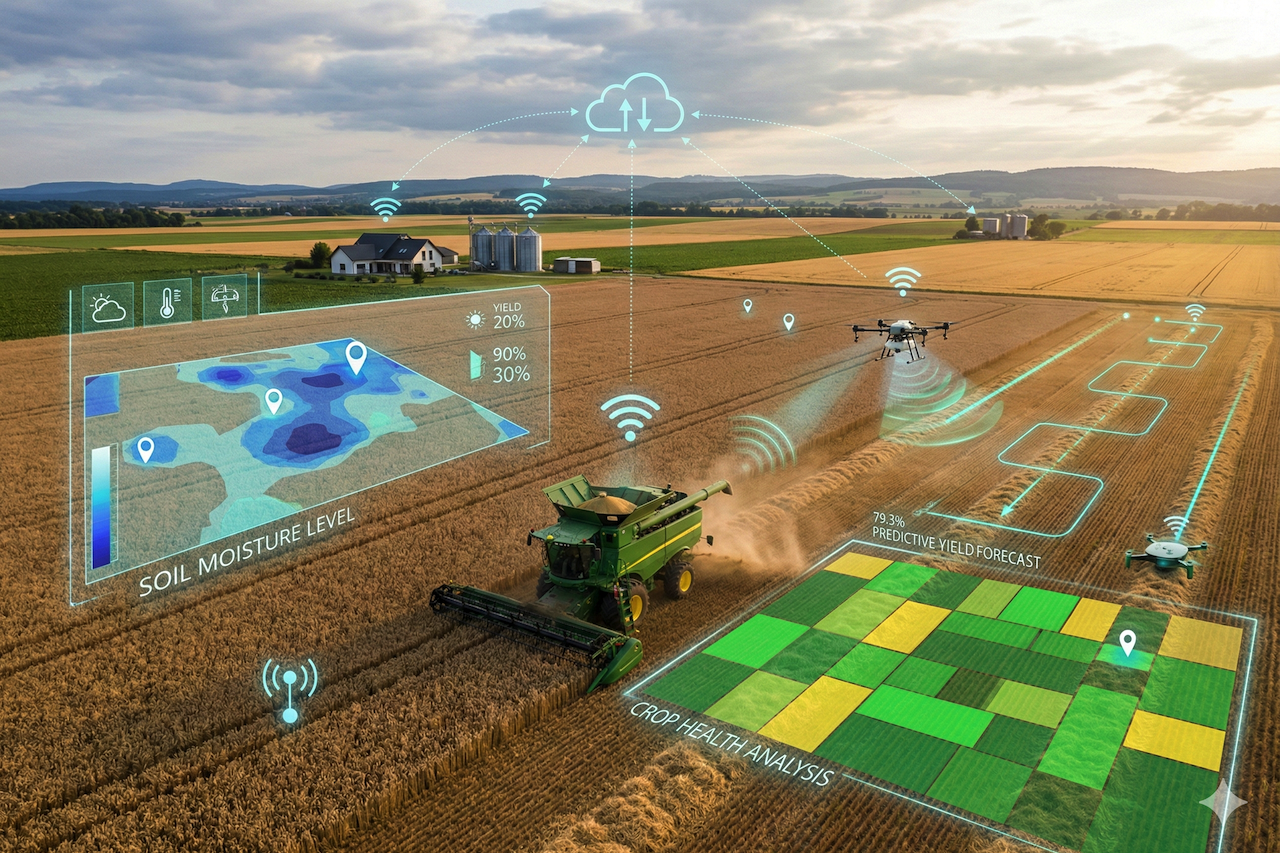
Precision farming today isn’t some futuristic buzzword. For many agricultural businesses, it’s already part of daily operations. Sensors in soil, satellite imagery, predictive analytics, and automated irrigation — all of this is now part of how serious farms operate.
But implementing technology in agriculture is rarely straightforward. Every farm has its own geography, its own crop cycle, its own logistics headaches. A dairy operation has nothing in common with a grain exporter except the word “agriculture.”
That’s why off-the-shelf software often falls short. And that’s why choosing the right development partner matters.
Below are five agriculture software development vendors worth considering in 2026 if you’re building or scaling precision farming systems.
1. Lionwood Software

When it comes to custom-built agricultural systems, Lionwood Agriculture software development focuses on something many vendors overlook: the operational realities on the ground.
Instead of pitching a fixed platform, they start with operational specifics — how fields are structured, how machinery is used, how teams are coordinated, how data flows between departments. That approach makes a difference in agriculture, where small workflow mismatches can create real losses.
Their work in the sector includes:
- Centralized farm management systems
- Drone and satellite analytics combined with computer vision
- IoT-based monitoring platforms
- Livestock tracking tools
- Agricultural risk forecasting solutions
One notable aspect of their positioning is the emphasis on practicality. The goal isn’t to overload farms with dashboards. It’s to make systems that quietly improve coordination, forecasting, and visibility.
They’re particularly relevant for:
- Agricultural enterprises managing large land areas
- Agritech startups building digital products
- Operations integrating IoT and AI technologies
- Companies needing scalable internal systems
For businesses that need software built around their existing know-how, not replacing it, they tend to be a strong match.
2. Intetics
Intetics operates at a different scale. They’re known for handling technically complex systems, especially when heavy data processing is involved.
In agriculture, that often translates into:
- Satellite image analysis platforms
- Crop health prediction systems
- Supply chain optimization tools
- Advanced analytics environments
If a project depends on large data sets, machine learning models, or integration with multiple external data sources, this is where they tend to perform well.
They are typically a good fit for companies that:
- Operate across multiple regions
- Require strong data engineering capabilities
- Need predictive analytics at scale
- Prioritize enterprise-grade stability
They’re not focused on small pilot tools; their strength lies in structured, technically demanding environments.
3. Itransition
Itransition brings enterprise experience into agriculture. Their teams are used to large system architectures and long-term digital transformation projects.
Within agritech, they often work on:
- Farm ERP systems
- Supply chain visibility platforms
- IoT integrations
- Sustainability tracking and reporting solutions
A common situation in agriculture is fragmented infrastructure — spreadsheets in one place, sensors in another, and accounting in a third system. Itransition is particularly strong at consolidating that landscape into a more unified whole.
They make sense for organizations that:
- Manage complex operations
- Need integration with legacy systems
- Require compliance-ready architecture
- Plan long-term software scaling
Their strength is less about experimentation and more about structural robustness.
4. ScienceSoft

ScienceSoft tends to appeal to companies that value process maturity and predictability in development.
Agriculture increasingly intersects with regulation, traceability, and reporting standards, especially for exporters and food producers. In those contexts, structured development and clear documentation matter.
Their agricultural projects commonly involve:
- Crop monitoring dashboards
- Equipment tracking platforms
- Predictive maintenance tools
- Yield analytics systems
They’re often chosen by businesses that:
- Export agricultural goods
- Operate under regulatory oversight
- Need audit-friendly systems
- Require stable long-term support
Their approach is measured and systematic, which can be reassuring for organizations operating in tightly regulated environments.
5. ELEKS

ELEKS often works at the intersection of engineering and product strategy. In agriculture, they’re frequently involved in projects that go beyond internal tools and aim to build commercial digital products.
Their experience includes:
- Digital farming platforms
- Agricultural data marketplaces
- Analytics dashboards
- Mobile solutions for field operations
Where they stand out is in product thinking. If the goal is to launch a platform that farmers will use as customers, rather than just digitizing internal processes, that product-oriented mindset can be valuable.
They tend to fit best for:
- Agritech startups
- Investor-backed digital agriculture platforms
- Cooperatives building shared systems
- Companies commercializing agricultural technology
How to Choose the Right Agriculture Software Vendor
Selecting a vendor in this space isn’t just about budget or company size. Agriculture has operational nuances that generalist development teams sometimes underestimate.
A few practical factors matter more than flashy presentations:
Domain Familiarity
Seasonality, weather volatility, and biological variability are not abstract ideas. They directly shape system requirements and influence how agricultural software must be designed.
Data Integration Capability
Modern farms rely on sensor data, weather APIs, drone imagery, and machinery telemetry. Bringing these data streams together into a unified system is often the most complex part of precision farming initiatives.
Scalability
Farms expand, and data volumes grow. Systems need to support this growth without requiring complete redesign or costly redevelopment.
Customization Depth
Rigid templates rarely survive real agricultural workflows. Effective solutions must adapt to operational realities rather than forcing farms to change their processes.
ROI Irientation
Technology should reduce costs, increase yield, or improve coordination. Without measurable value, digital tools risk becoming underused or abandoned.
Final Thoughts
Precision farming is evolving quickly. What used to be optional technology is becoming an operational necessity.
The competitive edge in agriculture increasingly comes from coordination, forecasting, and data visibility, not just land size or equipment count.
The vendors above represent different strengths: deep customization, large-scale analytics, enterprise integration, regulatory maturity, and product-focused development.
The right choice depends on the nature of your operation and the problem you’re trying to solve.
In agriculture, software works best when it adapts to the field, not the other way around.
Featured Image generated by Google Gemini.
Share this post
Author

Read the latest articles from Taras Tymoshchuk
AI-Enhanced Selfies: Fake Identity or Authentic Self-Expression?

May 27, 2026
Taking a selfie in the past and taking it now are two wildly different things. Before, it was enough to point a camera at yourself, snap a picture, and share it with your friends and family. Today, a lot of people use a ton of filters to adjust lighting, smooth their skin, change their hairstyles, and so on.
Learn moreHow to Build an Unbreakable Industrial Network in 2026

April 23, 2026
A three-minute network outage on an automated production line used to be an IT problem. Now, it costs millions of dollars in lost productivity and triggers severe safety hazards. When the connection drops, teleoperated machinery stops.
Learn moreLeave a comment
All comments are moderated. Spammy and bot submitted comments are deleted. Please submit the comments that are helpful to others, and we'll approve your comments. A comment that includes outbound link will only be approved if the content is relevant to the topic, and has some value to our readers.
Comments (0)
No comment