
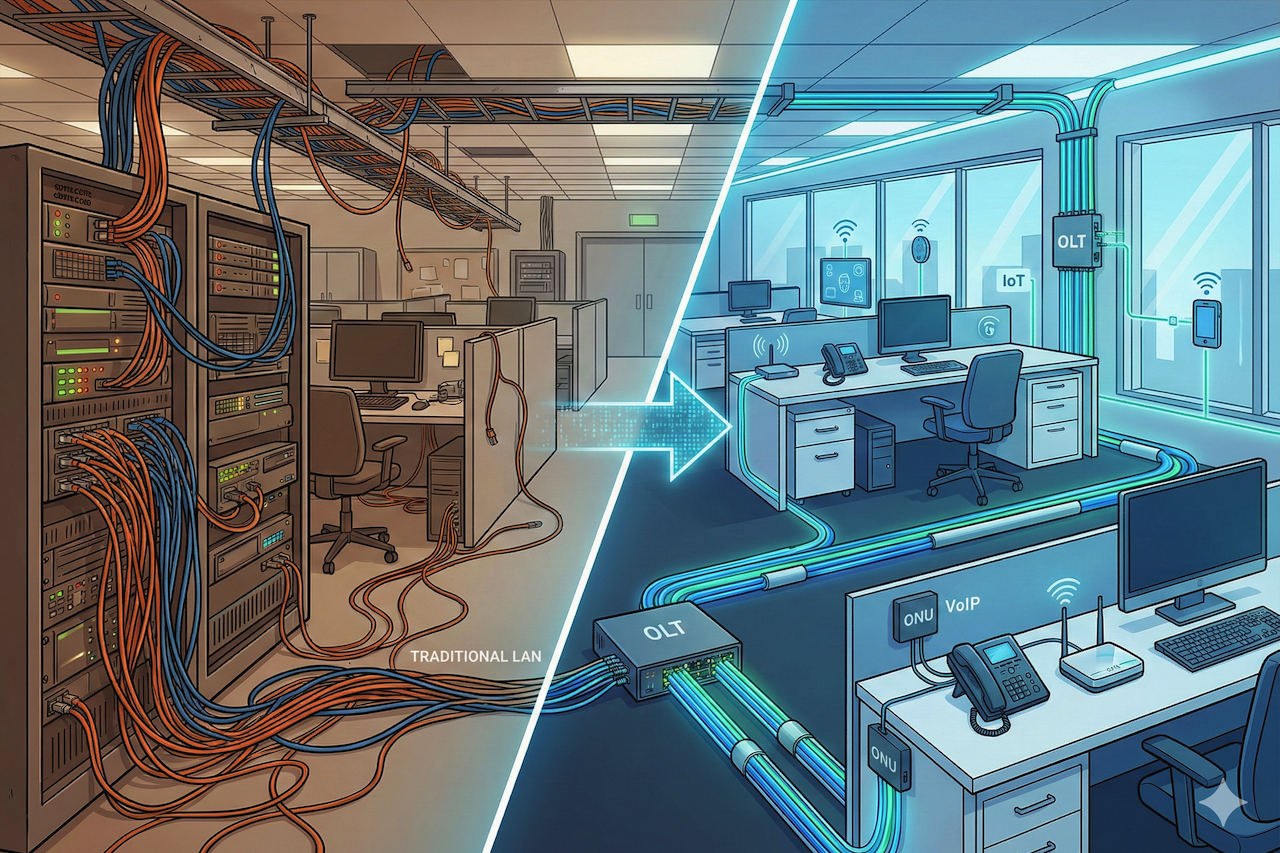
As enterprise networks evolve to support cloud applications, high-density wireless access, IoT terminals, and unified communications, infrastructure design has become a strategic decision rather than a purely technical one. For years, copper-based Local Area Network (LAN) architectures dominated commercial buildings. Today, Fiber to the Office (FTTO) is increasingly recognized as a long-term alternative.
This article explains why FTTO is replacing traditional LAN in modern enterprise environments, and how compact fiber access solutions are accelerating this transition.
What Is FTTO and How Does It Differ from Traditional LAN?
FTTO (Fiber to the Office) extends optical fiber directly from the core or aggregation layer to the office workspace. Instead of relying on horizontal copper cabling from floor switches to user terminals, FTTO deploys passive optical networks to deliver fiber connectivity to distributed endpoints such as optical network units placed near desks or inside rooms.
Traditional LAN architecture is typically based on a three-tier model:
- Core layer
- Aggregation or distribution layer
- Access layer with copper switches
Copper cables, usually Cat5e or Cat6, connect access switches to end devices within 90 meters.
FTTO replaces this copper-heavy access layer with fiber infrastructure. A centralized optical line terminal connects to multiple ONUs via passive optical splitters, which are deployed close to users. Each ONU then provides local Ethernet ports, PoE, or WiFi connectivity.
The architectural shift fundamentally changes power consumption, space utilization, scalability, and lifecycle costs.
The Structural Limitations of Traditional LAN
Traditional LANs have been reliable for decades, but their design imposes structural constraints in modern buildings.
1. Distance Limitation
Copper Ethernet is limited to 100 meters. Large campuses, hospitals, hotels, or industrial facilities often require additional telecom rooms and intermediate distribution frames to comply with this limitation. More rooms mean more racks, power supplies, cooling, and maintenance overhead.
2. High Power and Cooling Demand
Access switches distributed on every floor consume continuous power. In high-density environments, dozens of switches operate 24 hours a day, generating heat and increasing energy expenses.
3. Cabling Complexity
Copper infrastructure is bulky and heavy. In renovation projects or green buildings, cable trays quickly become congested. Expanding network capacity often requires additional cabling runs, increasing labor costs.
4. Limited Long-Term Scalability
Upgrading bandwidth in a copper LAN frequently requires replacing switches and sometimes re-cabling. With applications moving toward 10G and beyond, legacy copper infrastructure may become a bottleneck.
These structural factors have driven enterprises to explore fiber-first architectures.
Why FTTO Is Gaining Momentum
When comparing FTTO and traditional LAN, FTTO addresses the limitations of traditional LAN at the architectural level.
Extended Transmission Distance
Fiber can transmit over kilometers without signal degradation in campus environments. This eliminates the need for multiple telecom rooms and reduces the number of active devices distributed throughout a building.
Reduced Power Consumption
In FTTO architecture, only the central OLT is powered at the core, while passive optical splitters require no electricity. Compared to dozens of access switches, a centralized optical infrastructure significantly reduces overall power consumption.
Space Optimization
Without large access switch cabinets on each floor, enterprises can reclaim telecom room space for business purposes. This is especially valuable in hospitals, hotels, and commercial office buildings, where real estate costs per square meter are high.
Long-Lifecycle, Future-Proof
Fiber-optic cabling has a much longer service life than copper cabling. Once fiber is deployed, bandwidth upgrades typically involve upgrading active equipment rather than replacing cabling. This protects long-term investment.
FTTO in Real World Enterprise Scenarios
FTTO is particularly suitable for environments that require high reliability, dense device connectivity, and simplified management.
Hospitality
Hotels must support IPTV, WiFi, VoIP, and smart room systems in every guest room. Fiber to each floor or room ensures stable bandwidth while minimizing switch deployment and energy consumption.
Healthcare
Hospitals rely on imaging systems, electronic medical records, IoT medical devices, and secure wireless coverage. A fiber backbone ensures low latency and high reliability while reducing electromagnetic interference.
Education and Government Buildings
Campuses often consist of multiple buildings. Fiber distribution simplifies cross-building connectivity while reducing long-term operational expenses.
SMB Offices
For small- and medium-sized enterprises, simplified FTTO architectures reduce installation complexity. Compact OLT and mini ONU designs allow fiber deployment without large equipment rooms.
The Role of Compact FTTO Solutions
One reason FTTO adoption is accelerating is the emergence of compact, business-oriented solutions rather than carrier-scale systems.
Modern smart mini FTTO solutions integrate:
- Compact OLTs suitable for small equipment rooms
- Mini ONUs with integrated Ethernet and PoE
- Centralized management platforms
- Simplified plug-and-play deployment
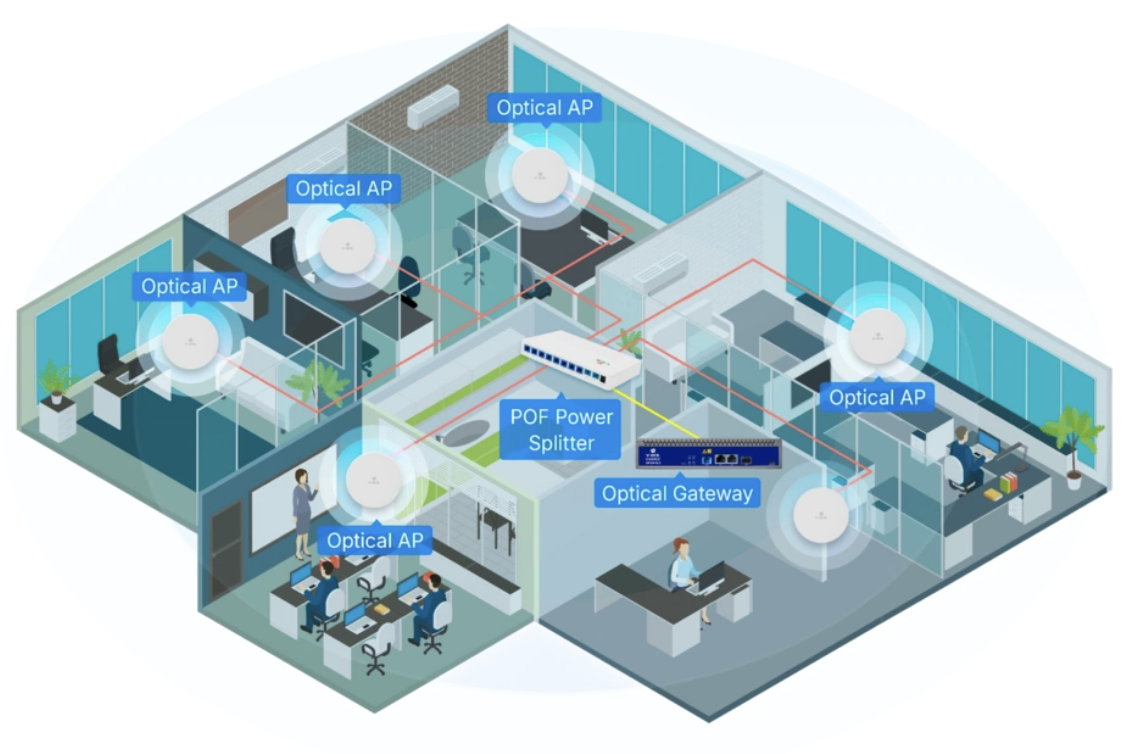
This approach makes FTTO practical not only for large enterprises but also for growing SMB environments that require stable, high-bandwidth connectivity without complex network engineering.
By combining fiber backbone reliability with simplified edge deployment, mini FTTO architectures lower the technical barrier to migrating from traditional LANs.
Cost Comparison: FTTO vs Traditional LAN
From a short-term perspective, fiber infrastructure may appear more expensive than copper. However, the total cost of ownership tells a different story.
Initial Investment
- Fiber cabling cost per meter is often comparable to high-grade copper
- Reduced number of active switches lowers hardware investment
- Fewer telecom rooms reduce construction costs
Operational Expense
- Lower power consumption
- Reduced cooling requirement
- Centralized management decreases maintenance labor
Lifecycle Value
Fiber infrastructure can support bandwidth evolution for decades. A copper-based LAN may require multiple upgrade cycles within the same period.
When evaluating a 10- to 15-year lifecycle, FTTO frequently demonstrates competitive or lower total cost than traditional LANs.
Deployment Considerations Before Migrating to FTTO
Although FTTO offers clear advantages, migration should be planned in a structured manner.
- Evaluate building layout and user density
- Calculate port requirements and PoE demand
- Assess future bandwidth growth
- Plan a centralized equipment location
- Ensure compatibility with existing IP systems
Hybrid models are also possible. Some enterprises retain copper in limited areas while deploying fiber for the backbone and high-demand zones.
The Strategic Shift Toward Fiber First Architecture
The move from traditional LAN to FTTO is not only a technology upgrade. It reflects a broader shift toward simplified infrastructure, centralized management, and long-term sustainability.
As enterprises prioritize energy efficiency, digital transformation, and scalable connectivity, fiber-first network design aligns with these objectives.
Compact FTTO solutions further reduce the adoption barrier by offering enterprise-friendly packaging and simplified deployment workflows.
For organizations building new facilities or renovating existing ones, the question is no longer whether fiber is necessary, but how to design an optimized FTTO architecture that balances performance, cost, and operational efficiency.
Conclusion
Traditional LANs have served enterprise networks for decades, but their structural constraints are increasingly evident in modern digital environments. FTTO replaces copper-heavy access layers with centralized optical distribution, delivering longer transmission distances, lower power consumption, reduced space requirements, and improved scalability.
With the availability of compact, intelligent FTTO solutions tailored for business use, fiber to the office is becoming a practical and strategic choice for hotels, hospitals, campuses, government institutions, and SMB offices alike.
For enterprises planning long-term infrastructure investments, FTTO is not simply an alternative to traditional LANs. It represents a forward-looking network architecture built for high bandwidth, low latency, and sustainable operations.
Featured Image generated by Google Gemini.
Share this post
Author

Read the latest articles from Thomas Lore
Turning Raw IP Logs into Insights

April 16, 2026
Every second, servers across the internet generate millions of log entries—cryptic lines of text documenting every connection, request, and error. For network administrators, security analysts, and digital forensics investigators, these IP logs contain invaluable intelligence about traffic patterns, security th [...]
Learn moreHow Developers Can Use The GPT 5.4 API To Build Smarter Web Tools And Automation Workflows

April 1, 2026
Web tools are no longer limited to static lookups, rule-based automation, or narrow search functions. Developers today are building products that must interpret user intent, summarize content, generate structured responses, and automate repetitive tasks, all with far greater flexibility. That shift is one reason [...]
Learn moreLeave a comment
All comments are moderated. Spammy and bot submitted comments are deleted. Please submit the comments that are helpful to others, and we'll approve your comments. A comment that includes outbound link will only be approved if the content is relevant to the topic, and has some value to our readers.
Comments (0)
No comment