
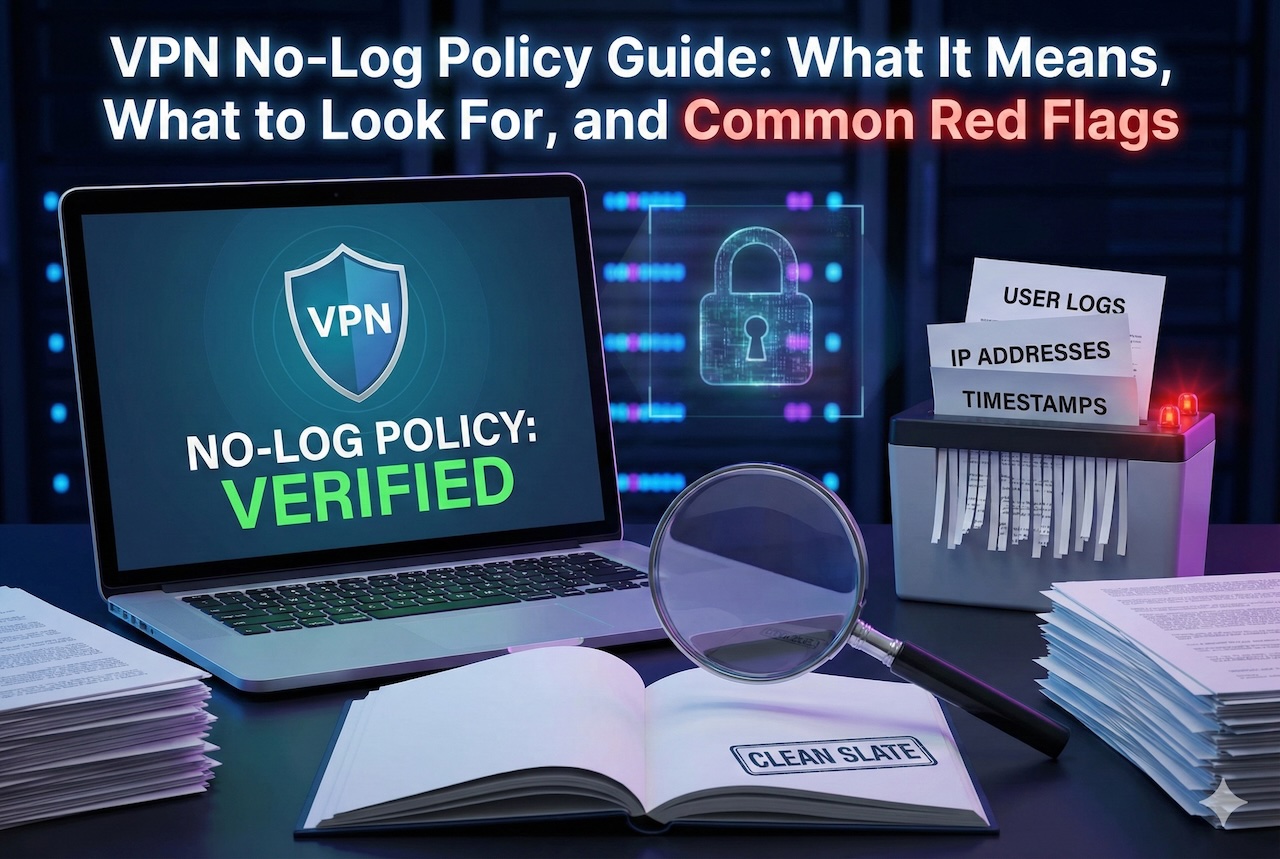
A “no-log” VPN can be a strong privacy tool, but the phrase is often used loosely. Some providers mean they do not record your browsing activity, while still collecting connection metadata. Others avoid storing identifiable data entirely, or keep only minimal operational data for short periods. This guide explains what a VPN no-log policy typically covers, what it does not, and how to evaluate a provider’s claims.
What “No Logs” Usually Means
In simple terms, a VPN no-log policy indicates the provider does not store information that can be used to identify what you did online through the VPN. The strongest interpretation is that the VPN does not record:
- Websites you visit (URLs)
- DNS queries
- Traffic contents (messages, downloads, streams)
- Connection timestamps tied to a specific user
- Source IP addresses linked to individual sessions
However, “no logs” is not a regulated label in many places. Providers may exclude certain categories while still using the term in marketing. The details matter.
Types of VPN Data: Activity Logs vs Connection Logs
VPN logging is often discussed in two broad categories:
1. Activity (Usage) Logs
Activity logs relate to what you do online: visited websites, DNS requests, content of traffic, and specific services used. A true privacy-focused VPN typically claims it does not store activity logs.
2. Connection (Metadata) Logs
Connection logs usually include technical metadata like connection times, session duration, bandwidth usage, and the server you used. Some providers may collect limited connection data for troubleshooting, capacity planning, abuse prevention, or service quality.
The key question is whether any metadata is stored in a way that can be tied back to you (directly or indirectly), and how long it is retained.
What a VPN Might Still Collect (Even With a No-Log Claim)
A VPN can operate without storing browsing history, yet still collect some data for legitimate operational reasons. Common examples include:
- Billing data (payment records, transaction IDs)
- Account identifiers (email address, username)
- Aggregate performance metrics (server load, crash reports)
- Device/app diagnostics (app version, OS type, anonymized error logs)
- Abuse prevention signals (rate-limiting, anti-spam/anti-DDoS controls)
None of these automatically contradict a no-log policy. The privacy impact depends on whether the data is identifiable, whether it can be correlated with sessions, and how long it is retained.
How to Evaluate a No-Log Policy (Practical Checklist)
When reviewing a VPN’s privacy policy or “no logs” statement, look for clear answers to these questions:
- What exactly is not collected? (activity logs, DNS, source IPs, timestamps)
- What is collected? (account data, diagnostics, aggregated metrics)
- Is any data tied to a user identity? (account, payment, device identifiers)
- How long is data retained? (hours, days, “as long as necessary,” etc.)
- Is the policy written in plain language? (not just marketing slogans)
- Are there independent audits? (and are results summarized publicly)
- Are there transparency reports? (legal requests, how they are handled)
- Does the provider explain infrastructure? (diskless servers, RAM-only, etc.)
Audits, Transparency Reports, and Real-World Verifiability
Because “no logs” claims can be hard to verify, strong providers often supplement policies with measures that increase trust and accountability:
- Independent audits that review configurations, logging practices, and operational controls. Audits are not perfect, but they can validate whether systems are designed to avoid collecting identifiable logs.
- Transparency reports that summarize legal requests and how the provider responded. These can show consistency over time.
- Warrant canaries (where legal) that indicate whether certain orders have been received.
- Technical design choices like RAM-only (diskless) servers to reduce the possibility of persistent logs.
The best signal is alignment: the policy language, technical architecture, and independent verification should tell the same story.
Jurisdiction and Data Retention: Why Location Still Matters
A VPN’s legal environment can influence how it responds to lawful requests and whether retention rules apply. “Jurisdiction” does not automatically determine privacy, but it can affect:
- Whether the provider can be compelled to start logging going forward
- How gag orders are handled
- Whether data retention laws apply to VPN providers
- How cross-border requests may be processed
A strong privacy posture is a combination of policy, architecture, and legal strategy—not just a country name.
Common Red Flags in “No-Log” Marketing
- Vague claims like “we never log anything” with no definitions or details.
- Contradictory privacy policy that mentions collecting IP addresses, timestamps, or browsing data.
- Unclear retention periods (e.g., “we retain data as needed” without specifics).
- Excessive analytics or third-party tracking inside the VPN app.
- No external verification (no audits, no transparency reporting, no technical explanations).
Practical Takeaways
A no-log policy is meaningful only when it is specific, consistent with the provider’s technical design, and supported by independent evidence. The safest approach is to treat “no logs” as a claim that must be validated by the details:
- Prefer providers that explicitly state they do not store activity logs (URLs, DNS, traffic contents).
- Check whether connection metadata is collected and whether it can be tied to you.
- Look for audits and transparency reporting as credibility signals.
- Understand what account/billing data is required and how it is protected.
Share this post
Leave a comment
All comments are moderated. Spammy and bot submitted comments are deleted. Please submit the comments that are helpful to others, and we'll approve your comments. A comment that includes outbound link will only be approved if the content is relevant to the topic, and has some value to our readers.
Comments (0)
No comment