
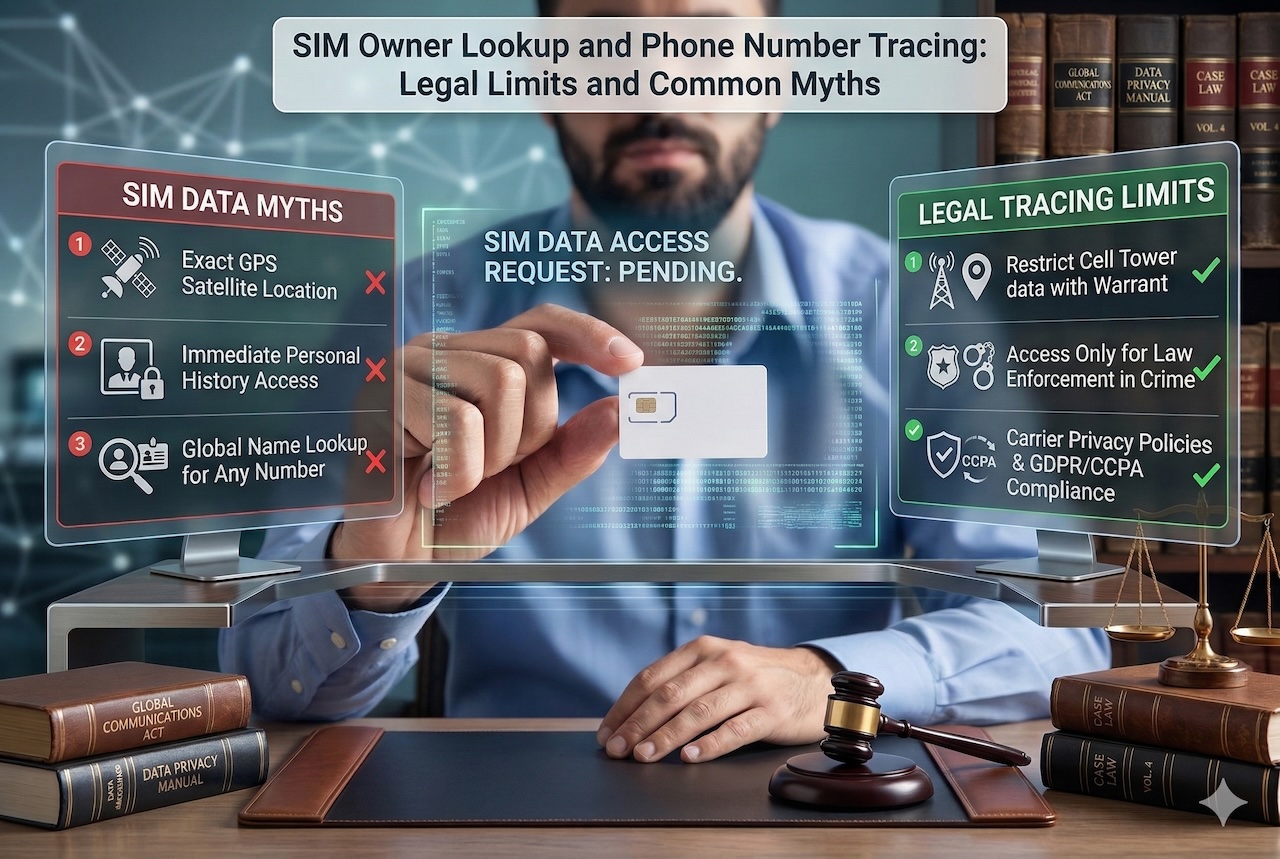
Let’s just get to the point: accessing SIM owner details or attempting to identify the registered owner of a phone number is tightly regulated in the United States. In California, for example, this type of information is generally only available to law enforcement agencies and authorized investigators, and even then it typically requires proper legal procedures such as a subpoena, court order, or warrant. Telecommunications carriers are required to protect customer information and cannot disclose subscriber identity details without a lawful request. If you’re a private individual poking around or misusing that info, you’re risking some pretty serious legal trouble, both civil and criminal. So, honestly, if you’re even thinking about digging up owner details without a court order or the carrier’s help, you could be opening yourself up to real legal headaches.
People often wonder why you can’t just type in a phone number and get all the details. Turns out, tracing tools and phone identifiers usually need a judge’s permission or a carrier’s cooperation. Only certain requests get real results, and crossing that legal line? Not worth it. If you’re tangled up in a criminal case over phone data, you’ll want to talk to a local criminal defense firm if you're in Santa Ana.
Understanding SIM Owner Details Searches and Number Tracing in California
Here’s what’s actually going on with SIM subscriber lookups and phone number tracing in California and many other states—what’s true, what’s just hype, which tech systems show up in reports, and why understanding the data really matters if you want to stay on the right side of the law.
Definition and Common Methods
When people talk about a SIM owner-details search, they mean finding out who the subscriber is, where they get their bills, and what the account history looks like for a mobile number. Carriers keep all this in their own databases, and law enforcement or sometimes civil lawyers can ask for it—but only through official channels. Usual routes? Subpoenas, court orders, or those emergency requests you sometimes hear about. Carriers don’t just hand this stuff out; they want a legit legal reason first.
Some people try using online tools that claim to provide a SIM owner details online check by number, but these services typically rely on publicly available or limited third-party data rather than official carrier databases. Those private lookup websites and caller ID apps, at best, can show you some basic info from public or crowd-sourced reports, not the deep, carrier-level records. There are also technical tools—like cell tower call detail records (CDRs) and carrier signaling logs—that can show where a phone connected and when, but those aren’t the same as the SIM registration data tied to an account.
Popular Myths Versus Reality
One of the biggest myths is that anyone can just “trace a number” and instantly find out who owns it and where they are. Not true. Normal people can’t get into carrier databases; only certain folks with carrier cooperation and the right paperwork can see registration info. Some apps or sketchy sites claim they can show you real-time location or owner identity, but honestly, they’re usually just pulling from user reports, reverse phone lookup databases, or old public records—not anything live or official.
Another common misconception? That tracing always gives you up-to-the-minute, totally accurate info. Carrier records might show the last cell tower used or a billing address, but sometimes that’s just a reseller, a prepaid card, or even a corporate account holder—not necessarily the person who actually had the phone. People often misread these fields and jump to the wrong conclusions about who was using the SIM at any given moment.
The Role of tap, ciss, and Gangs in Number Tracing
If you’ve spent time on forums or reading reports, you’ll see terms like tap and ciss thrown around. In legitimate cases, TAP (telecommunications access point) or similar tools are just ways for investigators to get call or subscriber data from carriers. CISS and similar acronyms pop up in some carrier systems for customer service or investigations, but these aren’t standard legal terms—just internal jargon that changes from one company to another.
And about “gangs”—sometimes you’ll see that word in crowd-sourced databases or investigations, but it’s not a technical method for getting subscriber info. Sometimes it’s just a label, maybe a support code or a tag for a corporate account, and misreading these can make people think a tracing tool is exposing some criminal network when it’s really not. The only real, reliable way to get official records? Go through the carrier with the right legal paperwork.
Privacy Concerns and Data Interpretation
Sharing SIM registration or tracing info is a big deal for privacy—California and federal laws both come into play. Carriers have to weigh legal requests against privacy rules and their own contracts before they’ll hand anything over. If someone leaks info or handles it carelessly, they could be on the hook for privacy violations or even lawsuits.
And just because you get data back doesn’t mean it’s crystal clear. “Account holder,” “billing contact,” “last used IMSI”—these all mean different things. Investigators have to line up timestamps, call records, and device IDs to avoid blaming the wrong person. Crowd-sourced or third-party databases? They’re often unreliable, and using them without checking can lead to mistakes or even legal trouble.
Legal Issues and Compliance in SIM Owner Searches
Let’s break down who’s allowed to ask for SIM subscriber info, what the law says, and what happens if you cross the line. It’s not as open-and-shut as some people think—law enforcement has a process, and carriers expect you to follow it.
Legal Framework Governing Data Access
Both California and federal law set the rules for accessing telecom subscriber info. Carriers only give out billing or subscriber details if there’s a proper legal request—like a court order, warrant, subpoena, or an emergency request under federal laws like the Stored Communications Act.
Private individuals, companies, or journalists can’t just demand that carriers hand over owner names or registration data. Sometimes, in a lawsuit, a judge might order it, but that’s it. Carrier contracts also limit what can be shared and always require proof before they’ll release account details.
Usually, records departments want you to provide things like IMSI, ICCID, or MSISDN, along with the official legal paperwork. If you try to get around this, you could be breaking state privacy laws, federal wiretap rules, or carrier policies.
Risks and Consequences of Unauthorized Searches
Trying to get or actually getting subscriber info without the right legal steps can land you in hot water—criminal charges, civil lawsuits, you name it. The law’s pretty clear: unauthorized grabbing, keeping, or sharing of electronic communications and account records is a crime.
If you’re a private person tracing numbers or pestering carriers for identities, you could get sued for privacy invasion, negligence, or for breaking California’s laws that protect electronic communications. Carriers might cut off your service, cancel your contract, or even report you to the authorities.
Businesses offering number-finding services without following the rules put themselves and their clients at risk—think fines, regulatory trouble, or having evidence thrown out in court. If there’s no documentation of a legal process, it’s tough to defend any disclosure.
Law Enforcement Exceptions and Processes
Law enforcement agencies can get subscriber info, but only if they follow certain procedures. Usually, officers bring in subpoenas for basic subscriber records, court orders if they want transactional data, and warrants for things like content or real-time location. All of this is supposed to line up with Fourth Amendment protections and whatever privacy laws a state has on the books.
There are emergency channels too—those kick in when there’s an immediate threat or danger. In those cases, things move a lot faster, but carriers still want written follow-up and a clear legal reason for the rush. Agencies have to keep track of their requests and maintain a solid chain-of-custody, since that’s what makes the evidence usable in court later.
Carrier legal teams don’t just rubber-stamp these requests, either. They’ll check for sufficiency and might ask for clarification or even an in-camera review if something’s unclear. Transparency reports and audit trails? Those help carriers show they’re playing by the rules and protect them from liability if they hand over records after following the right process.
Featured Image generated by Google Gemini.
Share this post
Leave a comment
All comments are moderated. Spammy and bot submitted comments are deleted. Please submit the comments that are helpful to others, and we'll approve your comments. A comment that includes outbound link will only be approved if the content is relevant to the topic, and has some value to our readers.
Comments (0)
No comment