

Short-Form Video Platform: Ultimate Tech Stack Guide
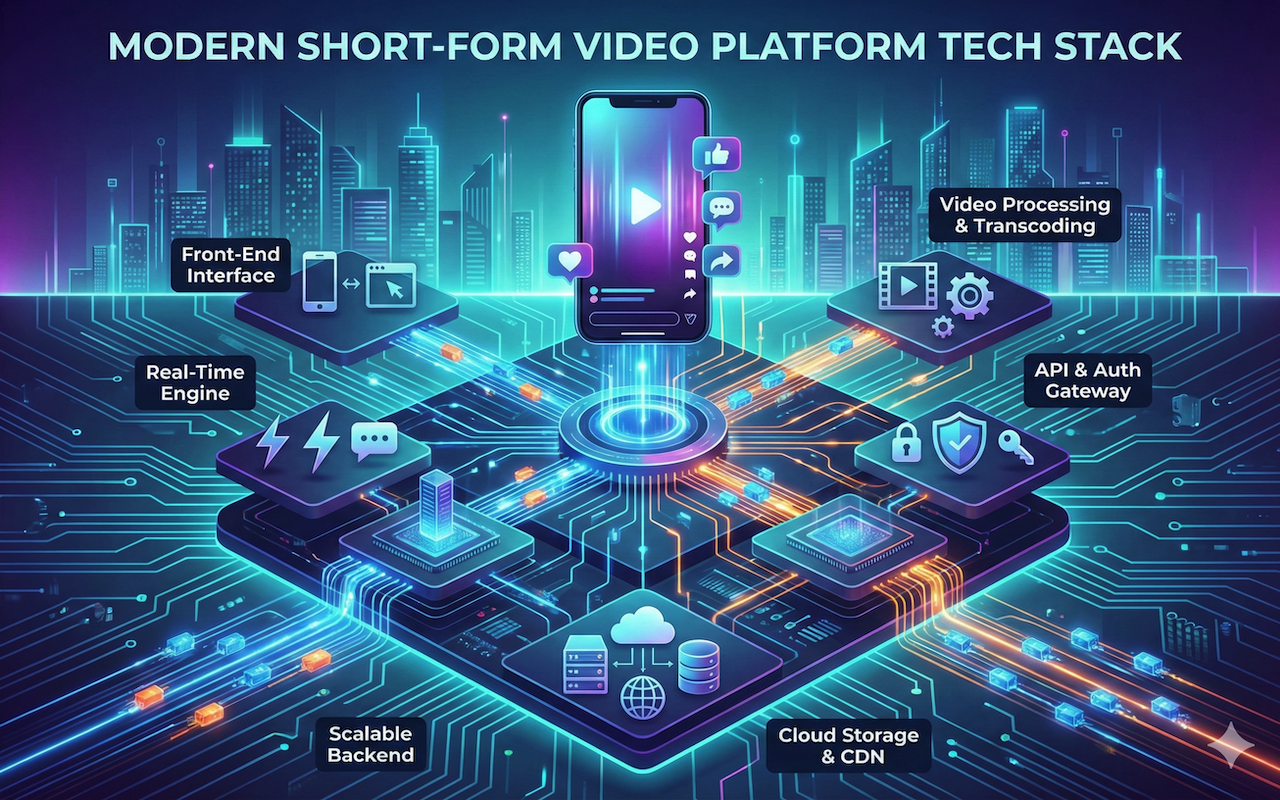
Short-form video content has transformed the digital landscape, driving massive changes in how users create and consume media. Platforms built around bite-sized videos, real-time interaction, and creator-driven discovery now set the standard for engagement. However, having a great idea alone isn’t enough. To compete in this space, the underlying technology must support scale, performance, and seamless user experiences.
One of the most important decisions when building a short-form video platform is selecting the right tech stack. The technologies you choose determine how well the application performs, how easily it scales, and how effectively it attracts and retains users.
This guide explores the core technologies that power modern short-form video platforms, including front-end frameworks, back-end systems, video processing, real-time features, and security considerations.
Front-End Technologies: Building an Interactive Interface
The front end defines how users interact with your platform. From scrolling through videos to engaging with profiles and content, the interface must feel smooth, responsive, and intuitive across devices.
React Native is a popular choice for building cross-platform mobile apps. It allows developers to maintain a single codebase for both iOS and Android, reducing development time while still delivering a near-native experience. This makes it well suited for media-heavy platforms that require real-time interactions and smooth video playback.
For more complex or device-specific functionality, native development using Swift for iOS and Kotlin for Android may be preferable. These languages provide greater control over hardware features such as cameras, video recording, and offline capabilities, which are critical for media-driven applications.
Back-End Technologies: Powering Scalability and Performance
A strong back-end is essential for managing high traffic volumes, user data, and media uploads. This includes handling authentication, video uploads, social interactions, and content feeds.
Node.js is widely used for real-time, high-performance applications. Its asynchronous, non-blocking architecture makes it ideal for platforms that must process large numbers of simultaneous requests. Paired with Express.js, it can efficiently manage APIs, authentication, and streaming services.
For larger or more complex systems, frameworks like Java Spring Boot or Django (Python) are often used. These solutions offer strong security, scalability, and seamless integration with databases, making them suitable for enterprise-grade applications.
Video Processing and Streaming: The Core of the Platform
Video is the foundation of any short-form video application. Ensuring smooth uploads, processing, and playback is critical to user satisfaction.
FFmpeg is a widely used open-source tool for video transcoding and compression. It allows platforms to convert videos into multiple formats and resolutions, ensuring compatibility across devices while maintaining quality.
For live streaming and real-time video communication, WebRTC enables low-latency peer-to-peer audio and video transmission. This is especially useful for live broadcasts, interactive sessions, or creator-led events where immediacy matters.
Real-Time Features: Enhancing User Engagement
Modern video platforms rely heavily on real-time feedback. Likes, comments, notifications, and live reactions all contribute to user engagement.
Socket.io enables real-time, two-way communication between clients and servers. It allows actions like likes or comments to appear instantly without page refreshes, creating a more interactive experience.
Firebase Realtime Database is another option for synchronizing user interactions in real time. As a cloud-based solution, it simplifies real-time data updates without requiring complex server infrastructure.
User Authentication and Account Management
Secure and flexible authentication is essential, especially for platforms supporting multiple devices and social sign-ins.
OAuth 2.0 is a standard protocol that enables users to log in using third-party accounts such as Google or Facebook while maintaining security. JWT (JSON Web Tokens) are commonly used to manage sessions efficiently without server-side state, making them suitable for large user bases.
These technologies support features like multi-device access and account switching while preserving security and performance.
Database and Storage: Managing User Data and Media
Short-form video platforms generate vast amounts of structured and unstructured data. Choosing the right storage solutions is key to maintaining performance and reliability.
MongoDB, a NoSQL database, works well for unstructured data such as videos, comments, and user-generated content. Its flexible schema supports rapid growth without significant performance loss.
For structured data like user profiles and relationships, relational databases such as PostgreSQL or MySQL provide strong consistency and transactional reliability.
Cloud storage solutions like Amazon S3 or Google Cloud Storage are commonly used to store video and image files, offering high availability, security, and fast retrieval times.
Scalability: Growing With User Demand
As user numbers increase, your platform must scale smoothly to avoid performance issues during peak usage.
Docker allows applications to be packaged into containers, making them easier to deploy across environments. Kubernetes automates container orchestration, enabling horizontal scaling and efficient resource management.
Using a CDN (Content Delivery Network) such as Cloudflare or Akamai further improves performance by distributing media content closer to users, reducing latency and load times globally.
Security: Protecting User Data
Security is a core requirement for any social platform handling personal data and media content.
SSL/TLS encryption secures communication between clients and servers, preventing data interception. Two-factor authentication (2FA) adds an extra layer of account protection.
For media security, AES encryption can be used to protect stored video files, ensuring that only authorized users can access content.
Final Thoughts
Building a modern short-form video platform requires thoughtful technology choices that balance performance, scalability, and user experience. With the right combination of front-end frameworks, back-end systems, video processing tools, and real-time communication technologies, it’s possible to create a platform that supports high engagement and long-term growth.
Choosing a well-aligned tech stack is foundational to success. Whether you’re launching a new social video concept or expanding an existing platform, prioritizing scalability, security, and usability will position your application for sustainable growth—often in collaboration with an experienced app development company that can help align technical decisions with long-term goals.
Disclaimer
This article is provided for informational and educational purposes only. It does not constitute professional, legal, financial, or technical advice. Technology choices, architectures, and implementation strategies may vary based on project requirements, business goals, and regulatory considerations. Readers should conduct independent research or consult qualified professionals before making development or investment decisions.
References to third-party tools, platforms, frameworks, or external websites are included for general context only. iplocation.net does not endorse, control, or take responsibility for the content, availability, or accuracy of external links, and is not liable for any outcomes resulting from their use.
Featured Image generated by Google Gemini.
Related Articles

May 15, 2026
Kling 3.0 API: Architecting Unified Multimodal Pipelines for Enterprise-Grade Video Synthesis
The evolution of visual content generation is shifting from manual, high-latency creative tools toward a programmable media infrastructure. For development teams and enterprise arc...
Read More
June 12, 2025
Beyond the Code: What High-Performing Tech Teams Prioritize
There’s a comforting myth in tech that great code solves everything. But if that were true, half the projects that fail wouldn’t even get close to production. The reality? Some of...
Read More
May 3, 2025
Next-Gen Infrastructure: Rethinking Base-Level Tech and Architecture
Building and maintaining technology feels like patching an old ship while still at sea. Many businesses struggle with outdated systems that can’t keep up. They face slow performanc...
Read More
Comments
Comments are available to signed-in users and are moderated to keep the discussion useful and respectful. Spam, automated submissions, and low-value promotional comments are removed. Outbound links may be approved when they are relevant and genuinely helpful to readers, but they are displayed as plain text rather than clickable hyperlinks.
No comments have been published yet.
Please sign in to submit a comment.