
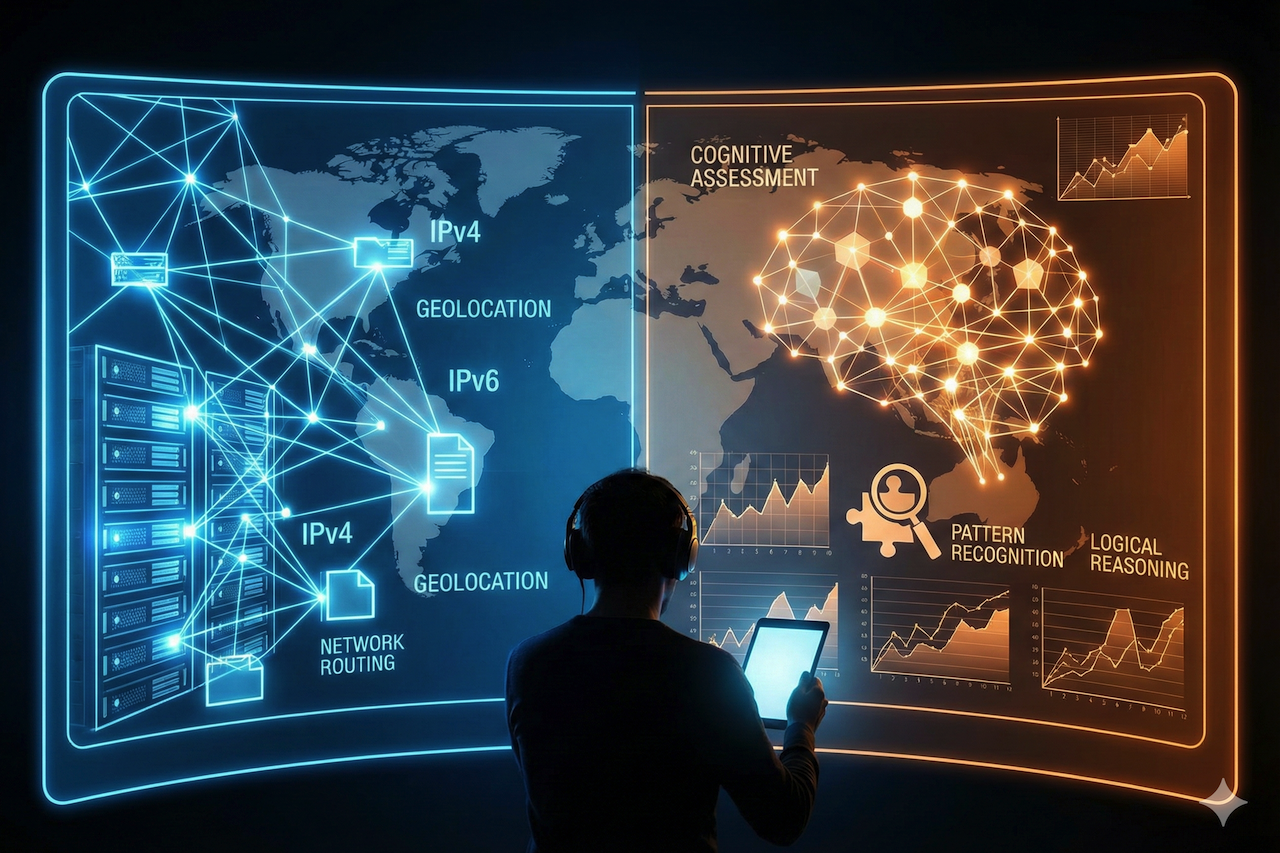
The modern internet revolves around data. Every time you check your public IPv4 or IPv6 address, analyze geolocation coordinates, or review regional network routing, you’re interacting with systems built on logic, structure, and analytical precision.
In the same digital environment where users monitor IP addresses and location data, cognitive self-assessment has also gained popularity. Online IQ tests allow individuals to evaluate reasoning abilities quickly and conveniently. Many platforms, such as MyIQ, now provide structured assessments and instant feedback, and users often share their experiences and scores in online communities such as Reddit discussions.
Just as understanding your IP address reveals how you are seen on the internet, understanding your cognitive profile can provide insight into how you process and interpret the digital world around you.
The Digital Age: IP Addresses, Geolocation, and Logic
Understanding the Infrastructure Behind the Internet
When users look up their IP address, they often see data such as:
- IPv4 or IPv6 classification
- City and region
- Country
- Latitude and longitude
- ISP (Internet Service Provider)
This information reflects the structured, mathematical backbone of the internet. Every packet of data travels according to strict logical protocols.
The internet is not random; it is engineered through problem-solving, pattern recognition, and numerical precision. These same types of cognitive abilities are often evaluated in intelligence and reasoning assessments.
How Intelligence Connects to Digital Awareness
Navigating today’s online environment requires:
- Analytical thinking
- Pattern recognition
- Logical deduction
- Problem-solving under uncertainty
Whether configuring a network, interpreting geolocation data, or understanding VPN routing, cognitive skills influence how efficiently users interpret technical information.
This is one reason why interest in cognitive testing and digital self-awareness continues to grow.
What Is Online Cognitive Testing?
A Modern Approach to Self-Assessment
Online IQ and reasoning tests are designed to measure core cognitive abilities through structured digital assessments. Unlike traditional paper-based exams, modern tools typically offer:
- Fully online accessibility
- Fast completion times
- Immediate feedback
- Structured breakdowns of cognitive strengths
These tests commonly evaluate areas such as:
| Cognitive Skill | Digital Relevance |
|---|---|
| Logical reasoning | Understanding system logic and protocols |
| Numerical ability | Interpreting metrics and analytics |
| Pattern recognition | Identifying anomalies and trends |
| Spatial reasoning | Visualizing systems and structures |
These abilities are increasingly relevant in a world shaped by technical systems and digital infrastructure.
Data About You vs. Data About Your Mind
External Digital Identity
When you check your IP address, you uncover external data such as:
- Approximate location
- Network provider
- Time zone
- Routing and connectivity details
This is how websites and services interpret your presence online. However, this type of data does not explain how you think, analyze, or solve problems.
Internal Analytical Identity
Cognitive testing focuses on internal processes — the way individuals approach complexity, recognize patterns, and apply reasoning. While network tools answer questions like “Where are you located?”, cognitive assessments explore:
- How do you approach complex challenges?
- How efficiently do you identify patterns?
- How strong is your abstract reasoning?
Both perspectives contribute to digital self-awareness, but they measure different dimensions.
Why Cognitive Skills Matter in a Technical World
The Rise of Analytical Demands
Modern internet users increasingly interact with:
- Cybersecurity tools
- IP lookup services
- VPN and privacy configurations
- DNS and networking systems
- Blockchain and digital identity platforms
Understanding these tools requires analytical thinking. For example:
- Recognizing inconsistencies in location data
- Interpreting latency or routing behavior
- Identifying suspicious activity
- Comparing technical structures such as IPv4 and IPv6
Logical and numerical reasoning supports confidence in interpreting complex systems.
Recognizing Strengths and Weaknesses
Cognitive self-assessment can provide clarity. By understanding strengths, individuals may:
- Choose learning paths aligned with analytical ability
- Improve structured problem-solving
- Develop better digital literacy
If certain areas are weaker, awareness can encourage:
- Structured learning approaches
- Visualization and modeling tools
- Step-by-step problem frameworks
- Use of automation and decision-support systems
Self-awareness often leads to more confident digital decision-making.
Community Feedback and Transparency
Public discussion plays an important role in evaluating modern digital services. Online communities often share experiences, discuss results, and compare different cognitive testing tools.
This kind of dialogue can increase:
- Transparency
- Independent feedback
- Critical evaluation
- User awareness
In a digital ecosystem filled with unreliable quizzes and exaggerated claims, open peer discussion can help users make informed choices.
Intelligence and Cybersecurity Awareness
Pattern Recognition in Online Safety
Digital security frequently depends on recognizing unusual patterns, such as:
- Suspicious login attempts
- Unusual geolocation changes
- Phishing or fraud signals
- Network anomalies
Pattern recognition, a core cognitive skill, supports early detection of risks.
Logical Thinking in Network Understanding
Even basic network troubleshooting relies on reasoning:
- Why does an IP address show a different region?
- How do VPNs alter routing?
- Why are IPv6 structures more complex?
These questions rely on logic rather than guesswork. Strengthening reasoning skills contributes to digital resilience.
Responsible Interpretation of IQ Results
Intelligence as a Tool, Not a Label
It is important to emphasize that cognitive assessments do not define an individual’s worth or potential. Instead, they offer:
- A snapshot of specific reasoning abilities
- Insight into problem-solving approaches
- Aware of analytical tendencies
Digital competence is influenced by experience, curiosity, and continuous learning. Cognitive testing should be viewed as a self-development tool rather than a fixed measure.
The Parallel Between Network Mapping and Cognitive Mapping
There is a clear parallel between:
- Mapping an IP address to a geographic location
- Mapping reasoning patterns to cognitive insights
Both involve structured data, interpretation, and meaningful conclusions. Just as geolocation converts numerical signals into understandable information, cognitive testing converts structured problem-solving into personal insight.
Conclusion: Digital Self-Awareness in Two Dimensions
The internet era is built on measurable systems. We track:
- Bandwidth
- Coordinates
- Latency
- Network identifiers
Yet we rarely measure the cognitive processes that interpret this information.
Online cognitive assessments provide a framework for understanding these internal mechanisms. Supported by growing public interest and accessible digital tools, they align with a broader culture of data transparency and self-awareness.
Understanding your network identity reveals how the internet sees you.
Understanding your cognitive tendencies reveals how you interpret the internet.
In a world defined by data, both perspectives contribute to a more informed and resilient digital experience.
Featured Image generated by Google Gemini.
Share this post
Author

Read the latest articles from Emily Carter
The Future of Digital Communication: Privacy Considerations

May 7, 2026
The way people communicate has changed more in the past decade than in the previous century combined. From encrypted messaging apps to AI-powered virtual assistants, digital communication tools have woven themselves into the fabric of daily life, both professional and personal. But as these technologies grow more [...]
Learn moreHow AI Is Changing IP Tracking in 2026
May 5, 2026
IP tracking has always been one of the basic building blocks of online security. Every website visit, login attempt, API request, email header, and network connection leaves technical signals behind. Among those signals, the IP address remains one of the most useful starting points for understanding where [...]
Learn moreLeave a comment
All comments are moderated. Spammy and bot submitted comments are deleted. Please submit the comments that are helpful to others, and we'll approve your comments. A comment that includes outbound link will only be approved if the content is relevant to the topic, and has some value to our readers.
Comments (0)
No comment