
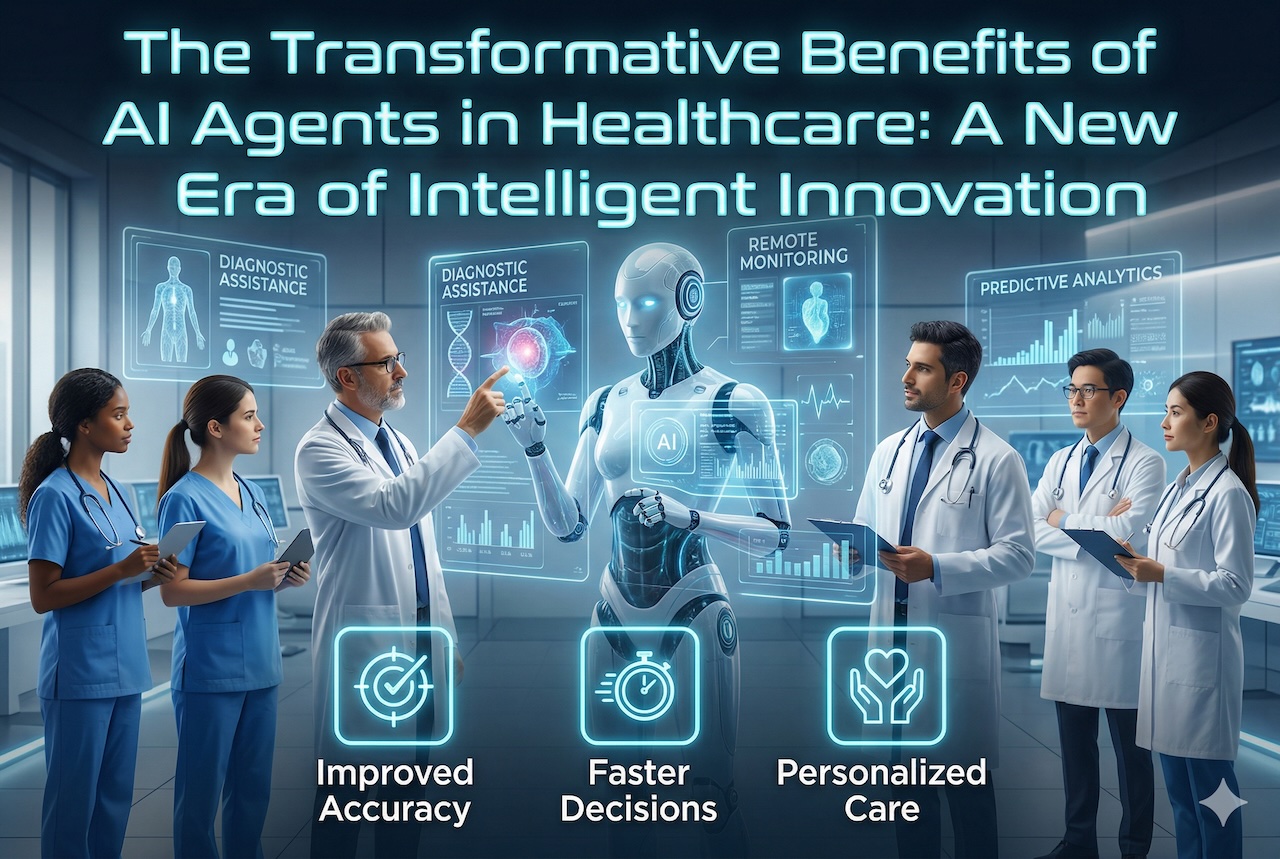
The healthcare sector changes dramatically, and most of the recent changes are driven by newly adopted AI-driven technologies. More and more organizations are partnering with AI software development companies to create intelligent solutions that improve operational efficiency, support better decision-making, and patient outcomes. As the demand for healthcare software development continues to rise, AI agents (autonomous or semi-autonomous systems designed to handle complex workflows) are emerging as critical elements of modern healthcare infrastructures. These healthcare software development services enable providers to integrate advanced AI capabilities into clinical and operational systems. Their applications span from patient interaction and administrative automation to clinical decision support, fundamentally redefining how healthcare organizations operate and deliver care.
Below, we outline five key advantages of AI agent development in healthcare, followed by an overview of the emerging trends that are set to define the next decade of AI-driven medicine.
1. Improved Clinical Decision Support and Diagnostic Precision
One of the most impactful uses of AI agents in healthcare lies in strengthening clinical decision support. These advanced systems can rapidly analyze enormous volumes of medical data, including patient records, diagnostic images, laboratory findings, and genomic profiles, far more efficiently than conventional approaches.
AI agents are particularly effective at detecting subtle irregularities in medical imaging such as CT scans, MRIs, and ultrasounds. They can recognize complex patterns that may escape human observation, especially during the early stages of conditions like cancer or neurological diseases. In addition, through deep learning and natural language processing, AI agents can continuously review medical research, clinical protocols, and treatment guidelines, ensuring clinicians rely on the most current and evidence-based information.
This leads to fewer diagnostic errors, more accurate treatment planning, and improved patient outcomes. Rather than replacing healthcare professionals, AI agents function as intelligent assistants that enhance clinical expertise and support confident, data-driven decision-making.
2. Improved Operational Efficiency and Lower Administrative Workload
Healthcare professionals are frequently weighed down by extensive administrative responsibilities, including appointment scheduling, insurance claims processing, and electronic health record management. This heavy workload limits productivity and significantly contributes to burnout, which has become one of the most critical challenges facing the healthcare workforce today.
AI agents address these challenges by autonomously handling repetitive and time-consuming tasks, including the following:
- Automating patient intake and initial triage
- Managing billing processes and insurance workflows
- Handling data entry, record updates, and clinical documentation
- Coordinating appointment scheduling, confirmations, and reminders
- Optimizing inventory tracking and medical supply management
Operating continuously without fatigue, AI agents increase operational throughput while minimizing errors and reducing process bottlenecks. Healthcare organizations that implement AI-driven automation benefit from improved resource utilization, shorter patient wait times, and smoother care delivery.
By shifting routine administrative work away from clinicians and staff, AI agents free healthcare professionals to devote more attention to direct patient care, helping restore balance and reinforce the human-centered nature of medicine.
3. Personalized Patient Engagement and Support
Modern patients expect healthcare experiences that are convenient, responsive, and tailored to their individual needs. AI agents, including intelligent chatbots and virtual health assistants, play a key role in delivering this level of personalization and accessibility.
These AI-powered systems are capable of:
- Provide real-time answers to common medical questions
- Track patient symptoms and medication adherence
- Offer health reminders and lifestyle recommendations
- Assist with chronic disease management
- Connect patients to the right healthcare professional based on urgency
By analyzing patient data, behavior patterns, and individual preferences, AI agents adapt their interactions to feel relevant and personalized. For people living with chronic conditions such as diabetes, asthma, or hypertension, these systems enable continuous oversight and proactive support, helping patients remain aligned with their care plans.
The outcome is higher patient satisfaction, improved adherence to treatment, and stronger, more trusting relationships between healthcare providers and the populations they serve.
4. Faster Drug Discovery and Research Innovation
Traditional drug discovery is time-intensive, costly, and laborious. AI agents are helping to transform this process by rapidly analyzing biological data, predicting molecular behavior, and identifying promising compounds in a fraction of the time required by conventional methods.
AI-driven research agents can:
- Model drug-target interactions
- Predict toxicity and side effects
- Simulate clinical trial outcomes
- Analyze genomic and proteomic data
- Discover repurposing opportunities for existing medications
Pharmaceutical and biotechnology organizations are increasingly turning to AI agents to shorten research and development cycles, reduce costs, and bring life-saving therapies to market more quickly. In high-pressure situations such as global health emergencies, AI-driven drug discovery delivers exceptional speed and accuracy that traditional methods cannot match.
By strengthening research capabilities and accelerating scientific breakthroughs, AI agents are becoming a critical force in advancing medical innovation and supporting global public health efforts.
5. Continuous Monitoring and Predictive Healthcare
Wearable technologies, remote monitoring solutions, and IoT-enabled medical sensors are producing massive streams of real-time health data. AI agents analyze this continuous flow of information to generate predictive insights and issue early alerts about emerging health risks.
Advanced predictive systems are capable of identifying early indicators of conditions such as heart failure, respiratory deterioration, infection onset, seizure activity, and irregular blood glucose levels. With this foresight, healthcare professionals can take action before issues become critical, helping to reduce emergency visits and unplanned hospitalizations.
For elderly individuals and patients with elevated risk profiles, AI-driven monitoring agents support safe, efficient, and affordable care at home. Families gain reassurance through constant oversight, while clinicians receive timely notifications that enable prompt intervention. By enabling earlier detection and prevention, this proactive model is reshaping healthcare away from crisis management and toward long-term health preservation.
The Future Trends of AI Agents in Healthcare
The influence of AI agents on healthcare is already significant, and the coming decade is expected to bring even more transformative progress. Several major trends are set to define how AI-powered systems will evolve and integrate into medical practice.
1. Multimodal AI for Holistic Understanding
Next-generation AI agents will simultaneously process text, medical images, audio signals, and sensor data. This multimodal approach will allow systems to grasp complete clinical contexts rather than isolated data points, leading to more accurate diagnoses and highly personalized treatment plans.
2. Federated Learning and Privacy-First AI
As data protection becomes increasingly critical, federated learning will play a central role. This technique enables AI models to learn from distributed datasets without moving sensitive patient information, preserving privacy while still supporting large-scale research and continuous model improvement.
3. Autonomous Clinical Agents
More sophisticated AI agents will support real-time decision-making in high-stakes environments such as surgery, emergency care, and intensive care units. Operating under clinician oversight, these systems will provide patient-specific recommendations and automate critical processes, enhancing precision and safety.
4. AI-Driven Interoperability
Future healthcare environments will depend on AI agents to connect fragmented systems, including electronic health records, diagnostic imaging platforms, wearable technologies, and telemedicine services. This intelligence-driven interoperability will significantly improve data exchange, care coordination, and collaboration.
5. Human-AI Collaboration Models
Rather than replacing medical professionals, AI agents will increasingly function as trusted partners. Healthcare will see wider adoption of AI-augmented roles, where clinicians seamlessly incorporate intelligent insights into everyday decision-making, strengthening both efficiency and quality of care.
Conclusion
AI agents are transforming healthcare by improving diagnostic accuracy, optimizing operational workflows, strengthening patient engagement, speeding up drug discovery, and supporting predictive, preventive care. As machine learning techniques evolve alongside privacy-focused technologies and real-time data analytics, healthcare systems are set to become more intelligent, more efficient, and increasingly centered on the needs of patients.
As organizations navigate this digital transformation, partnering with a skilled AI software development company and leveraging comprehensive healthcare software development services will be essential. Organizations that embrace this new era of AI-driven healthcare will be at the forefront of building medical ecosystems that are more sustainable, innovative, and deeply compassionate.
Featured Image generated by Google Gemini.
Share this post
Author

Read the latest articles from Emily Carter
The Future of Digital Communication: Privacy Considerations

May 7, 2026
The way people communicate has changed more in the past decade than in the previous century combined. From encrypted messaging apps to AI-powered virtual assistants, digital communication tools have woven themselves into the fabric of daily life, both professional and personal. But as these technologies grow more [...]
Learn moreHow AI Is Changing IP Tracking in 2026

May 5, 2026
IP tracking has always been one of the basic building blocks of online security. Every website visit, login attempt, API request, email header, and network connection leaves technical signals behind. Among those signals, the IP address remains one of the most useful starting points for understanding where [...]
Learn moreLeave a comment
All comments are moderated. Spammy and bot submitted comments are deleted. Please submit the comments that are helpful to others, and we'll approve your comments. A comment that includes outbound link will only be approved if the content is relevant to the topic, and has some value to our readers.
Comments (0)
No comment