
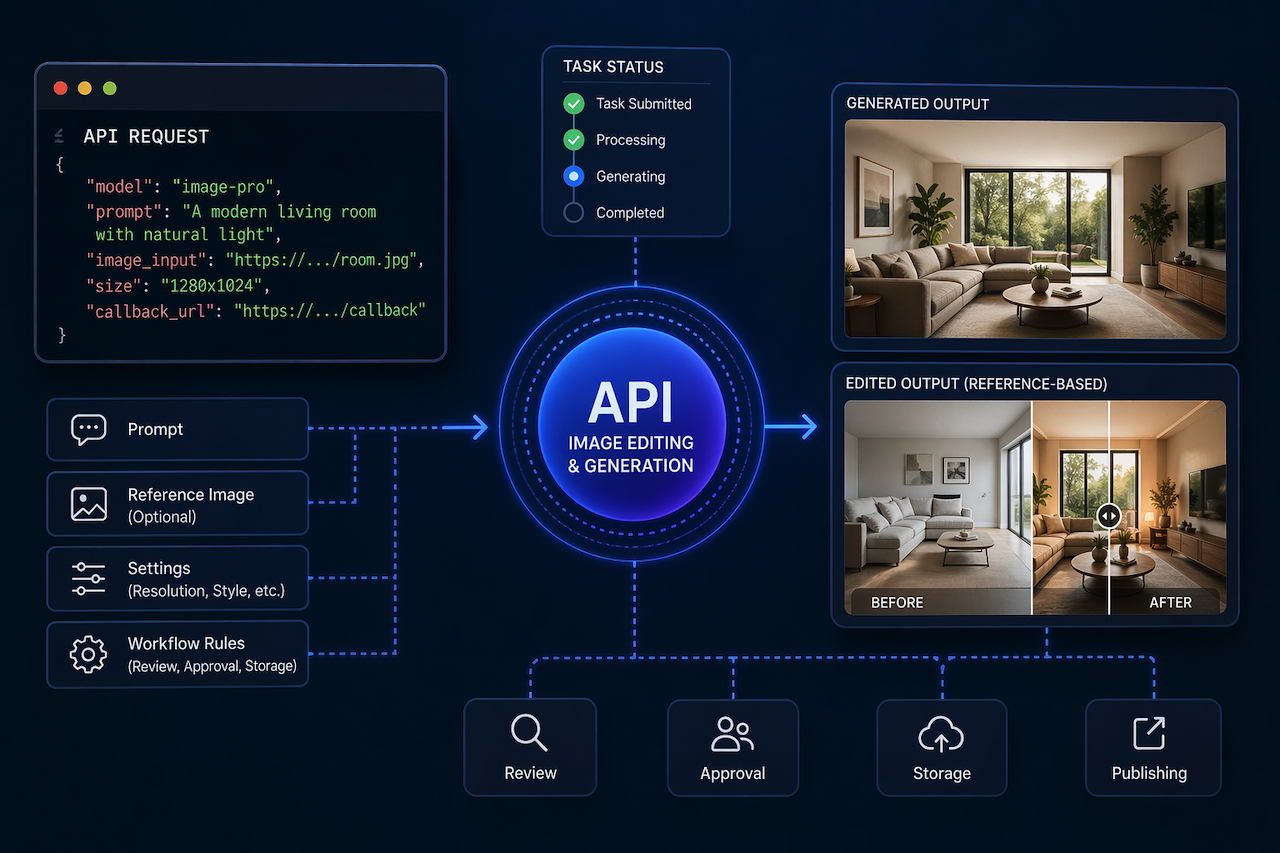
Image workflows become difficult to maintain when editing and generation remain disconnected from the rest of the production process. Many teams can test an endpoint once, get a result, and call that success. Real integration starts later, when image requests repeat, output has to move through review, and the workflow needs to stay stable under production pressure.
That is why Nano Banana Pro API matters more as a workflow component than as a one-off capability. For developers and workflow teams, value grows when image editing and generation can be structured into something repeatable, traceable, and easier to maintain.
Image Editing and Generation Workflows Need More Than a Standalone Endpoint
A single request-response example is not enough for production use. Teams usually need request handling, status tracking, output management, retry logic, and predictable integration behavior for an API to be operationally useful.
Production Teams Need Repeatable Image Workflows, Not One-Off Results
Testing proves access. Repeatability proves integration value. Most teams benefit only when image generation can be called repeatedly without turning every request into manual coordination.
This API Fits Teams That Need Integration, Not Just Output
Practical use begins when generated assets can move into downstream review, storage, approval, or publishing steps without creating more friction than they remove.
Where This API Fits in an Image Workflow
An image workflow usually starts with a prompt, optional reference assets, an output requirement, and a result path. That makes API placement fairly clear: request submission at the front, status handling in the middle, and output retrieval plus storage at the end.
The API Supports Both Editing and Generation Paths
Prompt-only requests make sense for pure generation. Prompt-plus-image inputs work better when teams need transformation- or reference-based output. This places both image generation and image editing within the same broader workflow layer.
Production Use Usually Starts With Defined Inputs, Output Rules, and Review Logic
Teams get better results when prompt design, source asset handling, resolution expectations, and output acceptance rules are defined before integration begins.
Nano Banana Pro API Integration Steps for Image Editing and Generation
Most modern image generation and editing APIs follow a task-based structure. This approach is a useful starting point because it helps shape how production integrations should be designed and maintained. For example, platforms like Kie.ai implement this model using task-based request handling and callback support.

Step 1: Get Access, Confirm API Key Handling, and Prepare Authentication
Request flow typically starts with Bearer token authentication. Teams need to send the token in the Authorization header. This makes API key handling part of the first implementation layer. Teams should verify token access, account readiness, and credit availability before moving into workflow logic.
Step 2: Review API Documentation and Define the Request Model First
Before building the integration, teams should review the API documentation and determine how the request model fits into their workflow. This includes confirming required fields, optional inputs, output settings, and whether the workflow should rely on polling or callback-based completion. A clear request structure at this stage reduces confusion later.
Step 3: Build the Request Around the Actual Editing or Generation Use Case
Integration works best when request logic reflects the real use case instead of treating every call the same way. Some workflows are prompt-led generation, while others rely on existing images and reference assets. That distinction should guide input preparation, output expectations, and how the workflow handles review and downstream usage.
Step 4: Submit the Task and Store the TaskId Immediately
A successful response typically returns a taskId (or equivalent identifier). This ID is required for downstream status checks. Teams should store it as part of the normal workflow state, since result retrieval depends on it.
This task-based structure makes image APIs easier to operationalize in production workflows compared to loosely managed synchronous request patterns.
Step 5: Query Task Status or Use Callback-Based Production Handling
Most APIs support task querying after submission. Teams can poll for status and retrieve results, which is useful during testing.
For production use, callback-based handling is usually more efficient. By providing a callback URL, the system can automatically send completion updates with task results and generated content. This approach reduces unnecessary polling and improves workflow stability at scale.
Nano Banana Pro API Pricing Matters Once Integration Moves Beyond Testing
Integration cost is rarely clear during the first few requests. Meaningful evaluation begins when request volume repeats often enough to become part of ongoing operations.
Pricing Considerations for Image APIs Should Be Evaluated Against Repeated Workflow Volume
A workflow serving recurring creative, editing, or publishing needs should be measured by request frequency, output resolution, retry rate, and review loss, not just by a single successful test.
Unit Cost Becomes More Meaningful When Image Requests Start Repeating at Scale
This is where pricing starts to matter operationally. Cost considerations change once teams move from trial requests to repeated cycles of generation and editing.
Integration Mistakes Usually Start Before the First Successful Request
Many failed implementations do not break because the endpoint is hard to call. They break because teams assume production requirements too early or skip basic control logic.
Unclear Use Cases Create Weak Integration Decisions
Image editing and image generation should not be treated as the same workflow unless the team has already decided they belong in the same request logic.
Mixing Editing and Generation Logic Without Clear Boundaries Adds Friction
Prompt-only flows and prompt-plus-image flows usually need different expectations around quality, review, and output acceptance. Teams should separate those assumptions early.
What to Watch Out for When Integrating Nano Banana Pro API
While task-based API structures are generally straightforward, production teams still need to pay attention to details that often lead to failures or long-term maintenance issues.
Watch Input Quality, File URL Handling, and Request Validation
Many image APIs accept image_input as URLs rather than uploaded binary payloads. This means teams need reliable file hosting before sending requests. It is also important to validate file count, file type, and file size prior to calling the endpoint. Validation failures can trigger 422 responses, which should be treated as input discipline issues rather than generation issues.
Watch Callback Design and Avoid Treating Polling as the Long-Term Default
Polling may work during development, but callback-based completion handling is generally better suited for production environments. By using a callback URL, the system can automatically send completion updates with results and generated asset links. Callback endpoints should accept JSON POST payloads and be secured using appropriate webhook verification methods.
Watch Response Codes and Build Error Handling Before Launch
Most APIs return structured response codes, such as:
- 200 success
- 401 unauthorized
- 402 insufficient credits
- 404 not found
- 422 validation error
- 429 rate limited
- 500 server error
- 501 generation failed
These codes should inform retry logic, alerting, and fallback behavior. Teams should define which errors are retriable and which should halt execution before production traffic begins.
Watch Workflow Drift Between Testing and Production Use
A request that works once is not the same as a workflow that performs reliably under repeated use. Production teams should monitor for prompt inconsistencies, broken asset URLs, callback delivery failures, storage mismatches, and result-tracking gaps tied to task identifiers.
Using Image APIs in Production Workflows
A production workflow becomes useful when teams can rely on it under repeated use. This is where image APIs become more relevant as part of a structured system rather than a one-off tool. Task-based architectures, defined model handling, prompt structure, optional image inputs, and callback support provide a clearer path from testing to production. For example, implementations such as Kie.ai follow this type of structure, which can help illustrate how task tracking and callback handling work in practice. For teams looking to build a practical Nano Banana Pro API workflow, consistency in request handling, storing task state, using callback-based completion, and clearly managing validation, credits, and failure responses are often more important than a single working code sample.
Featured Image generated by ChatGPT.
Share this post
Author

Read the latest articles from Thomas Lore
Turning Raw IP Logs into Insights

April 16, 2026
Every second, servers across the internet generate millions of log entries—cryptic lines of text documenting every connection, request, and error. For network administrators, security analysts, and digital forensics investigators, these IP logs contain invaluable intelligence about traffic patterns, security th [...]
Learn moreHow Developers Can Use The GPT 5.4 API To Build Smarter Web Tools And Automation Workflows

April 1, 2026
Web tools are no longer limited to static lookups, rule-based automation, or narrow search functions. Developers today are building products that must interpret user intent, summarize content, generate structured responses, and automate repetitive tasks, all with far greater flexibility. That shift is one reason [...]
Learn moreLeave a comment
All comments are moderated. Spammy and bot submitted comments are deleted. Please submit the comments that are helpful to others, and we'll approve your comments. A comment that includes outbound link will only be approved if the content is relevant to the topic, and has some value to our readers.
Comments (0)
No comment