

The evolution of visual content generation is shifting from manual, high-latency creative tools toward a programmable media infrastructure. For development teams and enterprise architects, the Kling 3.0 API provides a robust framework to treat video production as a standardized, code-driven service. By integrating high-fidelity synthesis directly into the enterprise stack, organizations can move beyond the "creative bottleneck" and toward an industrialized content pipeline that prioritizes precision and scalability.
Scaling Video Infrastructure with the Kling 3.0 API
Building a scalable media pipeline requires more than just high-quality output; it requires infrastructure that can handle asynchronous requests and high throughput without compromising visual authority.
Transitioning from Manual Editing to Code-Driven Media Assets
For growth-oriented enterprises, the move to a code-driven media environment is a strategic necessity. Traditional video production often involves high latency and significant human intervention, which impedes the speed of global campaign deployments. By using an API-first approach, developers can map structured data, such as product descriptions or campaign logic, to video-generation requests. This transition allows organizations to scale production throughput to support high-volume digital platforms while maintaining strict control over asset versioning and deployment.
Understanding the Unified Multimodal Framework for Spatial Coherence
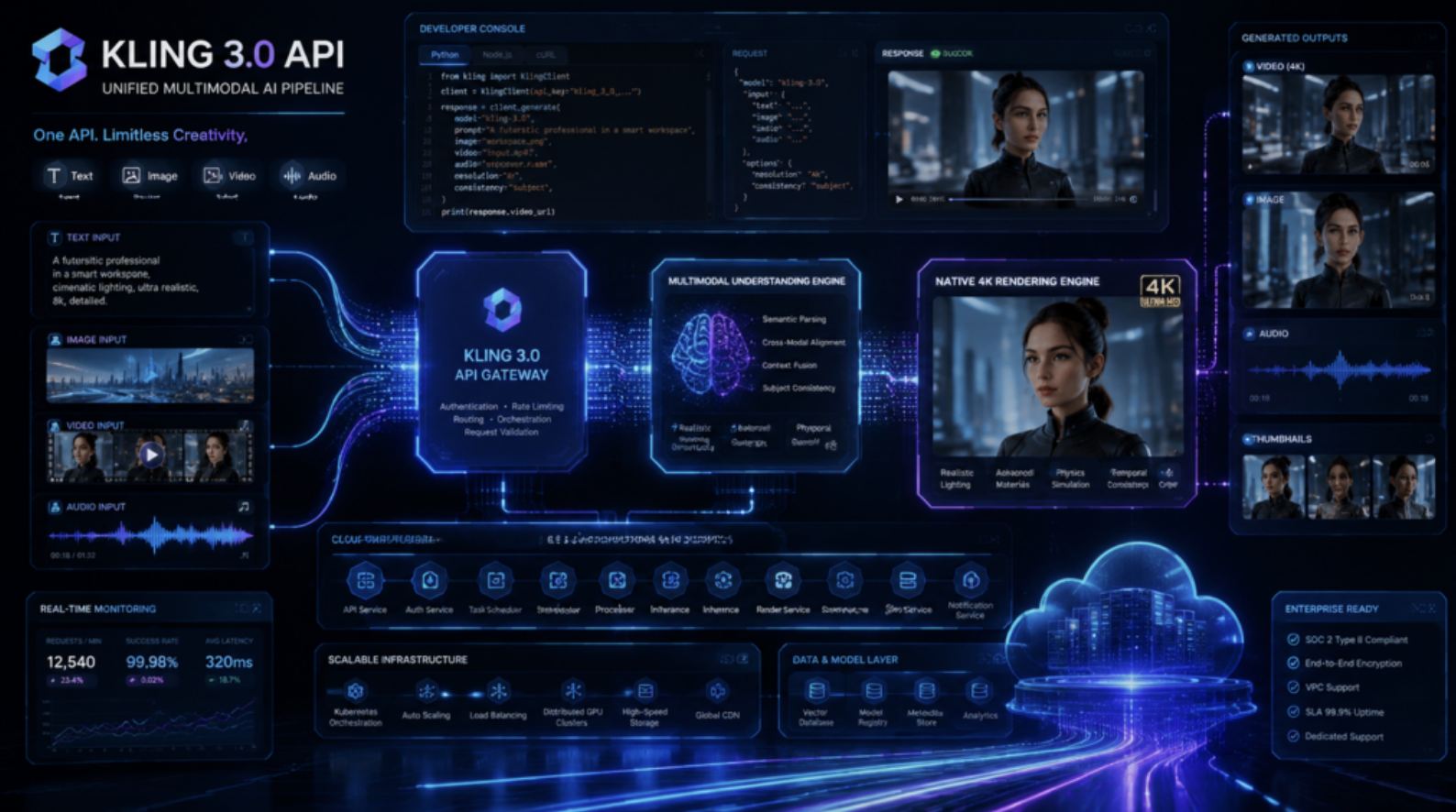
The core of the 3.0 architecture is its unified multimodal framework. Unlike previous iterations that might process movement and lighting in disjointed passes, this architecture handles motion, lighting, and physics simultaneously. For technical teams, this means the generated video maintains greater spatial and temporal stability, which is critical to ensuring cinematic realism in complex environments. By integrating these elements within a single processing pass, the API significantly reduces visual hallucinations and artifacts that can otherwise plague AI-generated media.
Technical Fidelity and Performance in the Kling 3 API
When managing media assets at an enterprise level, the technical metrics of the output, such as resolution and branding accuracy, directly impact brand authority and user engagement.
Native 4K Rendering vs. Post-Generation Upscaling
A significant technical feature of the Kling 3 API is its native 4K resolution support. Rather than relying on post-generation upscaling, which often introduces blurring or distorts fine-grained textures, the API synthesizes high-density pixels from the initial processing stage. This native output ensures that assets maintain structural integrity on high-definition displays, fulfilling a core requirement for professional digital environments where visual quality is non-negotiable.
Precision Text Rendering and Branding Integrity
For commercial applications, the ability to render legible text within a scene is a technical necessity. The 3.0 architecture has improved the precision of text synthesis, ensuring that brand logos, digital signage, and UI elements remain sharp and stable across dynamic frames. This stabilized rendering prevents "textual drift" during complex camera movements, allowing development teams to automate the production of marketing materials without manual post-production overlays.
Managing Data State and Persistence with the Kling V3.0 API
One of the most persistent hurdles in large-scale content generation is maintaining visual identity across multiple generation cycles—a challenge often referred to as "identity drift".
Implementing Subject Reference Logic to Eliminate Identity Drift
The Kling V3.0 API addresses identity drift through sophisticated subject reference logic. This capability allows developers to programmatically define and "lock" the physical attributes of a subject or character across diverse generation cycles. For serial content or long-term narrative pipelines, this technological consistency is essential, as it ensures the primary subject remains visually identical across thousands of automated video requests.
Refined Motion Control for Predictable Cinematic Dynamics
Achieving professional cinematography through code requires a refined spatial understanding that goes beyond the ambiguity of natural language prompts. The 3.0 version offers enhanced instruction interpretation, enabling developers to dictate exact camera dynamics, such as tracking shots, tilts, and pans. This precision enables a uniform cinematic aesthetic to be standardized across the entire production pipeline, ensuring that every asset aligns with the project's specific directorial intent.
Step-by-Step Integration: Deploying the Kling 3.0 API into Enterprise Stacks
Successfully deploying high-fidelity video synthesis in an enterprise environment requires a structured approach to authentication, task management, and parameter optimization aligned with the technical requirements of the Kling 3.0 API.
Credentialing and Authorization Workflow
The integration process begins with establishing secure communication between the enterprise client and the API infrastructure. Developers must initialize the connection by including an authorization token in the request header. This token serves as the primary credential for validating the developer's identity and ensuring that requests are processed under the correct account's billing and rate-limit structures. In an enterprise environment, this step typically involves configuring environment variables within the server-side stack to manage these credentials securely, ensuring they are never exposed in client-side code.
Asynchronous Task Management and Task Lifecycle
Because generating high-resolution video is a compute-intensive task, the API operates on an asynchronous model.
- Submission Phase: The developer sends a structured request to the generation endpoint. This request defines the core parameters of the video, such as the duration, aspect ratio, and resolution.
- Acknowledgment: Upon successful submission, the system returns a unique task identifier. This identifier is the primary reference for tracking progress in video synthesis.
- Lifecycle Monitoring: The enterprise application must then enter a monitoring phase, where it periodically checks the status of the task ID. The task moves through various states, including "queued," "processing," and finally "succeeded" or "failed." This state management is crucial for maintaining a responsive user interface and ensuring that computing resources are used efficiently.
Payload Configuration and Result Retrieval
Refining the output requires precise configuration of the request payload. Developers must specify the target model version to leverage the latest 3.0 features, such as improved subject reference and 4K output.
- Defining Constraints: The payload should include specific instructions regarding the visual style, motion intensity, and framing.
- Identity Locking: To use subject-consistency features, developers include a reference image or a character ID in the payload. This directs the engine to maintain the visual integrity of a specific subject throughout the motion sequence.
- Final Retrieval: Once the task status is complete, the API provides a secure, temporary URL for the finished video asset. The enterprise system then ingests this asset into its content management system or storage buckets for final distribution.
Strategizing with the Kling AI API for Global Content Delivery
Integrating a programmable infrastructure via the Kling AI API provides the leverage needed to bypass traditional production bottlenecks. By standardizing high-fidelity output and automating complex storytelling through code, technical teams can ensure that visual precision remains a core component of their enterprise media strategy. This industrialized approach allows founders and managers to refocus their human creative efforts on high-level strategy and market positioning. At the same time, the automated engine manages the resource-heavy tasks of visual synthesis.
Featured Image generated by ChatGPT.
Share this post
Author

Read the latest articles from Olivia
ERP Integration Best Practices: Connecting CRM, Accounting, and Logistics Platforms

May 15, 2026
Modern businesses rely on a growing network of digital platforms to manage sales, finance, operations, logistics, and customer relationships. However, when these systems operate independently, companies often face data silos, duplicated processes, reporting inconsistencies, and delays in decision-making. Disconne [...]
Learn moreBest AI Image Editing Tools for Professionals in 2026

May 12, 2026
Creative professionals face a lot of pressure to deliver high-quality work in less time. You need to produce visuals that stand out while keeping your workflow efficient. In 2026, the best tools are those that handle the repetitive parts of design so you can focus on the big ideas. These tools use artificial inte [...]
Learn moreLeave a comment
All comments are moderated. Spammy and bot submitted comments are deleted. Please submit the comments that are helpful to others, and we'll approve your comments. A comment that includes outbound link will only be approved if the content is relevant to the topic, and has some value to our readers.
Comments (0)
No comment