
Modern businesses rely on a growing network of digital platforms to manage sales, finance, operations, logistics, and customer relationships. However, when these systems operate independently, companies often face data silos, duplicated processes, reporting inconsistencies, and delays in decision-making. Disconnected platforms limit visibility across departments, making it difficult to maintain operational efficiency and respond quickly to changing business demands. As organizations scale, the need for seamless connectivity between systems becomes increasingly critical.
Integrating ERP software with CRM, accounting, logistics, inventory, and third-party business tools creates a centralized ecosystem where information flows automatically across departments. This improves data accuracy, reduces manual work, enhances automation, and gives decision-makers real-time visibility into business performance. According to recent market research, the global ERP software market is projected to exceed $30 billion by 2027, driven largely by demand for cloud-based integrations, automation, and real-time analytics. In addition, reports show that over 70% of enterprises now operate with multiple interconnected business systems requiring seamless interoperability.
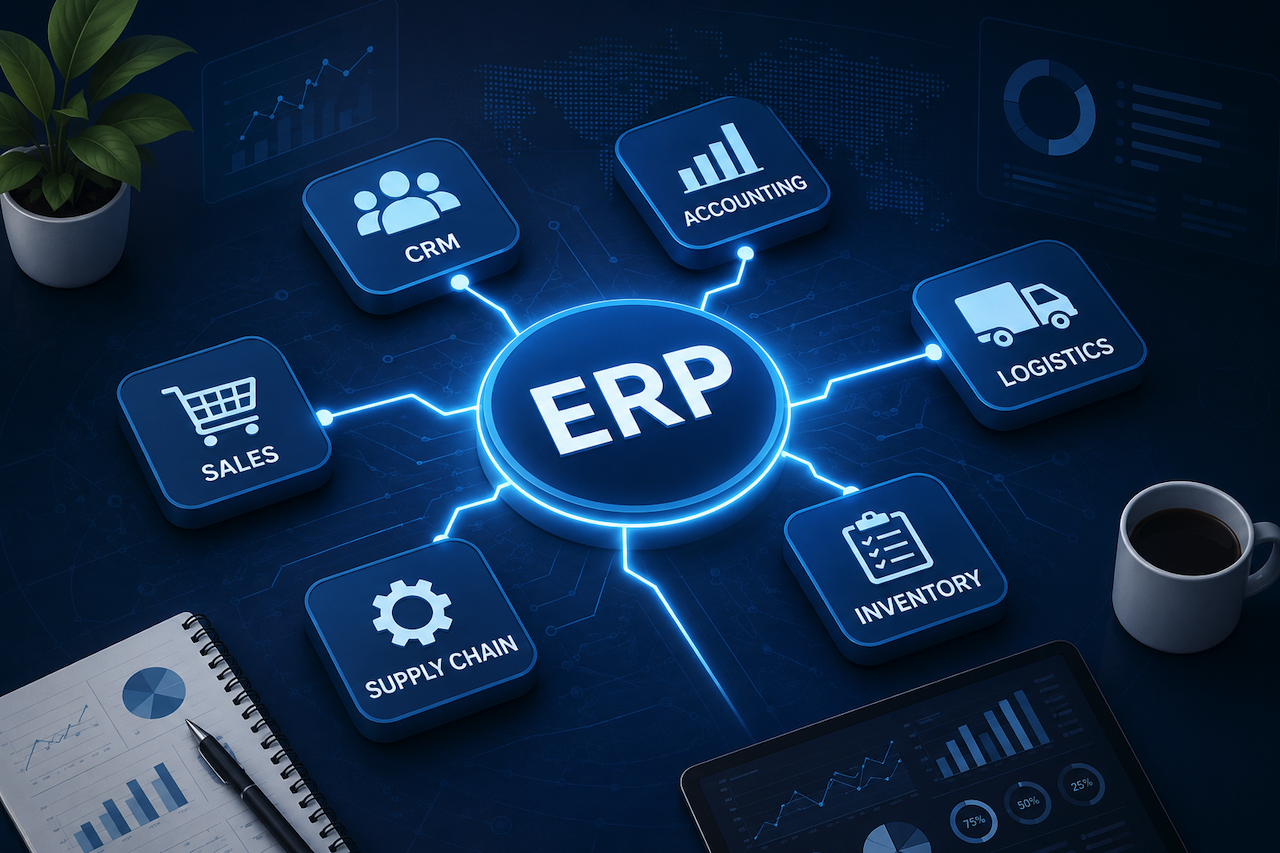
Today, ERP integration commonly connects platforms such as CRM systems for customer management, accounting software for financial operations, logistics and supply chain tools for fulfillment, inventory management platforms for stock visibility, and various third-party applications through APIs and middleware. By creating a connected infrastructure, businesses can streamline workflows, improve collaboration between teams, and build a scalable foundation that supports long-term growth and digital transformation.
Why ERP Integration Is a Business Priority
In many organizations, disconnected systems across finance, sales, operations, and logistics create fragmented workflows that slow down daily processes. When data is stored in separate platforms that do not communicate effectively, teams are forced to rely on manual updates, spreadsheets, and duplicate entries. This leads to operational delays, inconsistent information, and data silos that reduce overall efficiency and make interdepartmental coordination more difficult.
These inefficiencies directly affect decision-making, reporting accuracy, and customer experience. Without a unified view of business data, leadership teams struggle to access real-time insights, leading to delayed or poorly informed decisions. Reporting often requires manual consolidation from multiple sources, increasing the risk of errors. At the same time, customers may experience slower service, inaccurate order updates, or inconsistent communication due to gaps among systems that handle CRM, inventory, and fulfillment.
The integration of systems through ERP platforms addresses these challenges by creating a connected and transparent business environment. Key benefits include improved operational visibility across all departments, automation of repetitive and time-consuming tasks, and better cost optimization through reduced manual work and fewer process inefficiencies. By aligning data and workflows within a unified system, businesses can respond faster to changes, improve service quality, and support scalable, long-term growth.
Core Systems That Must Work Together
A successful ERP integration strategy depends on ensuring that key business systems are not operating in isolation, but are fully connected through a unified data flow. When these systems work together, organizations gain a complete operational picture, reduce inefficiencies, and improve coordination across departments.
CRM Integration: Aligning Customer Data With Sales and Service Processes
Customer Relationship Management (CRM) systems play a central role in managing leads, customer interactions, and service history. When integrated with ERP platforms, CRM data becomes directly linked to financial and operational processes. This allows sales teams to see real-time order status, marketing teams to personalize campaigns based on purchase history, and support teams to access complete customer profiles. The result is a more consistent and personalized customer experience across all touchpoints.
Accounting Integration: Ensuring Financial Consistency and Real-Time Reporting
Accounting systems integrated with ERP ensure that financial data is accurate, up to date, and consistent across the organization. Transactions from sales, procurement, and operations are automatically reflected in financial reports, eliminating manual data entry and reducing the risk of errors. This enables real-time visibility into cash flow, revenue, and expenses, supporting faster, more informed financial decision-making.
Logistics Integration: Improving Supply Chain Tracking and Fulfillment Accuracy
Logistics and supply chain systems benefit significantly from ERP integration by providing end-to-end visibility of inventory movement, order fulfillment, and delivery status. This improves coordination between warehouses, suppliers, and distribution channels. Businesses can better predict demand, reduce stockouts or overstocking, and ensure timely delivery of goods, which directly impacts customer satisfaction and operational efficiency.
Role of Unified Data Flow Across Departments
At the core of ERP integration is unified data flow, which ensures that all departments operate using the same real-time information. Instead of fragmented updates across multiple systems, data is synchronized across CRM, finance, logistics, and other tools. This eliminates silos, improves collaboration, and allows leadership teams to make decisions based on a single, accurate source of truth. Ultimately, unified data flow transforms ERP from a set of tools into a connected business ecosystem that supports scalability and long-term growth.
Best Practices for Seamless ERP Integration
Successful ERP integration is not only about connecting systems but also about designing a flexible, scalable, and future-ready architecture that supports continuous business growth. When implemented correctly, it ensures smooth data flow across departments, reduces operational friction, and enables real-time decision-making.
Using API-First Architecture for Flexible Connectivity
An API-first approach ensures that all systems—ERP, CRM, accounting, logistics, and third-party tools—can communicate through standardized interfaces. This makes integrations more modular, easier to maintain, and simpler to extend as new tools are added. APIs also reduce dependency on rigid, point-to-point connections, allowing businesses to adapt quickly to changing technology needs.
Ensuring Real-Time or Near-Real-Time Data Synchronization
Timely data exchange is critical for operational accuracy. Real-time or near-real-time synchronization ensures that updates in one system are immediately reflected across others. For example, a sales order created in a CRM should instantly update inventory and financial records in the ERP. This reduces delays, prevents data inconsistencies, and improves coordination across departments.
Establishing a Single Source of Truth for Master Data
A centralized master data management approach ensures that key business information—such as customer records, product catalogs, and supplier details—is consistent across all systems. This eliminates duplication, reduces errors, and improves reporting accuracy. A single source of truth also strengthens analytics and ensures that all departments operate using the same reliable dataset.
Prioritizing Scalability and Future System Expansion
ERP integration should be designed with long-term growth in mind. Scalable architecture allows businesses to add new modules, integrate additional platforms, or expand into new markets without rebuilding core systems. Cloud-based infrastructure, modular design, and microservices architecture all contribute to easier scaling and future-proofing.
Expert Implementation
Achieving seamless ERP integration often requires deep technical expertise, especially in complex industries such as travel, logistics, and transportation. Some software development companies, such as COAX Software, provide custom ERP integration services that help businesses connect fragmented systems into unified ecosystems. These types of solutions often focus on scalable architectures, real-time data flows, and API-driven integrations designed to improve operational visibility, automate processes, and support long-term digital transformation.
Common Challenges and How to Overcome Them
While ERP integration delivers significant benefits, organizations often face several technical and operational challenges during implementation. These issues are especially common in businesses that rely on legacy systems, multiple vendors, and fragmented data environments. Understanding these challenges early helps reduce risk and ensures smoother long-term adoption.
Data Inconsistency and Legacy System Limitations
One of the most frequent problems is inconsistent data stored across outdated or non-standardized legacy systems. Older platforms may use different formats, incomplete records, or incompatible structures, making it difficult to unify information within an ERP system. This often leads to duplication, reporting errors, and unreliable analytics. Overcoming this requires structured data cleansing, a gradual system migration, and middleware to translate and standardize data between systems during the transition.
Integration Complexity Across Multiple Vendors and Platforms
Modern businesses often operate a mix of SaaS tools, on-premise solutions, and third-party applications, each with its own architecture and limitations. Integrating these systems into a single ERP ecosystem can be complex, time-consuming, and costly. To address this, organizations should prioritize API-based integrations, adopt modular architecture, and avoid overly customized point-to-point connections that are difficult to maintain over time.
Security and Compliance Considerations in Data Exchange
As data flows between multiple systems, ensuring security and regulatory compliance becomes critical. Sensitive financial, customer, and operational data must be protected against unauthorized access and breaches. Compliance with standards such as GDPR or industry-specific regulations requires encryption, role-based access control, audit trails, and continuous monitoring of data exchanges across systems.
Practical Strategies to Reduce Risks and Improve Long-Term Stability
To ensure successful ERP integration, businesses should adopt a phased implementation approach, starting with core systems before expanding to secondary platforms. Investing in scalable cloud infrastructure, maintaining strong data governance policies, and continuously monitoring system performance also helps reduce operational risks. Regular testing and documentation ensure that integrations remain stable as the business evolves.
Building a Connected Enterprise That Works as One
ERP integration has become a foundational requirement for modern digital operations, where speed, accuracy, and coordination directly influence business performance. As organizations grow, disconnected systems create friction that slows down processes and limits visibility across departments. Integrating core platforms into a unified ERP ecosystem eliminates these barriers, enabling seamless data flow between finance, sales, operations, logistics, and external tools.
The long-term value of unified systems goes beyond operational efficiency. A well-integrated ERP environment improves decision-making, strengthens reporting accuracy, and supports automation across key business functions. It also creates a scalable foundation that can evolve with the organization, making it easier to adopt new technologies, expand into new markets, and respond to changing demands. Ultimately, ERP integration helps businesses operate as a single connected enterprise, where every process works together to support sustainable growth and competitive advantage.
Featured Image generated by ChatGPT.
Share this post
Author

Read the latest articles from Olivia
Kling 3.0 API: Architecting Unified Multimodal Pipelines for Enterprise-Grade Video Synthesis

May 15, 2026
The evolution of visual content generation is shifting from manual, high-latency creative tools toward a programmable media infrastructure. For development teams and enterprise architects, the Kling 3.0 API provides a robust framework to treat video production as a standardized, code-driven service. By integratin [...]
Learn moreBest AI Image Editing Tools for Professionals in 2026

May 12, 2026
Creative professionals face a lot of pressure to deliver high-quality work in less time. You need to produce visuals that stand out while keeping your workflow efficient. In 2026, the best tools are those that handle the repetitive parts of design so you can focus on the big ideas. These tools use artificial inte [...]
Learn moreLeave a comment
All comments are moderated. Spammy and bot submitted comments are deleted. Please submit the comments that are helpful to others, and we'll approve your comments. A comment that includes outbound link will only be approved if the content is relevant to the topic, and has some value to our readers.
Comments (0)
No comment