
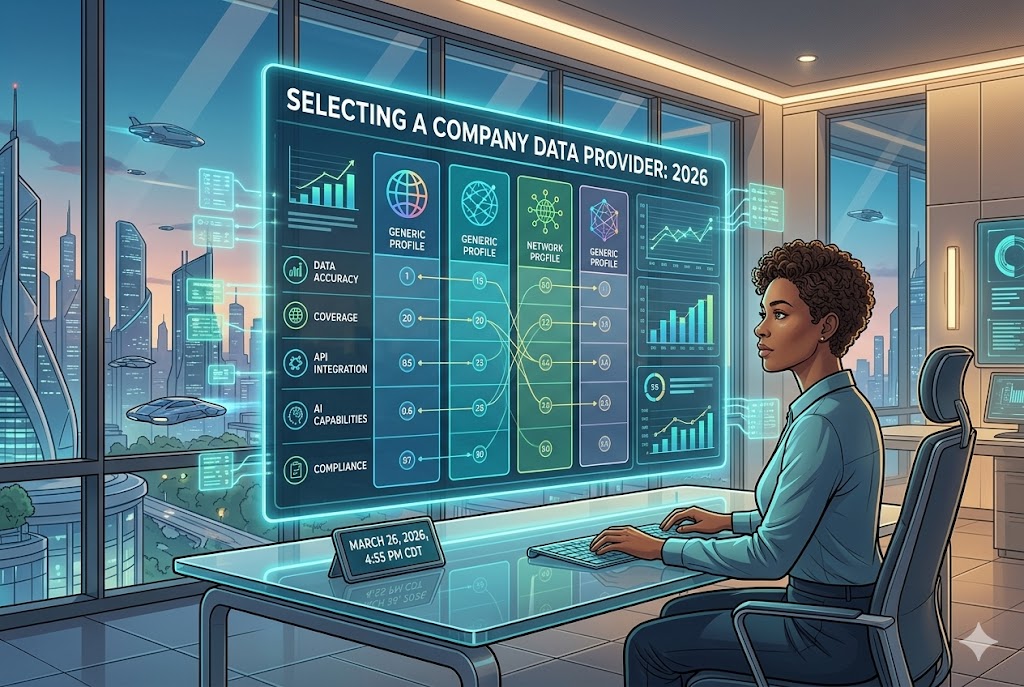
In 2026, choosing the right company data provider is not only a technical decision but also a strategic one. Every month, hundreds of thousands of new businesses are registered, while millions of existing companies evolve through hiring, funding, product launches, and leadership changes. Without structured, fresh, and reliable data, businesses risk making decisions based on incomplete or outdated information.
Today’s organizations rely on company data to power sales prospecting, CRM enrichment, investment analysis, AI model training, workforce intelligence, and competitive research. However, not all company data providers deliver the same level of data accuracy, update frequency, or integration flexibility.
The challenge is not identifying a company data vendor but choosing a B2B data solutions provider company that delivers accurate, multi-source, ethically collected data that aligns with your use case and can scale as your needs grow. This guide explains what a company data API is, what types of data matter most, how to evaluate a reliable vendor, and which providers stand out in 2026.
What Is a Company Data API and Why It Matters
Modern organizations require more than access to company names and basic firmographics. Teams need structured, continuously updated, and integration-ready data that can power internal systems, analytics platforms, CRMs, and AI-driven tools.
What Is a Company Data API?
A company data API (Application Programming Interface) is a technical solution that allows businesses to search, retrieve, and enrich company information directly from a large-scale database through automated requests.
Instead of downloading static spreadsheets, users can:
- Search for companies using filters such as industry, location, headcount, or funding status
- Retrieve structured records in formats like JSON or CSV
- Enrich existing company records using identifiers such as company domain, profile URL, or unique ID
- Access continuously updated data without manual re-imports
A company data API typically provides access to multiple data categories, including firmographic details, workforce insights, job postings, funding information, technographic signals, and company updates. More advanced APIs also offer multi-source datasets that are cleaned, deduplicated, standardized, and in some cases enriched with additional analytical attributes before delivery.
For organizations that need automation, scalability, and integration with existing systems, APIs support modern B2B data infrastructure.
Why APIs Are Replacing Static Company Lists
Static company lists have long been a common way to source business data and remain useful for many use cases, especially when working with structured snapshots. However, they require regular refreshing to stay accurate, often involve manual updates, and may include inconsistencies such as duplicates or formatting differences. Keeping data up to date typically means obtaining new or refreshed datasets over time.
At the same time, a company data API provides direct access to frequently updated information. Many providers now offer real-time or scheduled updates (daily, weekly, or monthly), which can be especially useful for tracking fast-changing signals such as headcount growth, hiring activity, leadership changes, or funding events.
APIs also support:
- CRM enrichment: automatically updating company records inside your CRM
- Sales prospecting: filtering companies based on specific attributes
- Investment research: monitoring growth indicators and company changes
- AI and analytics projects: supplying structured data for modeling and forecasting
Rather than replacing one another, APIs and datasets serve different needs. Datasets are often well-suited for analysis, modeling, or working with structured snapshots of data, while APIs enable continuous access, automation, and real-time enrichment.
In 2026, many organizations combine both approaches - using datasets for large-scale analysis and APIs for ongoing updates and integration - to maintain accurate and actionable company data.
Types of Data Offered by Company Data Providers
The value of a dataset depends on how well it aligns with your business goals, whether that’s sales targeting, investment research, competitive analysis, or AI model development.
Core data categories offered by company data vendors include:
- Firmographic Data. Core company attributes such as name, industry, location, founding year, company size, revenue range, legal status, and business model. This data is essential for segmentation, market mapping, and lead qualification.
- Employee and Workforce Data. Information about employees, leadership teams, seniority levels, job titles, locations, and historical headcount growth. Workforce insights help track company expansion, leadership changes, and organizational structure.
- Job Posting Data. Active and historical job ads, including roles, descriptions, required skills, and locations. Hiring trends can signal company growth, strategic shifts, or technology adoption.
- Technographic and Intent Data. Details about the technologies a company uses, such as CRM systems, cloud platforms, or software tools. Intent signals and tech stack insights are valuable for sales targeting and competitive intelligence.
- Funding and Financial Data. Information about investment rounds, funding amounts, investors, ownership structure, and financial indicators. This data is particularly useful for venture scouting, risk assessment, and long-term growth analysis.
The most advanced company data providers aggregate these categories from multiple sources, clean and standardize them, and deliver them through scalable solutions such as a company data API.
What Separates a Reliable Company Data Vendor from the Rest
When evaluating company and lead data providers, record volume alone is not enough. A reliable company data vendor stands out based on quality, transparency, and long-term usability. Key factors to assess include:
- Data Freshness and Update Frequency: The provider should update records in real time or on clearly defined cycles (daily, weekly, monthly) and indicate when a record was last refreshed. Frequent updates are essential for tracking hiring trends, leadership changes, funding rounds, and company growth signals.
- Multi-Source vs Single-Source Data: Multi-source datasets aggregate information from several public sources, remove duplicates, and standardize formats. This approach delivers more complete and consistent company profiles compared to single-source data, which may be limited or biased.
- Ethical and Compliant Data Collection: A trustworthy company data vendor should clearly explain how data is collected, rely on publicly available sources, and comply with regulations such as GDPR and CCPA. Responsible data practices reduce legal risk and ensure long-term reliability.
- Delivery Flexibility: Leading providers offer flexible access through a company data API, flat file downloads (CSV, JSON, JSONL), custom datasets, and self-service tools for search and enrichment. This ensures smooth integration with CRM systems, analytics platforms, or internal tools.
- Testing Before Committing: Free trials, sample datasets, sandbox environments, and transparent documentation allow you to validate data quality, structure, and fit before entering a long-term agreement.
These criteria help distinguish a scalable, professional company data vendor from providers that offer only basic or static datasets.
Top Company Data Providers in 2026
1. Coresignal
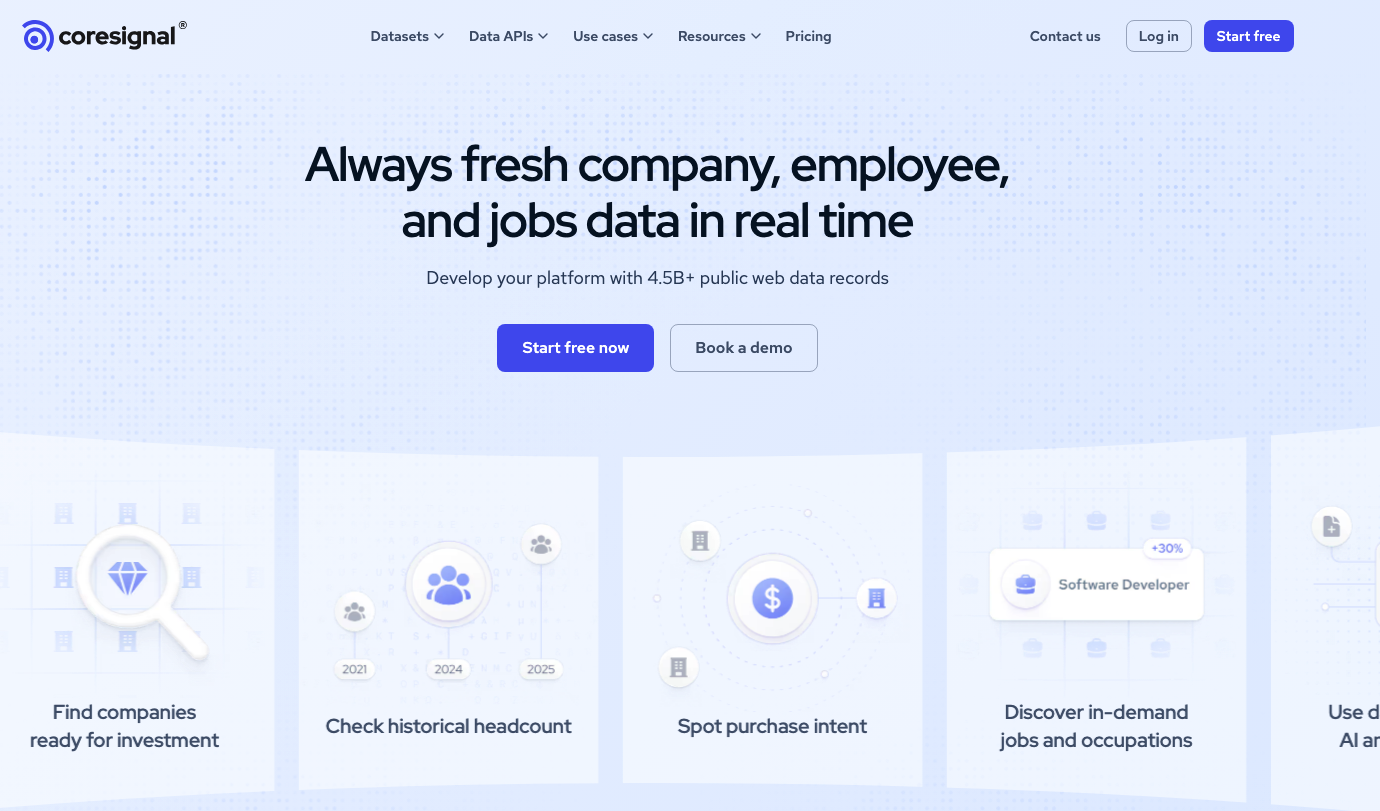
Coresignal is a multi-source public web data provider offering structured company, employee, and job posting datasets. Founded in 2016, it delivers aggregated, deduplicated, and standardized data with over 500 company-level data fields. The platform provides Base, Clean, and Multi-Source processing levels and supports delivery via API, flat files, and self-service tools.
A core strength of Coresignal is frequent data updates. Records are continuously refreshed, ensuring that company profiles, workforce insights, and job posting data reflect the most recent publicly available information. Instead of relying on static snapshots, users gain access to frequently updated datasets that capture hiring changes, leadership movements, funding activity, and headcount shifts as they happen.
Frequent dataset updates combined with real-time access make the platform particularly valuable for CRM automation, AI agents, workforce analytics, and investment monitoring, where up-to-date information is critical. Coresignal is often chosen by teams that prioritize fresh, frequently updated B2B data and need scalable infrastructure capable of supporting both large-scale analysis and real-time applications.
2. Bright Data
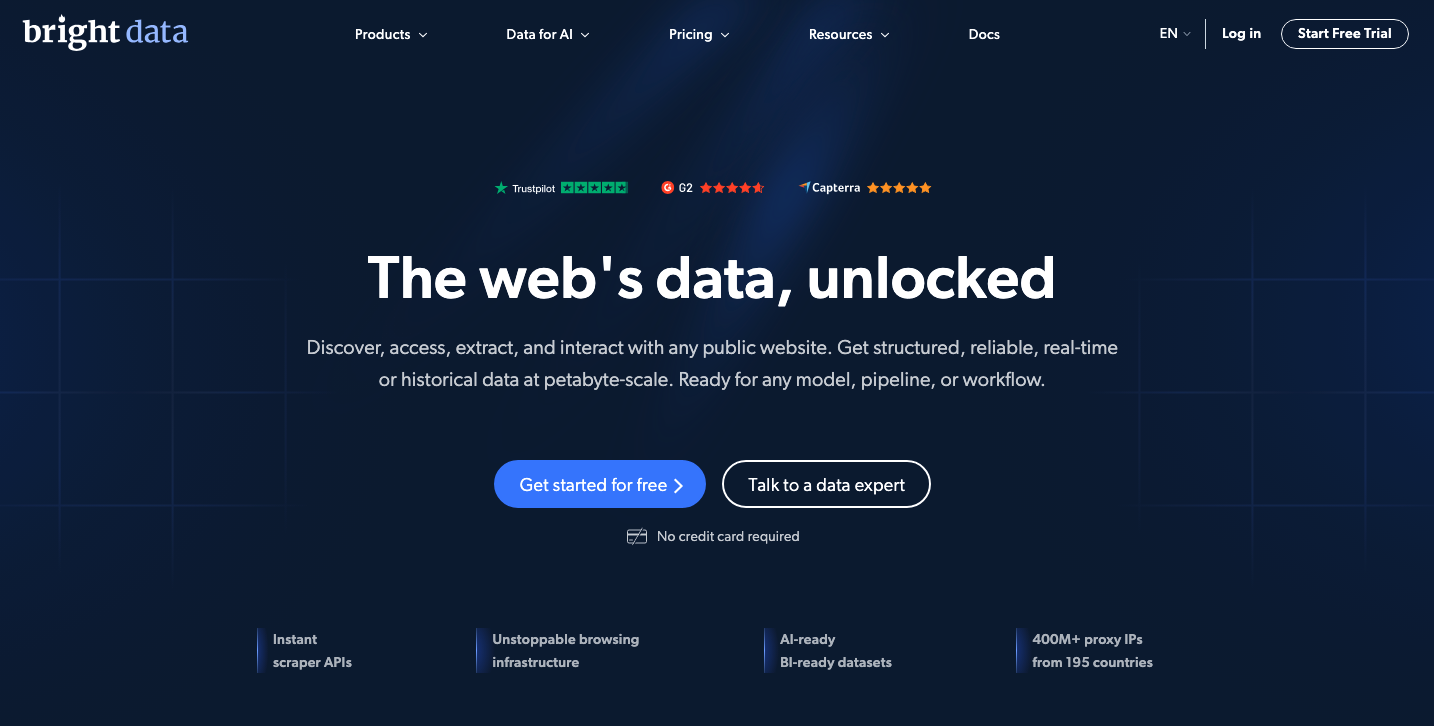
Bright Data is primarily a web data infrastructure provider specializing in proxy networks, scraping APIs, and data collection tools. In addition to its scraping capabilities, it offers access to B2B datasets sourced from public web data.
It is particularly suitable for organizations that want full control over data extraction or need raw data at scale. While it provides company and employee records, its core strength lies in supporting custom data collection pipelines.
3. People Data Labs
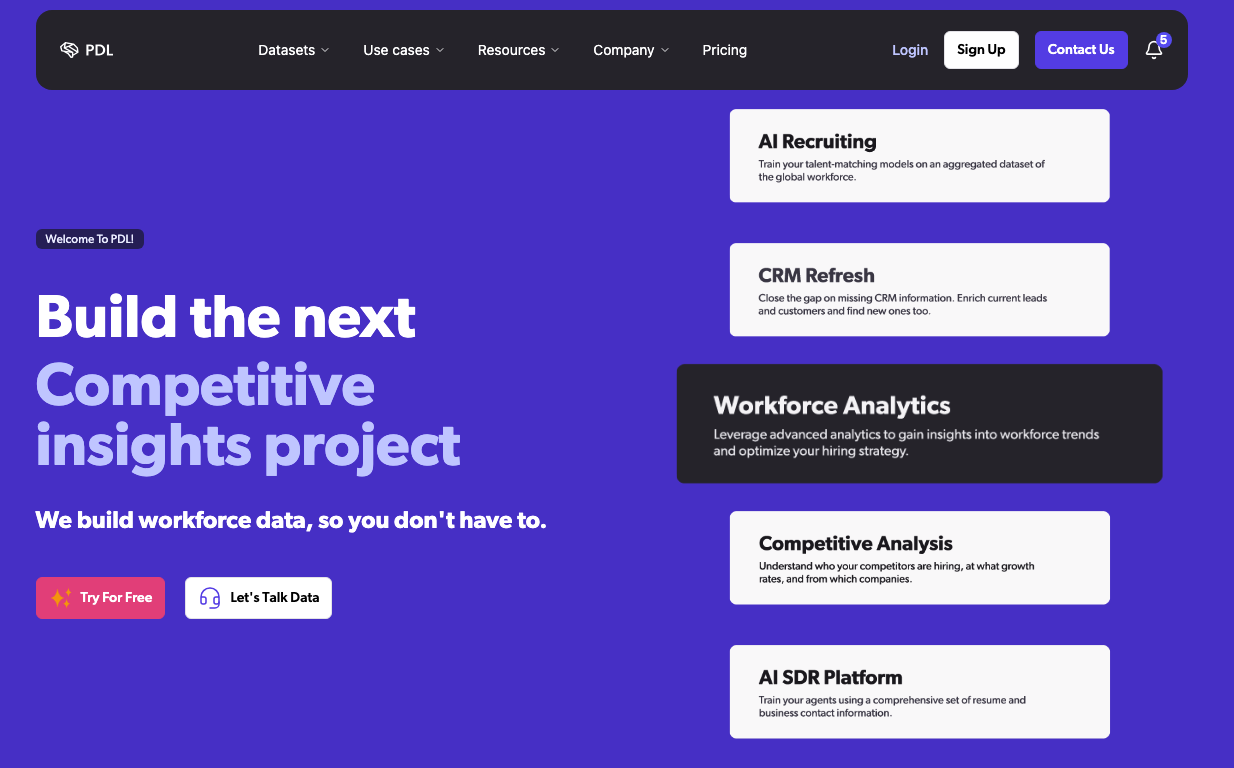
People Data Labs focuses heavily on employee data and professional profiles, offering extensive people datasets alongside company information. Its APIs and bulk data licensing options are used for enrichment, analytics, and predictive modeling.
The provider includes work history, skills, and contact details within its professional records. Job posting data is currently available in beta. People Data Labs is often used by HR tech, talent intelligence, and sales enrichment use cases centered around employee-level data.
4. Mixrank
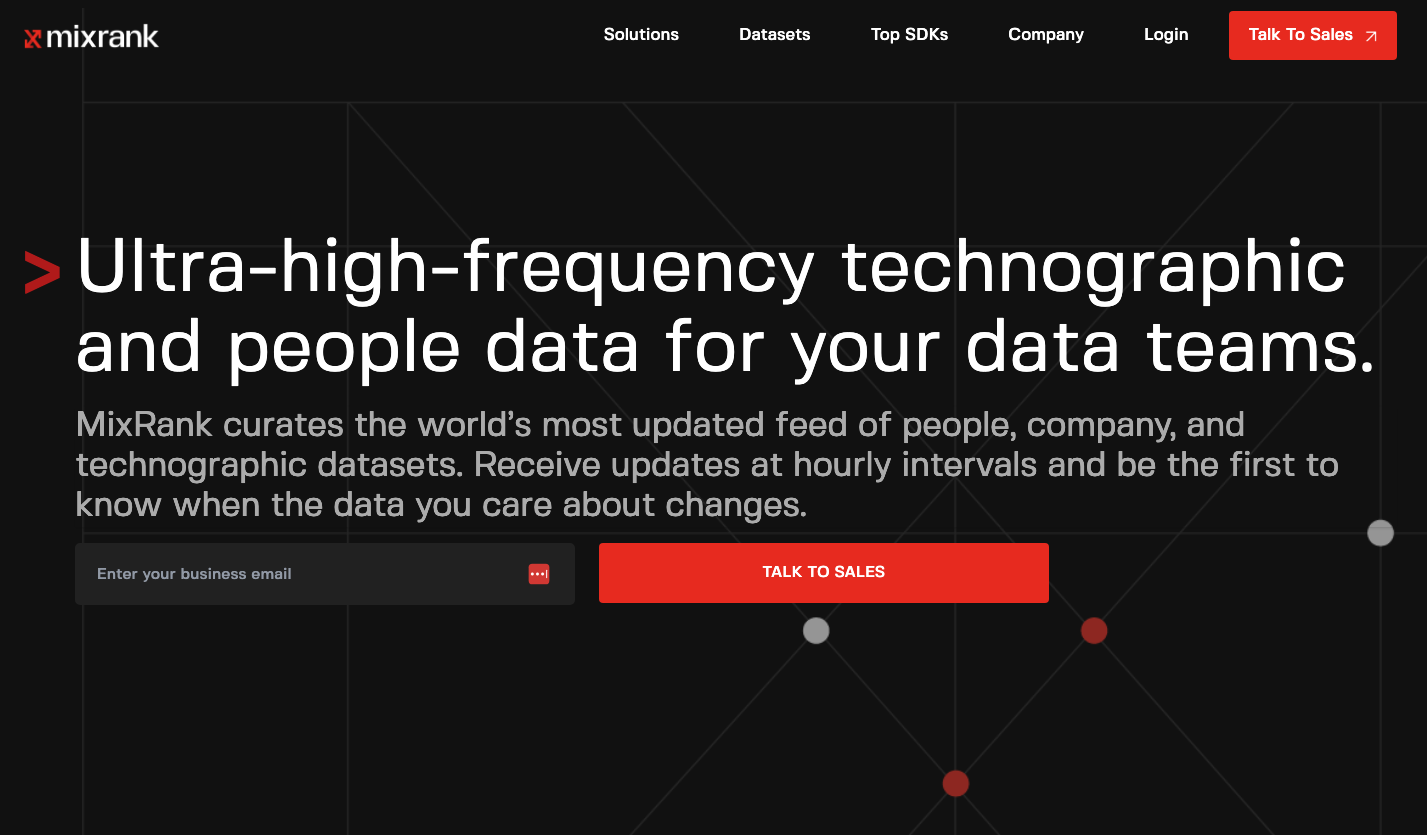
Mixrank provides company and employee data with an emphasis on technographic signals and long-term trend analysis. Its datasets include firmographic information and technology usage insights, with delivery options through APIs, exports, and hosted databases.
The provider updates data on regular update cycles and is often used for competitive analysis, enrichment, and benchmarking. Compared to more comprehensive multi-source datasets, Mixrank focuses on tracking companies over time and technographic intelligence.
5. Crustdata
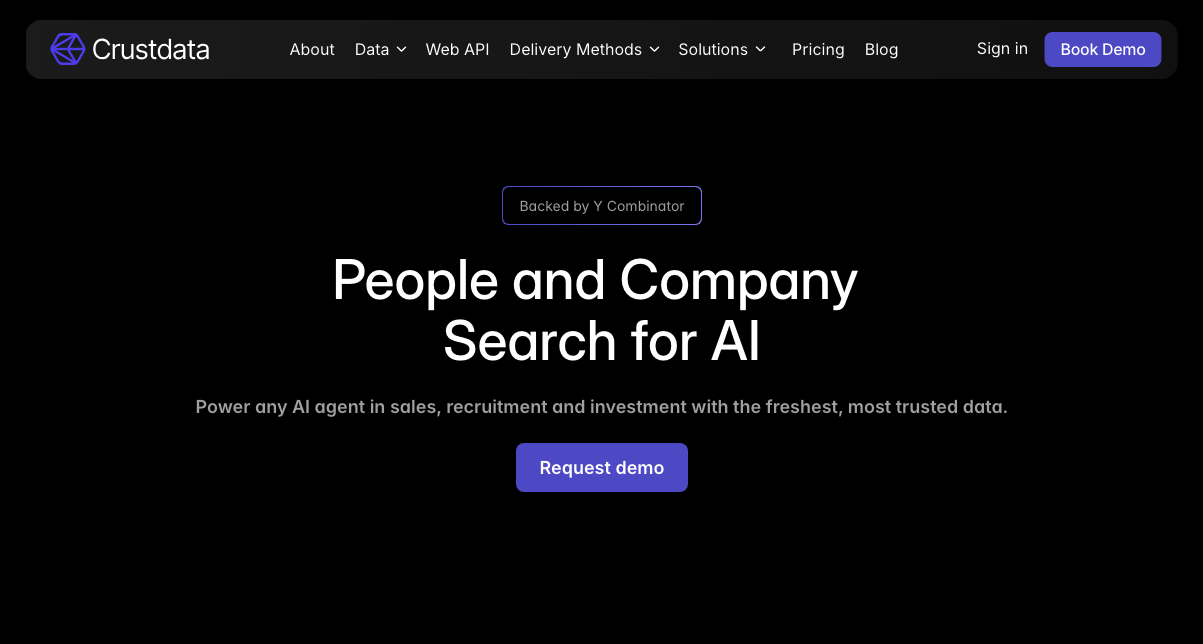
Crustdata is a newer real-time B2B data provider specializing in company and people signals. It delivers APIs and webhooks that track events such as funding rounds, hiring changes, promotions, and headcount shifts.
Its strength lies in frequent updates and event-driven use cases, making it suitable for AI SDR systems, recruiting tools, and investment monitoring. Crustdata provides multi-source company and employee data, though it does not offer job posting datasets.
How to Evaluate a Company Data API Before Signing a Contract
Choosing a company data API requires more than comparing pricing plans. Before signing a contract, confirm that the solution aligns with your goals and technical setup.
Start with relevance. Ask:
Does this API provide the specific data fields we need, and at the right level of detail? Your use case, such as sales enrichment, investment research, AI modeling, or market analysis, should determine the depth and structure required.
Next, assess freshness and transparency. Ask:
How often is the data updated, and can we see when records were last refreshed? Frequent updates are essential if you rely on hiring signals, funding events, or leadership changes.
Testing is critical. Ask:
Can we try the API through a free trial, sample dataset, or sandbox access? Hands-on testing helps evaluate data quality, structure, and integration ease before committing.
Finally, consider scalability and compliance. Ask:
Will this solution scale with our needs, and how is the data collected? The provider should clearly explain data sourcing practices and follow privacy regulations.
Evaluating relevance, freshness, testing options, scalability, and data sourcing reduces risk and ensures the API supports long-term growth.
Conclusion
Choosing the right company data provider in 2026 is less about access and more about accuracy, freshness, and scalability. As businesses increasingly depend on data to drive sales, investment decisions, and AI-powered systems, the quality of that data becomes a competitive advantage rather than a background utility.
The strongest providers distinguish themselves not just by the size of their datasets, but by how reliably they update, structure, and deliver that data across real-world use cases. Whether through APIs for continuous integration or datasets for large-scale analysis, the goal remains the same: actionable, trustworthy insights.
Organizations that take a structured approach to evaluating providers — focusing on data relevance, update frequency, ethical sourcing, and integration flexibility — will be better positioned to build resilient, data-driven strategies. In a fast-moving business environment, the right data partner is not just a vendor, but a long-term foundation for growth.
Share this post
Author

Read the latest articles from Uwe Dreissigacker
How Technology Is Solving the Data Crisis in Emergency Medical Services

April 21, 2026
Emergency medical services (EMS) sit at the intersection of healthcare and public safety — a space where speed, accuracy, and reliable data can be the difference between life and death. Yet for an industry built around urgency, EMS has been surprisingly slow to modernize its data infrastructure. Many or [...]
Learn moreLeave a comment
All comments are moderated. Spammy and bot submitted comments are deleted. Please submit the comments that are helpful to others, and we'll approve your comments. A comment that includes outbound link will only be approved if the content is relevant to the topic, and has some value to our readers.
Comments (0)
No comment