
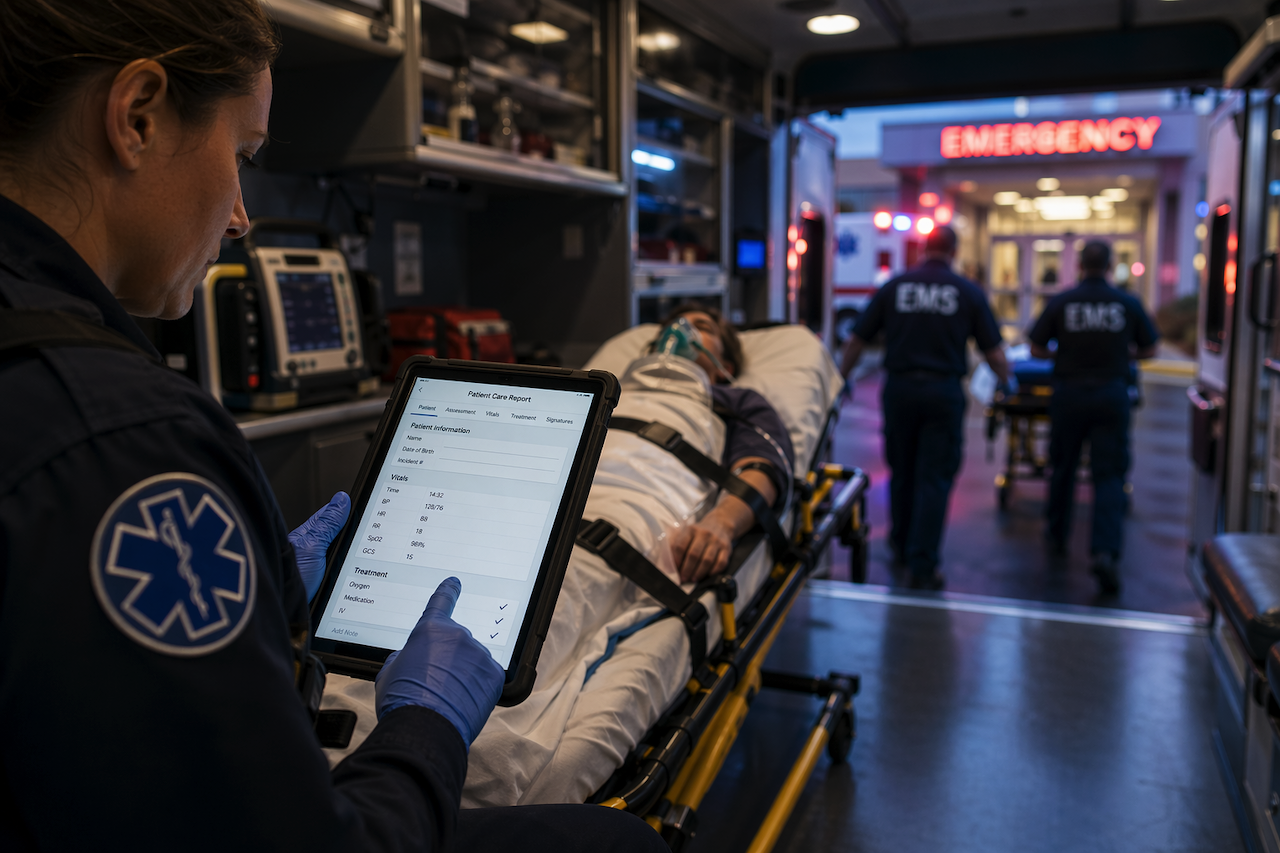
Emergency medical services (EMS) sit at the intersection of healthcare and public safety — a space where speed, accuracy, and reliable data can be the difference between life and death. Yet for an industry built around urgency, EMS has been surprisingly slow to modernize its data infrastructure. Many organizations still rely on fragmented documentation systems, handwritten run sheets, and disconnected software tools that create more problems than they solve.
That is starting to change. A new wave of purpose-built digital platforms is transforming how EMS teams capture, manage, and use patient and operational data. The shift is not just a technology upgrade; it is a fundamental rethinking of how emergency medical information flows from the field to the hospital and beyond.
The Paper Problem That Persists
Despite the widespread adoption of electronic health records in hospitals and clinics, a surprising number of EMS teams still struggle with documentation workflows involving manual entry, duplicate data capture, and disconnected systems. A paramedic treating a patient in the back of an ambulance may complete a paper form or use a basic tablet interface that does not integrate with the receiving hospital's systems. The result is information that arrives late, is incomplete, or must be re-entered by hospital staff, introducing errors at the exact moment when accuracy matters most.
The consequences compound over time. Organizations that cannot efficiently access their own historical data struggle with quality improvement, compliance reporting, and billing accuracy. Training gaps go unidentified because performance data is buried in filing cabinets. Protocol adherence is difficult to measure when documentation is inconsistent across crews and shifts.
Purpose-Built EMS Software Is Changing the Equation
The most significant advancement in EMS data management is the rise of charting platforms designed specifically for pre-hospital care workflows. Modern EMS charting systems, often called ePCR (electronic patient care report) software, are built around the way paramedics and EMTs actually work in the field.
These platforms allow teams to document patient encounters in real time on mobile devices, using structured data fields aligned with NEMSIS (National EMS Information System) standards. Vital signs, medications administered, procedures performed, and patient demographics are captured in a standardized format that accompanies the patient from the ambulance to the emergency department.
The operational benefits are immediate. Documentation is completed faster because the software guides teams through required fields rather than relying on memory. Data quality improves because structured inputs reduce free-text errors. Billing accuracy increases because charge capture is integrated into the charting workflow rather than handled as a separate downstream process.
For organizational leadership, centralized PCR data unlocks capabilities that were previously impractical, including response-time analysis and broader insights into how geolocation improves emergency response times.
The Integration Challenge
One of the persistent challenges in EMS technology is interoperability. Patient data captured in the field needs to flow seamlessly to hospital emergency departments, billing systems, quality assurance platforms, and state reporting databases. When these systems do not communicate, the data advantage of electronic charting is significantly diminished.
The best modern ePCR platforms address this through standardized data formats and API-based integrations that automatically connect field documentation to downstream systems. This is where the EMS technology space mirrors trends seen across enterprise software, as the value of any single platform is increasingly determined by how well it connects to everything else in the ecosystem.
Organizations evaluating new charting systems should prioritize integration capabilities alongside core documentation features. A platform that produces excellent patient care reports but cannot transmit them to the receiving facility in real time solves only half the problem.
Why User Feedback Drives Better EMS Software
EMS is a domain where generic software consistently fails. The workflows are too specific, the regulatory requirements too detailed, and the operating conditions too demanding for platforms designed for general healthcare or business use. This creates a product development challenge for the companies building these tools, as they need continuous, structured input from the people who actually use the software under pressure.
This is why customer feedback software has become a critical part of the product development stack for vertical SaaS companies, including those serving the EMS industry. Tools that allow users to submit feature requests, vote on priorities, and track how their feedback influences the product roadmap create a development loop that keeps the software aligned with real-world needs.
In a field like emergency medical services, where a poorly designed interface can slow documentation during a critical patient encounter, the difference between software built on assumptions and software built on structured user feedback is not abstract. It shows up in adoption rates, documentation completion times, and ultimately in the quality of patient care data that agencies can access and act on.
The Bigger Picture
The digital transformation of EMS documentation is part of a broader shift happening across public safety and healthcare. Teams that invest in modern data infrastructure today are positioning themselves for a future where predictive analytics, AI-assisted triage support, and real-time population health monitoring become standard capabilities rather than aspirational goals.
But none of that is possible without clean, structured, reliable data captured at the point of care. That is the foundation, and for EMS organizations still running on fragmented systems and paper-based workflows, building that foundation starts with adopting charting tools designed for the realities of pre-hospital medicine.
The technology exists. The standards are in place. The organizations that move now will define how emergency medical data is managed for the next decade.
Featured Image generated by ChatGPT.
Share this post
Author

Read the latest articles from Uwe Dreissigacker
How to Choose a Company Data Provider in 2026
March 26, 2026
In 2026, choosing the right company data provider is not only a technical decision but also a strategic one. Every month, hundreds of thousands of new businesses are registered, while millions of existing companies evolve through hiring, funding, product launches, and leadership changes. Without structured, fresh [...]
Learn moreLeave a comment
All comments are moderated. Spammy and bot submitted comments are deleted. Please submit the comments that are helpful to others, and we'll approve your comments. A comment that includes outbound link will only be approved if the content is relevant to the topic, and has some value to our readers.
Comments (0)
No comment