
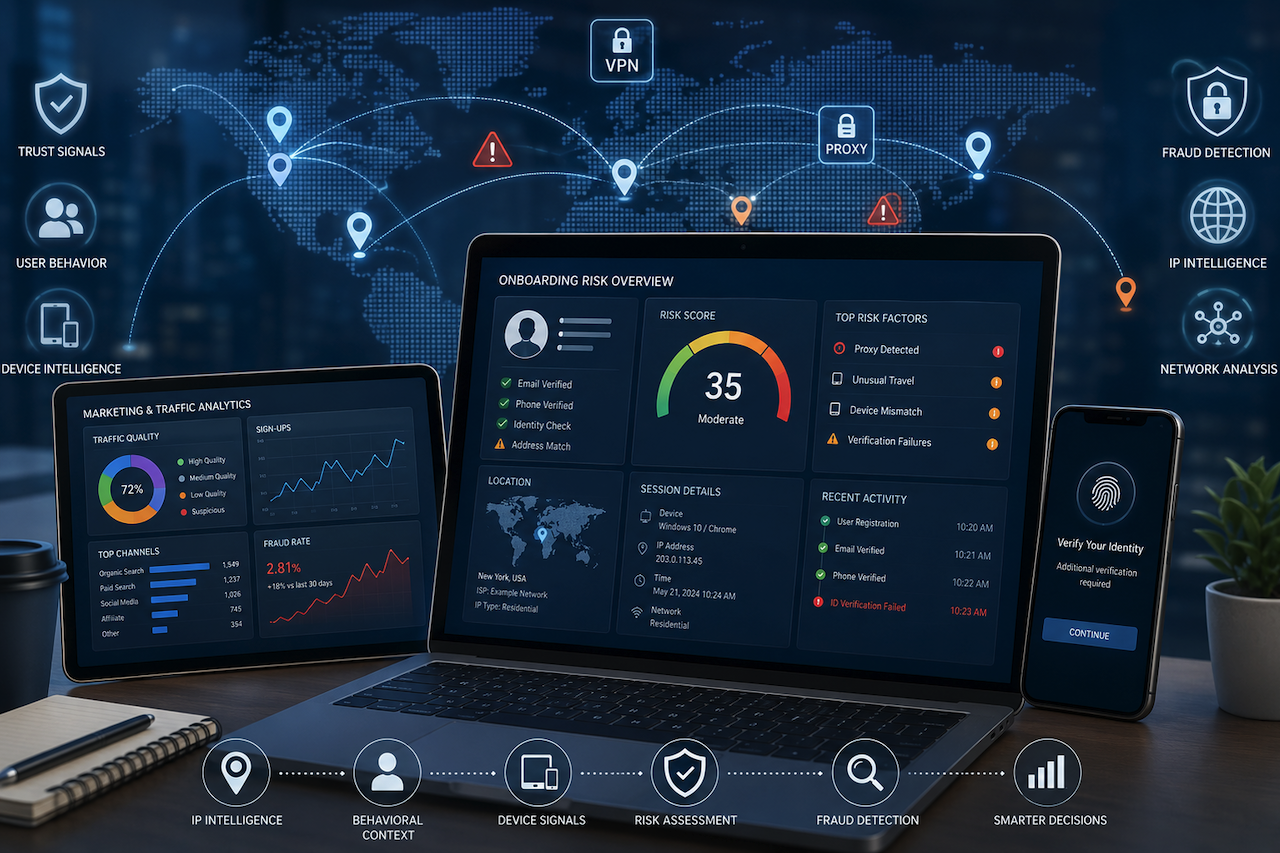
Strong fraud controls, accurate marketing data, efficient onboarding, and clear customer journeys are all important, but each additional verification step can introduce friction for legitimate users. Because of this challenge, IP intelligence, combined with behavioral context, device signals, and risk-based decision-making, has become a valuable tool for digital onboarding, fraud prevention, and marketing analytics.
An IP address gives you useful information about the type of network being used, the origin of traffic, and whether a session is typical of the user's behavior. You may improve onboarding options, save wasteful marketing costs, and offer a safer experience by correctly reading that signal.
Privacy, Compliance, And Transparency Shape How You Use IP Data
Users expect online platforms, including financial platforms, to safeguard their accounts and handle personal information responsibly. This means an IP strategy should support analytics and security without collecting more data than necessary or using information in ways that create unnecessary risk. Organizations should collect only the data needed to support a clear purpose. Each signal should serve a specific function, whether for campaign quality analysis, account protection, fraud detection, or access control. Raw data should not be shared across teams without appropriate safeguards, and it should not be retained longer than necessary.
Avoid Treating IP Data As Identity Proof
An IP address can help inform a risk model, but it should not be the only factor used to approve or reject a user. People may travel, use privacy tools, or access accounts across different networks, all of which can reduce the accuracy of location-based signals. For this reason, IP intelligence works best when combined with other indicators rather than being treated as proof of identity. Effective systems allow for additional evaluation, verification, and correction when signals appear inconsistent.
Marketing Analytics Become Cleaner When Fraud Signals Are Included
Marketing campaigns are often evaluated based on sign-ups, conversion rates, cost per lead, and activation. These metrics may appear impressive while concealing bot-driven form fills, incentive abuse, fake accounts, or low-quality traffic. When IP intelligence is combined with analytics and reporting, organizations gain a clearer view of which channels attract legitimate users and which ones artificially inflate performance.
Bot Traffic Can Distort Campaign Performance
The problem starts when those users fail verification, trigger fraud rules, abandon onboarding, or disappear shortly after registration. IP intelligence can help identify traffic from suspicious ranges, automated sources, or regions outside your actual target market. That gives marketing and fraud teams a shared view of traffic quality instead of separate versions of the truth.
Geo Data Improves Segmentation Without Overpromising Precision
IP-based geo data can support better segmentation, but it should be used carefully. City-level accuracy may vary, even on mobile networks, shared networks, and VPNs. Country or regional patterns are often more useful for marketing analysis than pretending every IP maps perfectly to a precise location.
Fraud Feedback Makes Attribution More Useful
Attribution becomes more useful when it includes what happens after sign-up. A channel that generates a large number of registrations may be less valuable if many users fail verification, trigger fraud rules, abandon onboarding, or exhibit account abuse patterns. By feeding fraud outcomes back into campaign analysis, organizations can separate genuine growth from low-quality acquisition. The most effective channels are not always those with the lowest acquisition costs, but those that consistently attract legitimate users who can be served safely and successfully.
Fraud Context Turns Raw Data Into Better Decisions
For someone who travels frequently, a single login from a different country may be entirely normal, but for someone who has never accessed an account outside a specific region, the same activity could appear unusual. Similarly, the use of a VPN may be expected for privacy-conscious users, but when combined with inconsistent account information, unusual device activity, or repeated verification failures, it may warrant closer review. Context helps organizations distinguish normal behavior from patterns that deserve additional attention.
Impossible Travel And Session Inconsistency
If an account logs in from Paris and then appears in Singapore ten minutes later, the system should investigate further. The goal is not to block the user immediately, but to challenge the session, review the device, and determine whether the credentials may have been compromised.
Why Risk Scores Need Human Logic
A score that rises due to proxy use, device mismatch, and abnormal session timing should be explainable to fraud, compliance, and product teams. Transparent risk assessment helps organizations make consistent decisions while maintaining user trust and reducing unnecessary friction.
IP Intelligence Adds Context Before A User Even Converts
IP intelligence can reveal the approximate region, internet service provider, network type, hosting provider, VPN usage, proxy behavior, or suspicious routing patterns associated with a visit. As organizations continue adapting to digital shifts, this type of context can support onboarding, fraud prevention, and risk assessment efforts. During digital onboarding, that early context can be valuable because fraudulent activity often begins before an account is fully established.
Why Location Is Only One Piece Of The Signal
A user may appear in a different city because of mobile routing, corporate networks, dynamic IP allocation, or a VPN. That means IP data should be treated as a risk indicator rather than a definitive answer. Location signals are often most useful when evaluated alongside device, behavioral, and account-level context.
How Network Type Changes Risk Interpretation
Residential networks often look different from data center traffic, mobile carrier traffic, public Wi-Fi, or known proxy infrastructure. If a new account is created from a data center IP, completed in seconds, and followed by repeated verification failures, the signal becomes more meaningful. Context helps determine whether a session appears legitimate or deserves additional scrutiny.
Why Real-Time Checks Matter During Onboarding
Onboarding decisions lose value when risk checks happen too late. If a system waits until after account creation to detect suspicious traffic, fraud teams may already be dealing with fake users, abuse, identity manipulation, or other forms of account misuse. Real-time IP checks allow organizations to adjust the onboarding journey while the user is still active. Low-risk users can proceed quickly, while higher-risk sessions can receive additional verification without affecting everyone else.
Trust Signals Help You Reduce Friction For Good Users
The best onboarding systems do not simply look for fraud. They also identify when a user appears trustworthy enough to move forward with less friction. If a session comes from a consistent region, a familiar device, a low-risk network, and a normal completion pattern, organizations can often reduce unnecessary checks while maintaining appropriate safeguards.
Trust Is Built Through Signal Consistency
A user’s IP region, device profile, phone country, payment information, and declared address do not need to match perfectly, but they should make sense together. Small differences are normal, while multiple inconsistencies may warrant closer review. This helps organizations avoid both extremes: making poor risk assessment decisions or overwhelming legitimate users with unnecessary verification requirements.
Why Clear Internal Rules Protect The Brand
If users feel blocked without reason, they may blame the product rather than the security process. Clear internal rules help support teams explain verification requirements without exposing fraud controls. The user experience feels more professional when checks appear consistent, proportionate, and tied to account safety.
Conclusion
Organizations can use digital context before, during, and after onboarding to better understand how users interact with their platforms. It can help identify whether activity follows typical patterns, where traffic originates, and how sessions behave over time. When combined with trust signals and fraud context, IP intelligence supports better decision-making without forcing every user through the same level of verification. While IP data can strengthen risk assessment, compliance processes, and identity verification workflows, it should complement rather than replace them. Used appropriately, it can help reduce fraud, improve marketing insights, protect legitimate users, and create onboarding experiences that are both secure and efficient.
Disclaimer
This article is provided for informational and educational purposes only and should not be considered legal, financial, compliance, cybersecurity, or professional advice. Readers should evaluate their own requirements and consult qualified professionals before making decisions related to fraud prevention, identity verification, compliance, security controls, or risk management.
This article may contain links to third-party websites for reference and convenience. IPLocation.net does not own, control, endorse, monitor, or guarantee the accuracy, completeness, availability, security, or reliability of any external websites, products, services, or content. Readers access third-party websites at their own risk. IPLocation.net shall not be liable for any loss, damage, claim, or consequence arising from the use of, reliance on, or interaction with external websites or their content.
Featured Image generated by ChatGPT.
Share this post
Author

Read the latest articles from Jana Radojcic
The 6 Most Secure EOR Providers to Pay Global Contractors and Employees as an SMB

April 24, 2026
The best EOR for an SMB in 2026 is the provider that gives you fewer handoffs, stronger controls, cleaner compliance ownership, and less room for expensive human error. That matters because payroll, HR, and contractor management tools are adding AI features faster than most small businesses can properly evaluate [...]
Learn moreLeave a comment
All comments are moderated. Spammy and bot submitted comments are deleted. Please submit the comments that are helpful to others, and we'll approve your comments. A comment that includes outbound link will only be approved if the content is relevant to the topic, and has some value to our readers.
Comments (0)
No comment