
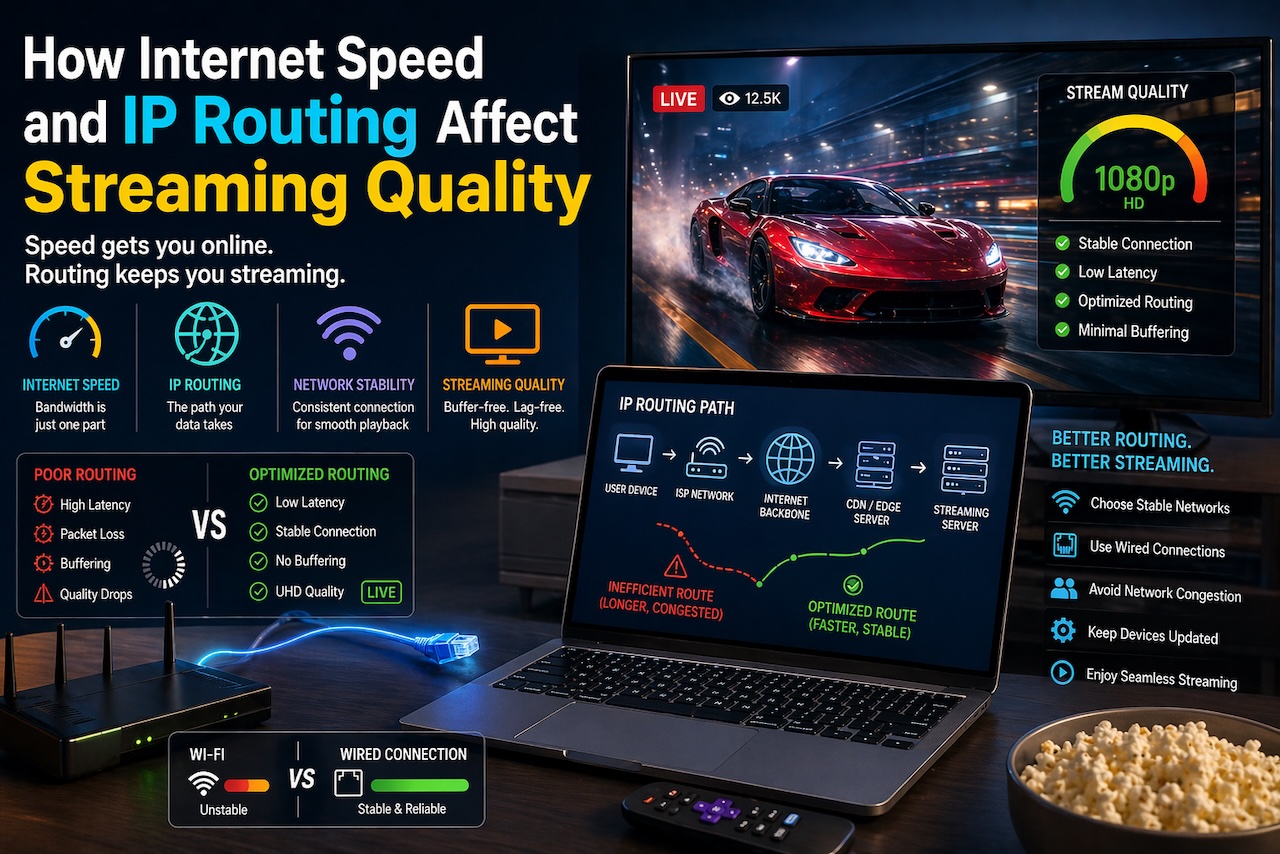
Modern streaming has become a core part of digital life. From live sports to on-demand entertainment, users expect smooth, high-quality playback without interruptions. However, even with fast internet connections, streaming issues like buffering, lag, and sudden quality drops are still common.
The reason is simple: streaming quality is not only about speed — it depends heavily on IP routing, network stability, and service infrastructure. Understanding how these elements work together can help users create a more reliable and consistent viewing experience without constant interruptions.
1. Internet Speed vs Real Streaming Performance
Many users assume that upgrading to a higher internet speed will automatically solve buffering problems. While speed is important, it is only one part of the equation.
Streaming performance depends on several hidden factors:
- Packet loss during data transfer
- Network congestion during peak hours
- Distance between user and server
- Stability of the connection (wired vs wireless)
Even with high-speed fiber internet, unstable routing can cause delays in video delivery. This is why users sometimes experience buffering even when their internet speed test shows excellent results. Speed tests typically measure maximum bandwidth under ideal conditions, but real-world streaming depends on consistent data flow rather than peak speed.
In many cases, an IPTV Provider plays an important role in maintaining stable servers and optimized delivery systems that help reduce interruptions during streaming.
Many users exploring modern streaming solutions often overlook how network stability and routing efficiency directly impact their overall viewing experience. Without a stable path for data to travel, even the fastest connection can feel slow when watching live content.
2. The Role of IP Routing in Streaming Quality
IP routing is the process of determining how data travels from the content server to your device. This process is controlled by multiple networks and ISPs (Internet Service Providers).
When routing is inefficient, data may:
- Travel longer paths than necessary
- Pass through congested networks
- Experience delays or packet loss
This directly impacts streaming quality, especially for live content where real-time delivery is required. Even a slight increase in latency can cause noticeable delays, while packet loss can lead to buffering or drops in video quality.
Unlike on-demand videos, live streams cannot buffer ahead of time. Even a small delay in routing can result in visible freezing or lag. This is why live sports or real-time broadcasts are more sensitive to network conditions compared to pre-recorded content.
To address this, modern streaming systems often optimize routing paths and server distribution using technologies like content delivery networks (CDNs).
Many users also explore IPTV solutions to understand how streaming platforms handle routing and performance optimization across different networks and conditions.
3. Why Wireless Connections Often Fail Under Load
Another major factor affecting streaming quality is the type of home network being used.
Wi-Fi is convenient, but it is also unstable under certain conditions:
- Interference from walls and appliances
- Signal overlap from nearby networks
- Device overload in busy households
These issues create jitter and packet loss, which are highly noticeable during video streaming. A connection that seems fine for browsing or social media may struggle to deliver consistent performance for high-definition or 4K streaming.
For consistent performance, wired Ethernet connections are often recommended because they provide a direct and stable data path between the router and the streaming device. This reduces interference and ensures that data packets arrive in order and on time, which is critical for smooth playback.
4. Device Performance Also Matters
Streaming is not only dependent on the internet and routing — hardware plays a significant role as well.
Smart TVs and older devices often struggle with:
- Limited processing power
- Outdated software support
- Slower decoding of high-resolution video
This leads to laggy interfaces, delayed channel switching, and occasional crashes. Even if the internet connection is stable, weak hardware can still create a poor viewing experience.
Modern streaming devices, on the other hand, are built to handle high-bitrate content, advanced codecs, and real-time playback more efficiently. With faster processors and better memory management, they deliver smoother navigation and more reliable performance, especially during extended viewing sessions.
5. Why Buffering Happens Even on Fast Internet
One of the most common frustrations for users is buffering despite having a fast internet connection. This happens because streaming depends on multiple layers of performance, not just bandwidth.
Some common causes include:
- Temporary congestion in network routes
- ISP traffic management during peak hours
- Slow response from streaming servers
- Background downloads or device updates
These factors can interrupt the steady flow of data required for video playback. Even a brief disruption can cause the stream to pause or drop in quality.
Understanding these issues helps users realize that improving streaming is not always about increasing speed — sometimes it requires optimizing the entire network environment.
6. Understanding Real-World Streaming Issues
One of the most frustrating situations for users is when everything appears fine on paper — high-speed internet, updated devices, and a stable connection — but streaming still buffers.
In most cases, the issue lies in one of the following:
- Inefficient IP routing between networks
- Overloaded streaming servers
- Wireless instability
- Background bandwidth usage from other devices
This shows that streaming quality is a combination of multiple technical layers working together, not just internet speed alone. Small inefficiencies at any stage of data delivery can create noticeable issues for the viewer.
7. The Future of Streaming Optimization
As streaming continues to evolve, providers are focusing more on intelligent routing, adaptive bitrate streaming, and distributed server systems.
These improvements aim to:
- Reduce buffering during peak usage
- Improve real-time streaming stability
- Optimize delivery based on user location and network conditions
- Enhance overall viewing experience across devices
Emerging technologies are also focusing on predictive optimization, where systems adjust streaming quality in real time based on network conditions. This ensures smoother playback even when network performance fluctuates.
Users are no longer just consuming content — they are part of a complex global data network where efficiency matters at every step.
Conclusion
Internet speed is only one part of the streaming experience. True performance depends on a combination of IP routing efficiency, network stability, hardware capability, and service infrastructure.
By understanding these factors, users can make better decisions when choosing their streaming setup and reduce common issues like buffering and lag. Small improvements in network configuration and device selection can lead to a significantly better viewing experience.
In the end, a well-optimized system ensures that streaming becomes seamless — allowing users to focus on content rather than technical problems.
Disclaimer
This article is provided for informational purposes only and is not intended as technical, legal, or professional advice. While every effort has been made to ensure accuracy, streaming performance may vary based on individual network conditions, devices, internet service providers, and third-party services. The information presented does not guarantee specific results or improvements. Readers should conduct their own research and consult with qualified professionals or service providers before making any decisions related to network configuration, streaming services, or technology purchases. The author and publisher are not responsible for any outcomes resulting from the use of this information.
Featured Image generated by ChatGPT.
Share this post
Author

Read the latest articles from Shahid Latif
How to Restyle Short Video Clips with Video-to-Video AI

June 5, 2026
You come back from a shoot with footage that’s good enough to use. The lighting works, the movement feels natural, and a few clips could easily become social media teasers. Then you hit the usual wall: making them look anime-inspired, illustrated, or cinematic often means learning effect-heavy editing, testing [...]
Learn moreAI Video Enhancer: Your Videos Don’t Look Professional? Here’s the Fastest Fix
June 1, 2026
Ever invest hours into making a video only to upload and find it looks blurry, dull, or just… not professional?
Learn moreLeave a comment
All comments are moderated. Spammy and bot submitted comments are deleted. Please submit the comments that are helpful to others, and we'll approve your comments. A comment that includes outbound link will only be approved if the content is relevant to the topic, and has some value to our readers.
Comments (0)
No comment