
Early-stage telecom operators don’t lose because the market is saturated. They lose because they can’t turn technical capability into predictable revenue fast enough. Coverage can be leased. Infrastructure can be shared. What remains hard to replicate is how a company packages, sells, and scales its services.
That shift from infrastructure to product is where custom software starts to matter. Not as a back-office layer, but as the mechanism that defines what gets sold and how money flows through the business. Teams that treat software as a cost center tend to stall. Teams that build around monetization logic move differently, often with fewer assets but sharper execution. This is the space where partners like SysGears typically enter the picture, helping operators shape platforms around revenue rather than operations.
The problem with selling connectivity in 2026
Selling raw connectivity has become a race to the bottom. Average revenue per user has been flat or declining across most regions for years, while data consumption keeps climbing. Operators carry more traffic but don’t capture proportional value.
Look at what happened with messaging. SMS used to be a reliable revenue stream. Then apps like WhatsApp and Telegram reduced it to near zero for many operators. Voice followed a similar path with VoIP. The pattern is consistent: when a service is easy to replicate at the application layer, telecom providers lose pricing power.
Early-stage operators don’t have the scale to offset that with volume. They need higher-margin services from day one. That forces a different approach to telecom software monetization, one that focuses on packaging capabilities instead of selling access.
Where software actually drives revenue
There’s a tendency to overstate what telecom platforms do. OSS/BSS systems are often described in abstract terms: automation, orchestration, efficiency. Those matter, but they don’t explain revenue.
Revenue shows up when software controls three things: how fast a service can be launched, how it can be priced, and how easily it can be integrated into someone else’s product.
Take Twilio. It didn’t build a telecom network from scratch. It built APIs on top of existing infrastructure and turned communications into a developer-friendly product. That decision defined its growth curve. The same logic applies to smaller operators, even if the scale is different.
A custom platform gives control over these layers. Off-the-shelf systems rarely do.
Off-the-shelf platforms: faster start, slower growth
Pre-built telecom stacks look attractive early on. Vendors promise quick deployment, predictable costs, and built-in features. For a startup under pressure to launch, that’s hard to ignore.
The tradeoff appears later.
Pricing models become rigid because billing systems weren’t designed for experimentation. Integrations take longer because APIs are limited or poorly documented. New services depend on vendor roadmaps instead of internal priorities. At that point, growth slows not because of demand, but because the platform can’t adapt.
This is where discussions about custom telecom platform ROI become more grounded. The return isn’t just about saving money on licenses. It’s about removing constraints that block revenue.
Operators that switch away from rigid platforms often do it after hitting these limits. By then, they’ve already lost time.
Productizing telecom capabilities, not just delivering them
The more interesting shift is happening at the product level. Operators are starting to package network capabilities as discrete, sellable services.
Location data is a clear example. It used to sit inside the network, used for routing and internal analytics. Now it’s being exposed, carefully and with privacy controls, as a service for logistics, fraud prevention, and retail analytics. Companies pay for access because the data is hard to replicate elsewhere.
The same applies to authentication. Instead of relying solely on passwords or third-party identity providers, businesses can use network-based authentication tied to SIM data. That’s a telecom capability turned into a product.
This is telecom product commercialization in practice. It’s not theoretical. It’s already happening, and it’s driven by software layers that can expose, secure, and monetize these capabilities.
Why early-stage operators have an advantage here
Large telecom companies talk about transformation, but they’re constrained by legacy systems. Integrating new services often means working around decades-old architecture. That slows everything down.
Startups don’t have that problem. They can design platforms around APIs, microservices, and real-time data from the start. That doesn’t guarantee success, but it removes a major source of friction.
The catch is execution. Building a flexible platform is harder than deploying a pre-built one. It requires clear decisions about architecture, data flow, and monetization models early on. There’s less room for guesswork.
This is where an early-stage telecom software strategy either works or collapses. Teams that focus on a narrow, monetizable use case tend to move faster. Those that try to replicate full-scale telecom stacks usually burn time and capital without clear returns.
Revenue doesn’t come from features, it comes from timing
One of the less discussed aspects of telecom software is timing. Launching the right feature six months late can be worse than launching a simpler version early.
Cloud-native platforms help here, but only if they’re used properly. Companies like Rakuten Mobile built their networks with software-first principles, allowing faster iteration than traditional operators. That doesn’t mean everything worked perfectly, but it changed how quickly they could test and adjust services.
For startups, this speed directly affects the revenue growth telecom startups can realistically achieve. The faster a service reaches the market, the sooner it generates data: usage patterns, pricing sensitivity, and integration demand. That data feeds back into product decisions.
Without that loop, growth stalls.
Data as a revenue source: useful, but limited
There’s a lot of hype around telecom data monetization. Some of it is justified. Network data is valuable, especially for industries that depend on location or movement patterns.
But there are limits.
Privacy regulations are tightening, not loosening. GDPR in Europe set the tone, and similar frameworks are appearing elsewhere. Any data-driven product needs strong anonymization and compliance layers. That adds complexity and cost.
There’s also competition. Companies like Google and Apple already collect massive amounts of user data. Telecom operators don’t automatically have an advantage unless their data is uniquely tied to network-level insights.
So yes, data can drive revenue, but it’s not a shortcut. It works best when combined with other services, not as a standalone strategy.
APIs are the real distribution channel
If there’s one consistent pattern in telecom growth stories, it’s the role of APIs.
APIs turn internal capabilities into external products. They allow other companies to build on top of telecom services without needing to understand the underlying infrastructure. That expands reach without requiring direct sales for every use case.
This is how companies like Vonage repositioned themselves, from a consumer VoIP provider to a platform company, offering communications APIs. The shift wasn’t just technical. It changed how revenue was generated.
For early-stage operators, APIs are often the most efficient path to scale. They reduce dependency on direct customer acquisition and open up partnership-driven growth.
The cost side that often gets ignored
Custom platforms are not cheaper upfront. Development takes time. Skilled engineers are expensive. Mistakes in architecture can be costly to fix later.
There’s also operational overhead. Running a custom platform means handling updates, security, and scaling internally. With a vendor solution, some of that responsibility sits outside the company.
These tradeoffs matter. Not every startup should build everything from scratch. In some cases, a hybrid approach, using existing components while developing critical layers in-house, makes more sense.
The key is knowing which parts of the system directly affect revenue. Those are the parts worth customizing.
What actually drives a custom telecom platform's ROI
When operators talk about ROI, they often default to cost savings. In telecom, that’s rarely the main story.
The more meaningful returns come from control.
Control over pricing allows experimentation with subscription models, usage-based billing, or hybrid approaches. Control over integrations makes it easier to partner with other platforms. Control over deployment cycles reduces time-to-market.
These factors compound over time. A platform that enables faster decisions tends to generate more opportunities, even if each individual change seems small.
That’s the real shape of custom telecom platform ROI, not a single metric, but a shift in how quickly a company can respond to the market.
Building for monetization from day one
The common mistake is treating monetization as a later step. First, build the network, then add billing, then think about products. That sequence doesn’t hold anymore.
Monetization logic needs to be part of the initial design. How will services be priced? What triggers a charge? How are partners billed? These questions affect architecture decisions early on.
Ignoring them leads to rework. Systems built without monetization in mind often require significant changes later, especially when moving from pilot projects to real customers.
An early-stage telecom software strategy that prioritizes monetization avoids that trap. It doesn’t try to build everything at once. It focuses on a specific service, ensures it can be sold effectively, and expands from there.
The direction the industry is already taking
The term “telco” is gradually being replaced by “techco” in industry discussions. It’s not just branding. It reflects a shift toward software-driven business models.
Operators are expected to behave more like technology companies: building platforms, exposing APIs, and participating in digital ecosystems. Connectivity remains essential, but it’s no longer the primary source of value.
This shift isn’t optional. Companies that don’t adapt will continue to see margins erode.
For early-stage operators, the situation is different. They’re not adapting, they’re starting from this model. That gives them a chance to build systems that align with where the industry is going, not where it’s been.
The outcome depends on execution. Custom telecom software doesn’t guarantee revenue. But without it, turning capabilities into scalable products becomes significantly harder.
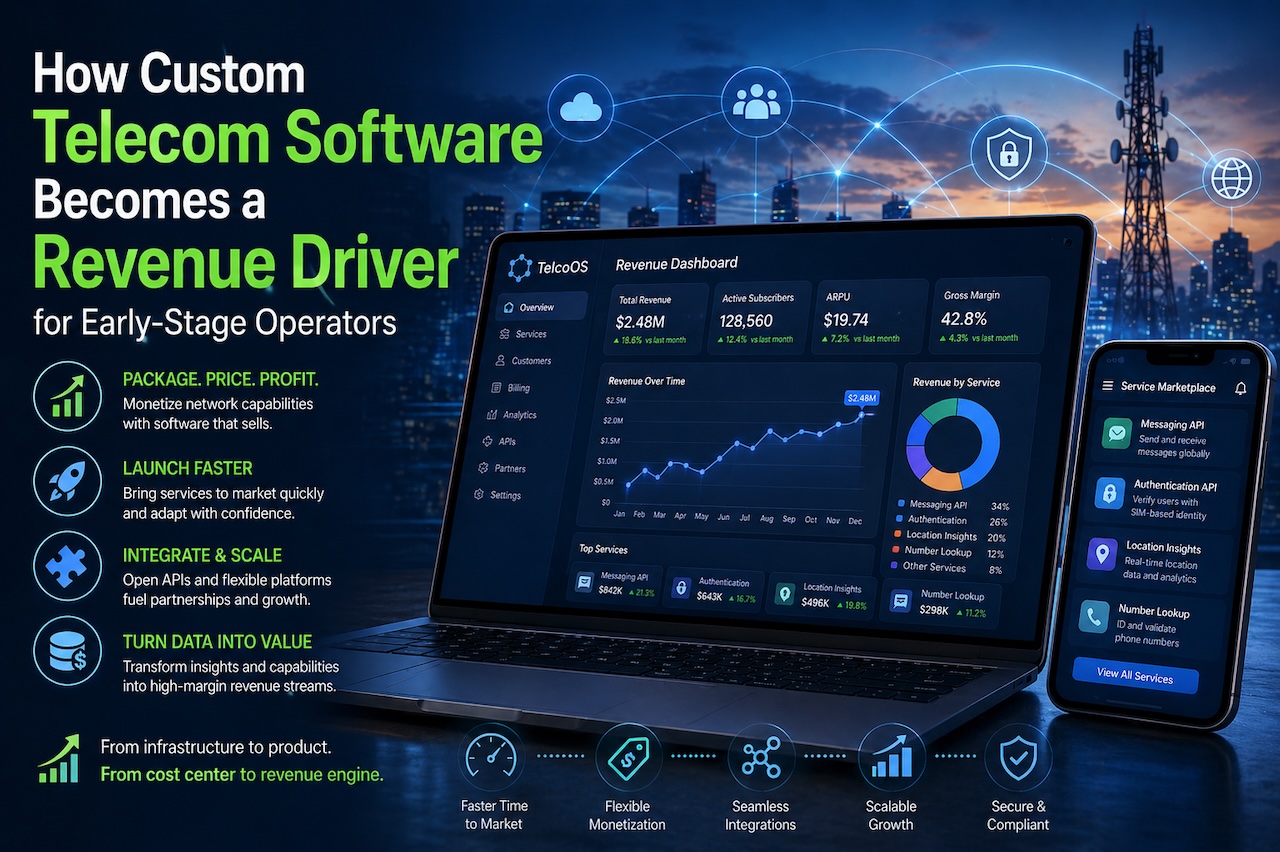
Featured Image generated by ChatGPT.
Share this post
Leave a comment
All comments are moderated. Spammy and bot submitted comments are deleted. Please submit the comments that are helpful to others, and we'll approve your comments. A comment that includes outbound link will only be approved if the content is relevant to the topic, and has some value to our readers.
Comments (0)
No comment