
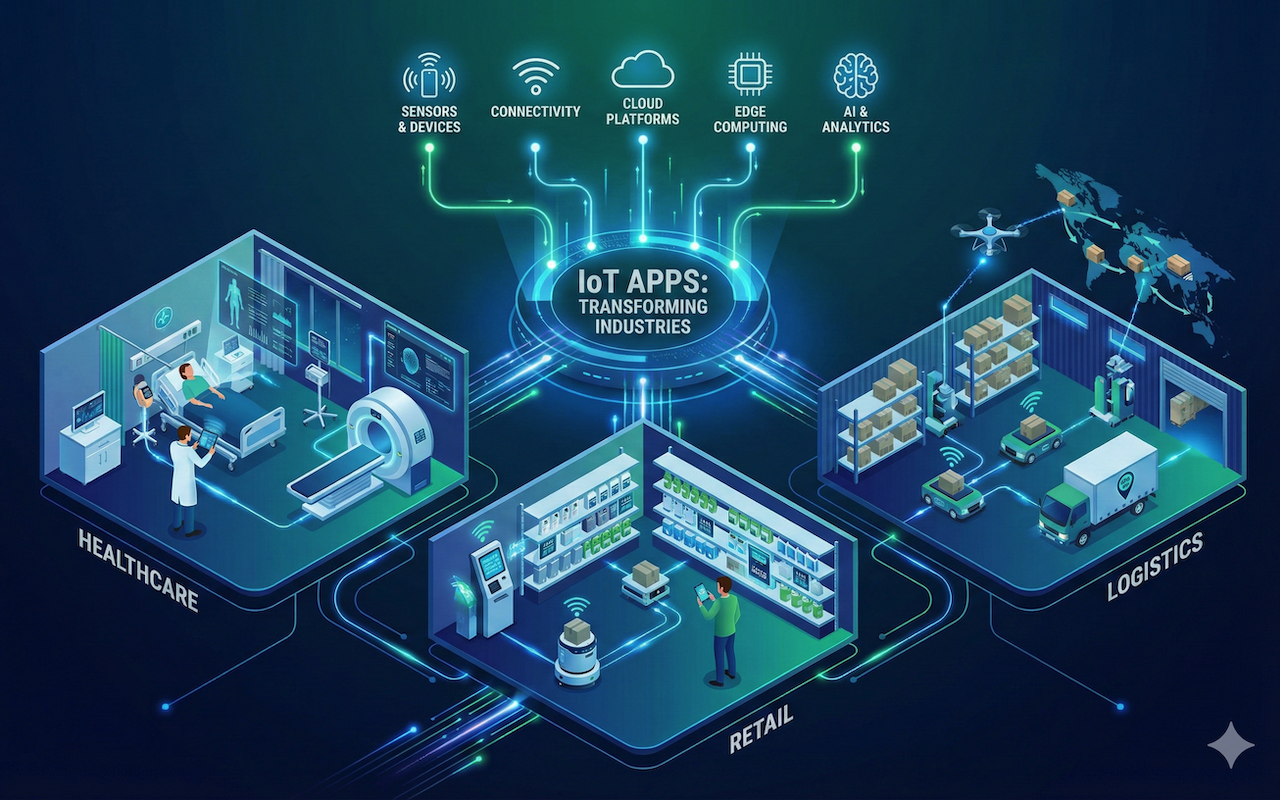
IoT technology is becoming a cornerstone achievement of the IT sector. It enables the connection of devices across the internet, which allows leaders to make smarter choices.
This is why there has been a widespread use of IoT applications across healthcare, retail, and logistics industries. These digital solutions are power-packed with automation and unlock business opportunities by leveraging predictive analytics. They help businesses solve operational bottlenecks by using sensors in machines that study the next course of action.
So, whether it’s a critical healthcare scenario or a retail business decision, IoT apps enable leaders to make more responsive choices today. Moreover, these decisions are context-aware, secure, scalable, and based on relevant information. This eventually leads decision-makers to trust skilled IoT specialists who can create custom apps that are modern, future-ready, and business-focused.
That being said, this article explores the dynamics of IoT apps. Further, it also explains how these solutions are a progressive way forward, helping transform industries like retail, healthcare, and logistics.
Understanding IoT Apps and Their Key Technologies
IoT (Internet of Things) is one of the key modern technologies used in industries today. Simply, IoT refers to a network of interconnected objects that can exchange data over the internet without any human intervention.
These digital solutions enable collecting, sharing, and analyzing data in real time. Interestingly, they are connected using sensors, machines, and wearables to make systems more responsive and intelligent.
This section explores the key technologies used by IoT professionals in detail to achieve this operational success.
1. Sensors and Devices
These are embedded in systems to collect data (related to temperature, pressure, location, and biometrics), which is further shared with the connected systems.
2. Connectivity Networks
These technologies support device communication via high-speed networks like Wi-Fi and 5G. Additionally, long-range networks such as LoRaWAN and NB-IoT also support large-scale deployments.
3. Cloud Platforms
Data from devices is often stored on secure and scalable cloud platforms (AWS IoT, Azure IoT Hub, Google Cloud IoT), which analyze massive amounts of data in real time.
4. Edge Computing
As part of edge computing, data can be processed directly on the device or near the data source. This reduces latency and enables real-time decision-making. It has helped many logistics firms in real-time route optimization and serves well in the healthcare sector too.
5. AI and Analytics
AI and machine learning models provide major value in:
- Interpreting sensor data
- Detecting anomalies
- Predicting failures
- Recommending corrective actions
Overall, combining these technologies results in faster automation, data-backed decisions, and greater transparency across operations.
IoT apps offer measurable value by focusing on the following:
- Improving overall operational efficiency
- Reducing costs and preventing downtime
- Enhancing user experience and offering personalized services
- Providing data-driven insights that promise better results
- Boosting innovation by helping create what customers value
This is why the IoT market is expanding across industries. Statistics show projected growth of the IoT market from USD 547.06 billion in 2025 to USD 865.20 billion in 2030, with a CAGR of 9.6% during this duration. Hence, IoT solutions are set to see widespread adoption globally.
How IoT Is Transforming Healthcare
As IoT apps make their way into healthcare systems, organizations have seen better, smarter, and more efficient patient outcomes. Below are the major transformations:
1. Remote Patient Monitoring (RPM)
IoT-enabled remote monitoring assists healthcare providers in tracking patients’ vitals from any location. This means doctors don’t need to be physically present in the hospital to guide people about their illnesses. As a result, medical assistance becomes more accessible during emergencies.
Modern IoT solutions can power custom wearables and sensor-based tools that track vitals through smart patches. These stats—such as heart rate, blood pressure, glucose levels, and oxygen saturation—are monitored in real time. This supports continuous monitoring, early diagnosis, and proactive treatment plans.
2. Smart Medical Devices
IoT-enabled devices are used in the medical field to present accurate diagnostic data. This eliminates chances of errors and streamlines treatment plans.
They provide real-time insights for faster patient assessments, improving precision of care and boosting patient trust.
Intelligent devices such as connected insulin pumps, ECG monitors, and imaging systems can auto-adjust dosage, deliver cardiac data, or transmit imaging results directly to clinicians.
3. Predictive Maintenance in Healthcare Equipment
Predictive maintenance improves equipment reliability and patient workflow management. It helps avoid delays, reduces downtime, and ensures efficient resource utilization.
IoT sensors can monitor critical machines like ventilators, MRI systems, and more. Knowing equipment health helps optimize appointments and avoid disruptions. In many cases, a healthcare app development company assists hospitals in integrating these sensor-driven insights into their existing digital systems, ensuring smoother alerts and real-time visibility. Automated notifications can instantly alert doctors when urgent attention is needed.
How IoT Is Transforming Retail & Logistics
Beyond healthcare, modern IoT solutions are reshaping retail operations and logistics networks. They bring automation, visibility, and intelligence throughout enterprise systems.
1. Smart Inventory and Warehouse Management
Retailers now have real-time visibility of stock movement and warehouse updates due to sensors and RFID tags. These tools record inflow and outflow of goods and help track equipment usage and productivity.
Sensors enable smoother in-store operations, while smart shelves detect low stock and trigger automatic restocking. Autonomous robots also assist with route optimization, speeding up order fulfillment.
This optimization directly supports better customer experiences.
2. Connected Supply Chain and Distribution
IoT helps retailers track goods in real time, improving the management of product flow and ensuring smarter distribution chains.
Sensors in transit vehicles offer visibility into inventory conditions, enabling better dispatch planning and route adjustments. They can also analyze traffic and environmental conditions to provide accurate delivery estimates.
3. Enhanced In-Store Customer Experiences
IoT apps help personalize shopping experiences through guided navigation, frictionless checkouts, and interactive digital touchpoints.
Modern RFID-enabled carts and automated scanners reduce manual billing efforts, lowering wait times in stores.
All these innovations contribute to superior retail experiences while strengthening logistics networks in the background.
Final Thoughts
To summarize, IoT improves both frontend and backend functions, and integrating this technology is not an afterthought in today’s industries. Everything relies on data and IoT is deeply rooted in data-driven intelligence.
It has become a foundational element in how modern retail and logistics systems operate. It enables real-time visibility, automated processes, and smarter decision-making. Moreover, IoT helps businesses eliminate inefficiencies and system flaws.
As retailers and logistics sectors continue to scale, the integration of connected devices, smart sensors, and intelligent analytics will only grow. IoT-enabled apps are the future of these industries in 2026 and beyond.
Featured Image generated by Google Gemini.
Share this post
Author

Read the latest articles from Aliona Miller
How can UX design influence adoption rates?
March 24, 2026
The insurance sector faces many persistent challenges in 2026, and the question usually boils down to increasing an app’s acceptance, trust, and adoption among users. With this key concern in mind, many leaders brainstorm how this digital paradox can be re-evaluated and improved.
Learn moreHow Blockchain Apps Improve Medical Records, Compliance, and Data Sharing
January 28, 2026
Healthcare organizations handle a large volume of sensitive data, which is shared across hospitals, labs, insurers, and external partners. Because these traditional systems operate independently, data is often scattered across departments. This also means records become fragmented, making them hard to man [...]
Learn moreLeave a comment
All comments are moderated. Spammy and bot submitted comments are deleted. Please submit the comments that are helpful to others, and we'll approve your comments. A comment that includes outbound link will only be approved if the content is relevant to the topic, and has some value to our readers.
Comments (0)
No comment