
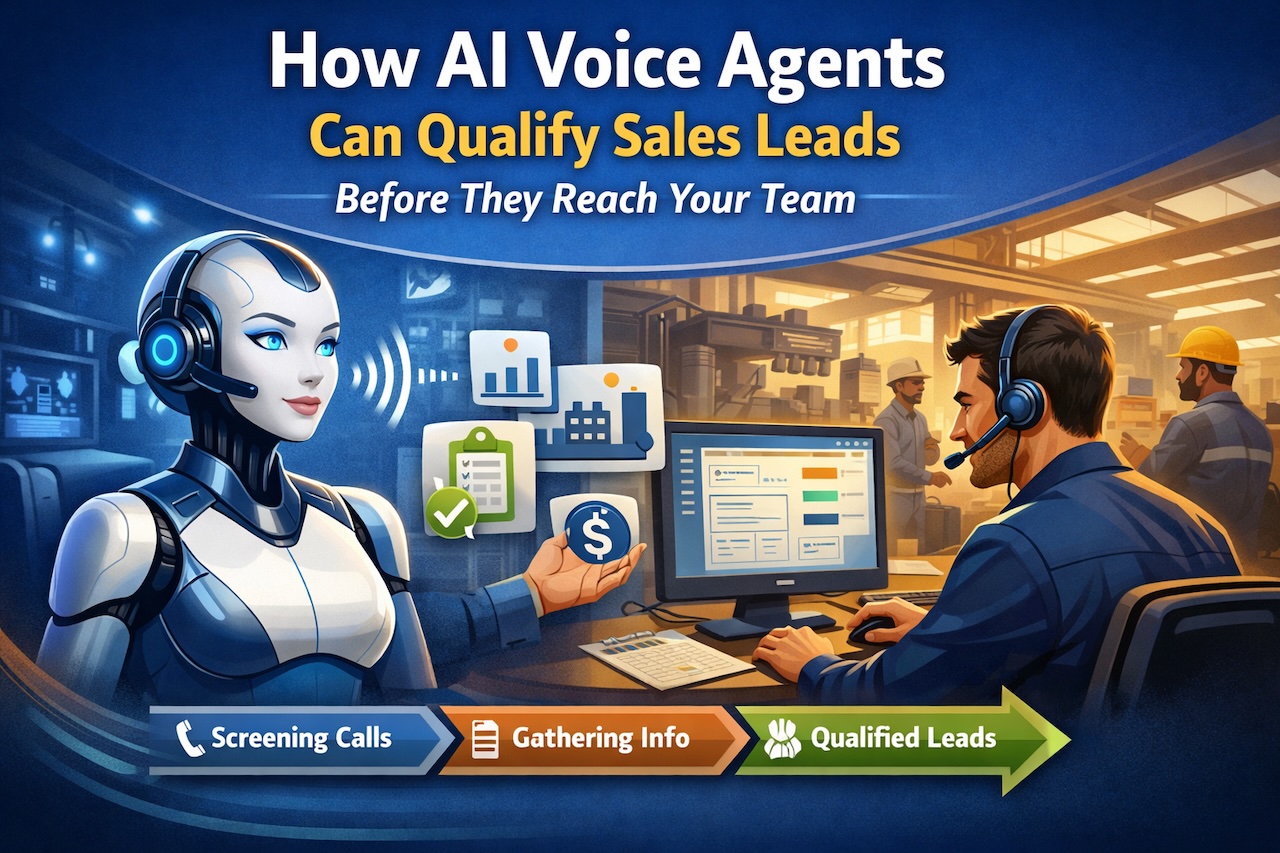
Sales teams working in manufacturing and factory environments often face a familiar problem. The phone rings constantly with enquiries about pricing, stock availability, custom orders, technical specifications, and delivery timelines. Many of these calls are valuable, but not all of them are ready for a sales conversation.
A production manager might be calling for technical clarification. A student may want general information about materials. A buyer may only be comparing suppliers and is not yet prepared to place an order. When these calls go directly to sales staff, valuable time disappears into conversations that do not move the pipeline forward.
AI voice agents are increasingly being used as the first layer of interaction. Instead of replacing sales teams, they act as an intelligent filter, gathering the information needed to determine whether a caller is a genuine sales opportunity or simply an enquiry that can be handled differently.
Why Unqualified Sales Calls Slow Down Manufacturing Sales Teams
Factories and industrial suppliers receive a unique mix of enquiries. Unlike many other industries, calls often combine technical questions with commercial discussions.
A typical inbound call might involve someone asking about alloy composition, minimum order quantities, machine compatibility, or fabrication tolerances. While these are important conversations, they do not always require immediate involvement from a sales representative.
Without a filtering process, sales teams spend hours answering questions that could be handled earlier in the process. This creates several operational challenges:
- Sales staff have less time to focus on high value prospects
- Response times to serious buyers become slower
- Technical teams may be interrupted with non urgent requests
- Pipeline visibility becomes unclear
Over time, this creates a bottleneck. The team is busy, but not necessarily productive.
How AI Voice Agents Act as the First Qualification Layer
An AI voice agent can answer the phone immediately and begin a structured conversation designed to understand the caller's intent.
Instead of simply transferring calls, the system gathers useful information such as the company name, purchase requirements, timeline, and type of product needed. These questions are not random. They are designed to mirror the qualification steps that experienced sales teams already follow.
For example, when a manufacturing supplier receives a call, the AI agent may ask:
- What product are you looking for today
- What industry is your company in
- What quantity are you looking to purchase
- Is this for an immediate order or future project
- Do you require custom fabrication or standard stock
Within seconds, the system has enough context to determine whether the call should move to sales, customer service, or technical support.
This approach keeps conversations efficient without making callers feel like they are navigating a complicated menu system.
Practical Example in a Factory Supply Environment
Consider a company that supplies stainless steel components to construction and engineering firms.
A contractor calls to ask about sheet sizes and lead times. Instead of waiting in a queue, the AI voice agent answers immediately and begins gathering details.
The system asks what thickness and grade the caller is interested in, the estimated order volume, and whether the purchase is for an upcoming project or immediate delivery.
If the caller confirms they are preparing a large order for an active construction project, the call is transferred directly to a sales representative along with the captured information. The sales team already knows the caller's requirements before saying hello.
If the caller is simply exploring options or looking for general specifications, the enquiry can be directed to a technical resource or an information line instead.
This small adjustment dramatically improves how calls flow through the business.
Using an AI Call Centre to Structure Lead Qualification
Many industrial businesses are now introducing this capability through an ai call centre platform that combines voice automation with customer data systems.
In this model, the AI agent is connected to CRM software, product databases, and order systems. When the system identifies a qualified prospect, the information is automatically logged and attached to the lead record.
Sales teams receive calls that already include context such as product interest, estimated order value, and project timelines. This allows them to begin the conversation at a much more advanced stage.
For factory suppliers dealing with high volumes of inbound enquiries, this structured qualification process removes much of the guesswork from pipeline management.
Capturing After Hours Sales Opportunities
Manufacturing companies often operate across different time zones or serve clients working outside typical office hours.
A buyer in another region might call in the evening to check availability before placing an order the next day. If nobody answers the phone, that opportunity may simply move to another supplier.
AI voice agents ensure that every call is answered regardless of the time of day. The system can collect key information, confirm requirements, and schedule a call back from a sales representative.
By the time the sales team returns the call, they already know the customer's needs and can move directly into a meaningful discussion.
For factories that rely heavily on inbound enquiries, this capability alone can significantly improve lead capture.
Reducing Interruptions for Technical and Production Teams
Another overlooked benefit is the impact on internal operations.
In many manufacturing businesses, sales staff frequently rely on engineers or production managers to answer technical questions during calls. When these calls are poorly qualified, they interrupt workflows on the factory floor.
AI voice agents reduce these interruptions by filtering calls before they reach internal teams. Only enquiries that genuinely require technical expertise are escalated.
Routine questions about stock availability, order status, or delivery timelines can be handled automatically or routed to the appropriate department.
This keeps production teams focused on manufacturing rather than fielding random phone enquiries.
Improving Sales Focus Without Removing the Human Element
There is often concern that automation will remove the human aspect of sales. In practice, the opposite tends to happen.
When AI handles early stage conversations, sales representatives spend more time speaking with buyers who already have a clear requirement. These conversations are more productive and more likely to convert.
The technology simply removes the repetitive filtering stage that previously consumed hours of the team's day.
Sales professionals remain responsible for building relationships, negotiating contracts, and guiding customers through complex purchasing decisions.
The AI voice agent simply ensures that those conversations begin with the right prospects.
Conclusion
Factories and industrial suppliers often struggle with the volume and variety of inbound enquiries they receive. Many calls require information gathering before they are ready for a meaningful sales discussion.
AI voice agents provide a practical way to handle this challenge. By capturing key information, identifying genuine buying intent, and routing calls appropriately, they create a structured path from enquiry to qualified opportunity.
Businesses that implement an AI call centre approach are not replacing their sales teams. Instead, they are protecting their time, improving pipeline quality, and ensuring that every inbound enquiry is handled with the right level of attention.
Featured Image generated by ChatGPT.
Share this post
Leave a comment
All comments are moderated. Spammy and bot submitted comments are deleted. Please submit the comments that are helpful to others, and we'll approve your comments. A comment that includes outbound link will only be approved if the content is relevant to the topic, and has some value to our readers.
Comments (0)
No comment