
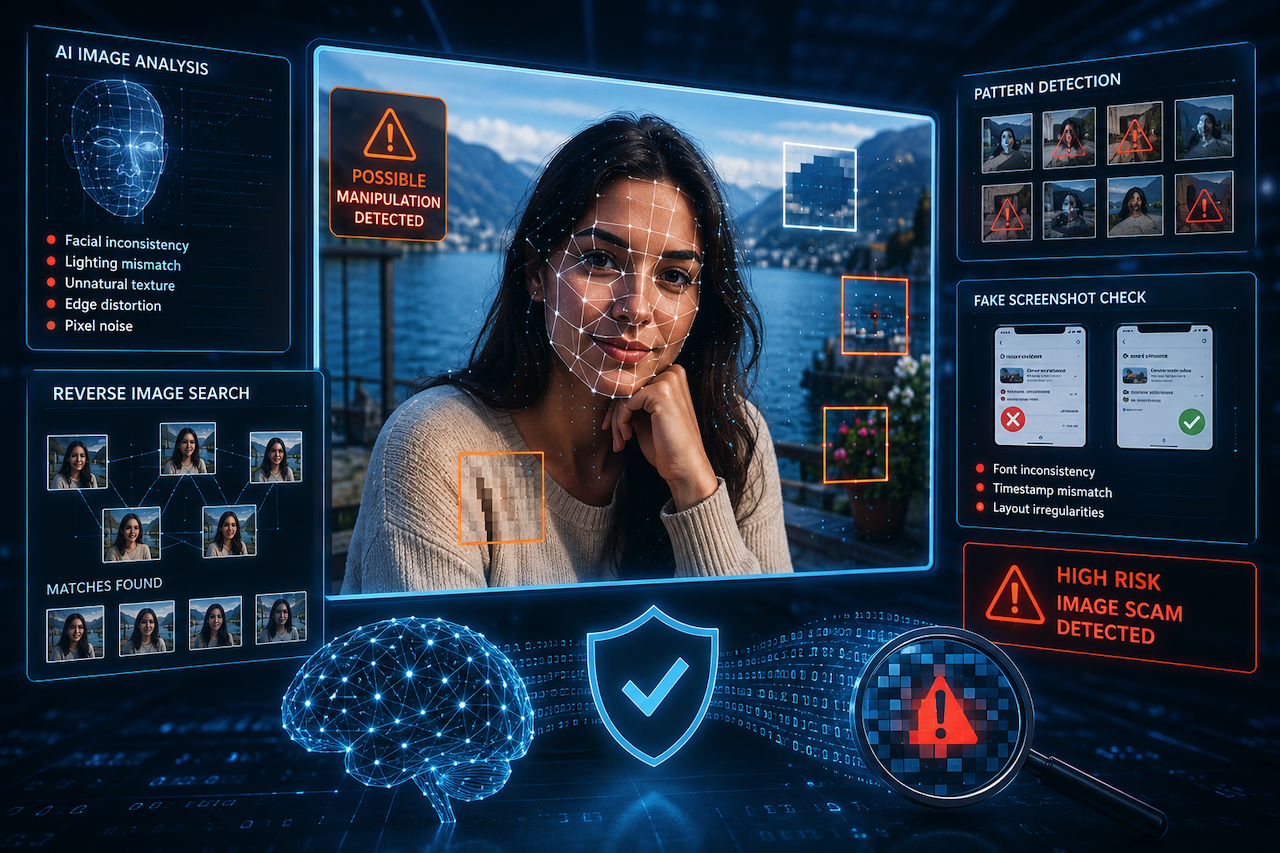
Image scams nowadays are more common than you might imagine.
Scammers online are always on the hunt to generate fake profiles, create convincing visuals, and trap you into sharing your personal information or paying them money.
And the problem is that, since the rise of AI, image-based scams look way more legitimate than ever. And honestly, your eyes are surely not enough to catch the deception.
Therefore, what you actually need here to stay safe is to take a little help from AI to cut through the illusion created by scammers.
Confused?
Well, keep reading, as this guide covers all the details on how the tools work and how you can use them to stay protected.
5 Smart Ways AI Can Help You Detect Image-Based Scams
Here are some smart, effective ways AI can help you spot and expose image scams.
1. Spotting Manipulated and Deepfake Images
Scammers today increasingly rely on AI to create fake visuals.
And honestly, modern AI tools can generate images that sometimes appear just as realistic, or even more polished, than real photographs.
So you might be wondering: if AI-generated images have become so advanced, how can they still be detected?
The answer is simple: AI can create images, but AI can also help detect them.
An advanced AI image detector is specifically designed to identify manipulated and AI-generated visuals, often spotting details that are difficult for the human eye to notice.
But how does that work?
Every image is made up of elements like pixels, colors, lighting, textures, and patterns. AI detection tool analyzes these details in greater depth to identify subtle inconsistencies that often arise during image generation.
These signals may include:
- Unnatural or overly smooth skin texture
- Lighting that does not match across different parts of the image
- Blurred, warped, or distorted facial edges
- Pixel noise patterns that appear inconsistent
- Unusual shadows, reflections, or image artifacts
Because these tools are trained to recognize common AI generation patterns, it can identify flaws and determine whether an image has likely been manipulated or generated using AI.
2. Verifying Images Through AI-powered Image Search
Another powerful way AI helps in detecting image scams is through reverse image search.
Basically, when you upload an image, AI doesn’t just look for exact matches anymore. It goes way deeper than that.
A modern AI-powered reverse image search tool analyzes the image's actual visual structure, not just its surface. This includes patterns, shapes, objects, and even context within the picture.
Let me break it down.
Instead of only asking “Where has this image appeared before?”, AI looks for the following:
- Is this image being reused in a different, misleading context?
- Has this photo been slightly edited or cropped to hide its origin?
- Are there multiple versions of this image across different websites?
- Does this image match real-world sources or stock databases?
So even if scammers try to slightly modify an image, by cropping it, changing colors, or adding filters, AI can still trace its origin or find similar versions online.
This makes it much easier to expose fake listings, impersonation profiles, or misleading product images before they can trick users.
3. Flagging Fake Product Images in E-commerce
Professional, polished, and attractive images make even a fake store look legitimate. These stores use stolen images to get you to click on their sites and place an order, but in reality, you never receive your parcel.
To eliminate this threat, AI is very helpful, as it analyzes images for signs of reuse or manipulation. Many legitimate online stores, such as Amazon and eBay, already use image recognition AI to verify listings.
Here's what the system checks:
| What AI Checks | Why It Matters |
|---|---|
| Image stolen from another seller | Proves the listing isn't original |
| Watermark digitally removed | Sign of deliberate deception |
| The photo doesn't match the product category | Listing is likely fraudulent |
| AI-generated visuals | No real product exists |
AI-powered browser extensions also scan product images in real time while you shop. They alert you before you hand over your payment details.
4. Detecting Fake Screenshots and Fabricated Proof
Buyers online never prove a website's claims alone. They need social proof to judge its worth and proof of liability.
So, scammers often add fake screenshots and customer reviews to earn that trust.
These can be highly convincing, such as doctored bank receipts, forged payment confirmations, or even fabricated chat logs.
And honestly, these fabrications are something that even the image search tools can't detect.
Because let's be logical, where else are you supposed to find those fake screenshots except on that same scammer's page?
Therefore, in such cases, you can surely seek help from AI to analyze patterns and identify digitally generated or edited visuals.
They check things like:
- Font rendering and style consistency
- Timestamp formats
- Layout spacing
- App UI elements specific to known platforms
Wondering how it helps?
Let me illustrate it with a simple example.
Suppose a scammer sends a "proof of payment" screenshot. The font used for the payment amount doesn't match the original app's font. That's a clear sign the image was edited.
So, in simpler words, you can trust AI to catch those large portions of amateur edits that scammers rely on.
5. Identifying Suspicious Patterns in Bulk Image Uploads
Most scammers online pay more attention to the number of listings than to their quality.
Reason?
Because if there are more listings, the account obviously becomes more credible, and people will trust it without thinking twice.
So, humans can't really spot these patterns. However, AI surely can.
An AI detection tool looks at the patterns such as;
- Upload timestamps — were hundreds of images uploaded within minutes?
- File naming patterns — do they follow an automated, non-human sequence?
- Image hashes — is the same image file appearing across many accounts?
- Geolocation data — does the upload location match the claimed seller location?
When the same image, or nearly identical images, appear across many unrelated accounts in a short time, the system flags them automatically.
And the best part is, in such scenarios, even if the scammer slightly edits each image to avoid a direct match, AI still detects the visual similarity.
Conclusion
Scammers are getting smarter, but so are the tools built to stop them. The real advantage AI brings isn't just speed. It catches what the human eye naturally misses: a mismatched pixel, a recycled image, a font that doesn't belong. These are the details that scammers count on you to overlook. You don't need to become an expert in spotting fraud. You need to use the right tools before you click, pay, or trust. Stay skeptical. Stay protected.
Featured Image generated by ChatGPT.
Share this post
Author

Read the latest articles from Ethan David
Catfishing Explained: How to Identify Fake Profiles and Stay Safe Online
June 16, 2025
Fake online identities aren’t new, but the risks associated with them have grown with our increasing digital footprint. One of the most deceptive and dangerous online scams today is catfishing.
Learn moreBest Plagiarism Checkers for Bloggers - Why Is It Important to Check for Plagiarism?

January 15, 2024
Blogging is fun. It’s one of the best side hustles right now. Many people who run their blogs don’t need to find any other job. For many, it’s an excellent investment. But for others, it’s a challenging and tiring job requiring a lot of hard work, time, and consistent effort.
Learn moreLeave a comment
All comments are moderated. Spammy and bot submitted comments are deleted. Please submit the comments that are helpful to others, and we'll approve your comments. A comment that includes outbound link will only be approved if the content is relevant to the topic, and has some value to our readers.
Comments (0)
No comment