

IP Address, Cybersecurity, Geolocation
8 Ways IP-Based Lead Scoring Filters Out Fake Leads

Your lead scoring is only as good as the leads you pour into it. And a huge slice of today's leads are not even human. A lot are bots or junk form fills. Every one of them wastes your marketing efforts. Score that garbage like a real buyer, and your whole model slowly goes rotten.
The thing most sales and marketing teams sleep on is the IP address behind every form. It is carrying a ton of signals you never look at. That same IP intelligence already flags fraud at checkout, and it works just as well on your leads. Here are 8 ways it filters the fakes out before they ever reach your sales team.
What Lead Scoring Is And Why Fake Leads Break It
Fast refresher first. If you already know this cold, skip down to the 8 ways.
Lead scoring enables organizations to rank leads so their team calls the best ones first. Points go to whatever suggests a real buyer, like a senior job title or a company that fits. The whole lead scoring process just squeezes a long, complicated list down to one number.
Most teams mix a handful of data points, from firmographics to on-site behavior. Some add a predictive lead scoring model and let it do the weighting. The point is always the same, though.
Get marketing and sales teams agreeing on the same definition of a good lead, then prioritize the most promising leads first. Clear scoring rules also help reps prioritize leads based on fit and buying intent.
So, why is lead scoring important? Because your sales team has limited time, and not every lead deserves the same attention. Without a clear scoring system, reps can spend hours chasing people who will never buy while qualified prospects wait for a response.
Pull it off, and this becomes the spine of solid lead management. Reps stop wasting their day on dead-end leads. Your highest quality leads float to the top. And they get there earlier in the sales cycle.
Every lead scoring model leans on one assumption, though. That a human is behind the lead at all. Give it a bot, and it will gladly crown that bot a hot lead.
This is not some fringe worry. Thales pegs automated traffic at 51% of the entire web now. More than half. That junk goes straight into the top of your sales and marketing funnel and drags the whole score down with it.
So you want one more layer that answers a blunt question. Person or machine. IP data settles it faster than anything else. Most lead scoring software can pull it in on its own, flagging the fakes before they ever reach your pipeline.
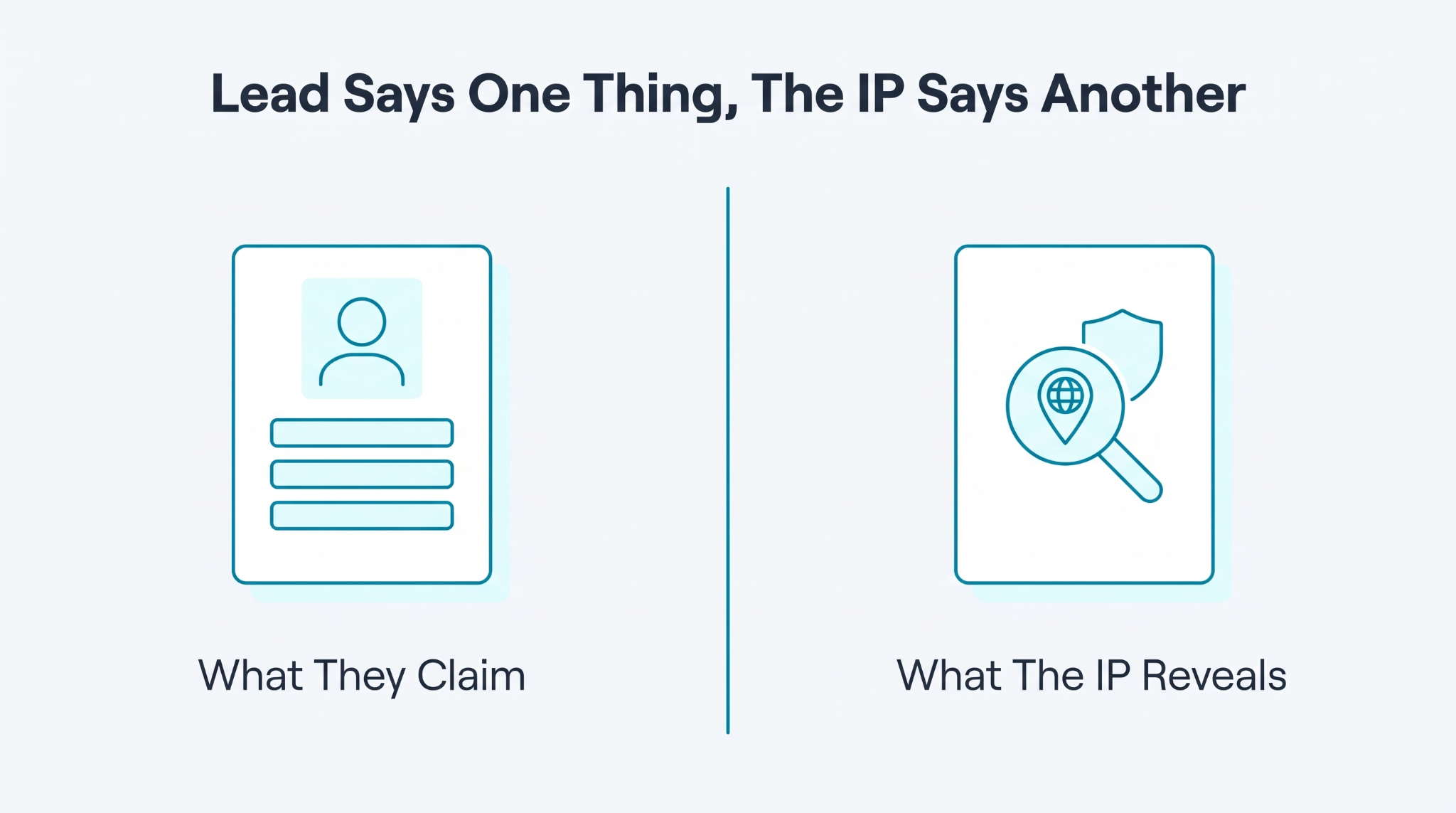
What The Lead Types In
| What The Lead Types In | What The IP Actually Reveals |
|---|---|
| A name and work email | Whether a human or a server sent it |
| A US business address | A data-center IP in another country |
| A senior-sounding job title | A residential IP with no company behind it |
| One eager prospect | Fifty submissions from the same subnet |
8 Ways IP-Based Lead Scoring Filters Out Fake Leads
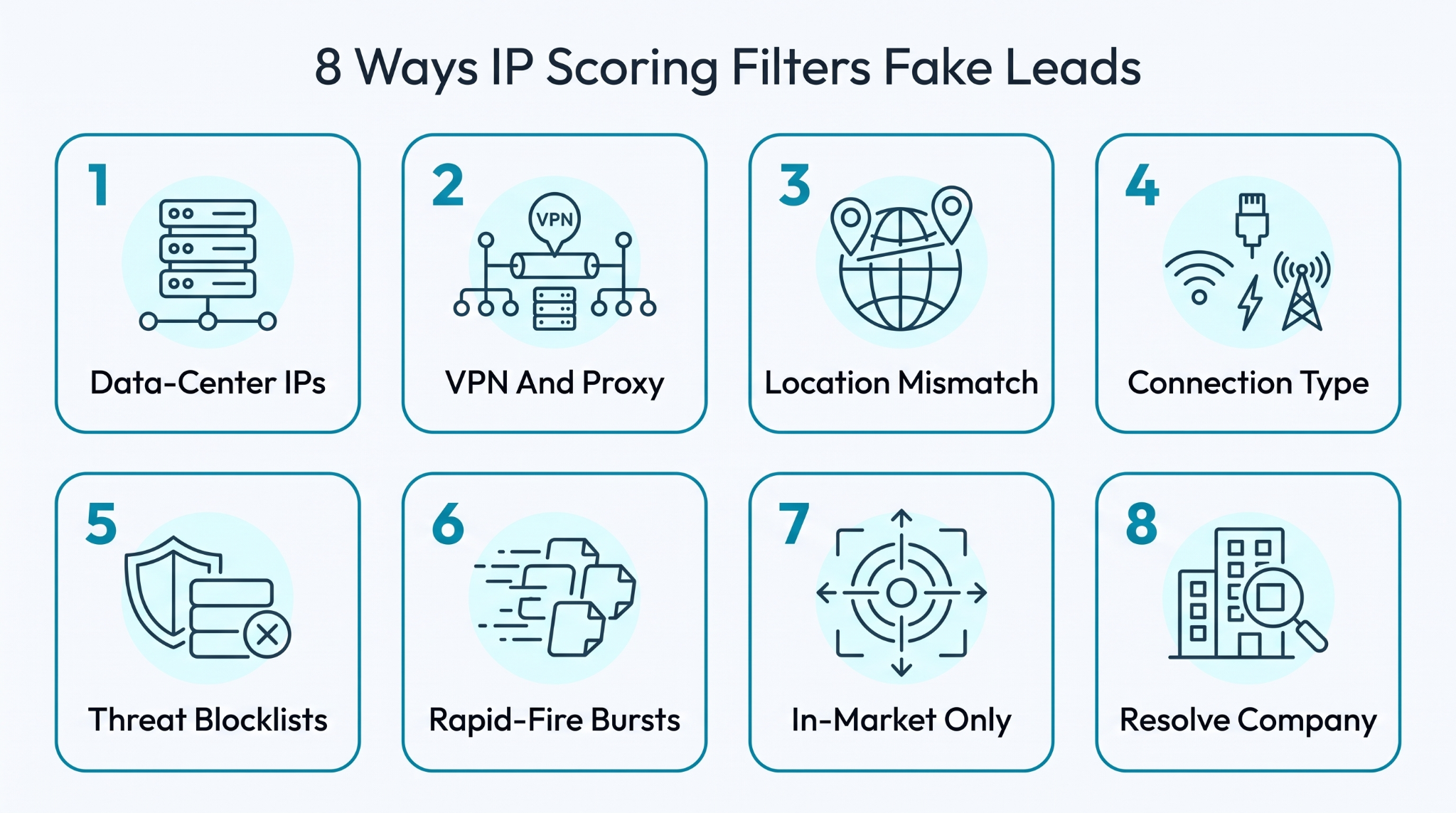
Okay, the eight ways. Each reads a different IP signal, so none of them step on each other. Run two or three together and most fakes never even reach your lead scoring system. Automated lead scoring can apply these IP checks as soon as a form comes in.
1. Drop Leads Coming From Data Center And Hosting IPs
Real humans show up from homes, offices, and phones. Nobody files a form from inside a server rack. So when a lead's IP points back to AWS or some hosting outfit, you already know. No person did that. A script did.
Most of the junk is born right here. Scrapers, spam bots, fake-signup scripts – all running on cheap cloud servers. And the scale is brutal. Only 25% of leads are actually real, going by Lunio.
Learn to spot those data-center ranges, and you wipe out a massive chunk of the problem in one shot. Combining IP checks with other lead generation tools helps you catch more fake submissions early.
How To Do It:
- Check every new lead's IP against a known list of hosting providers
- Auto-reject any submission whose IP resolves to a cloud or server network
- Flag the whole ASN so one bad network gets scored down everywhere
- Keep a short allowlist for the rare legit corporate cloud user too
2. Spot VPN, Proxy, And Tor Traffic Hiding The Real Visitor
Some fakes are craftier than a plain server. There is a real person on the other end, just hiding where they are. A VPN covers their tracks. So does a proxy or Tor. Plenty of the time, that is harmless privacy. Other times, it is someone dodging the fact they are in a country you would never ship to.
That said, a VPN on its own is not proof of fraud. Loads of genuinely careful buyers run one. So treat it as a factor in the score, never an instant door slam. It just means look closer. Getting familiar with how sites really detect proxies helps you split a cautious shopper from a bot in a mask.
How To Do It:
- Add a VPN and proxy check to every single inbound form submission
- Dock some points for masked traffic rather than blocking the lead outright
- Treat Tor exit nodes as a far stronger signal of real fraud
- Combine the VPN flag with other data points before you ever act
3. Compare The IP Location Against What The Form Claims
This one is just a contradiction check. The lead types in a Chicago address and a 312 number. Their IP is parked in Vietnam. Both can’t be true at once. A real Chicago buyer connects from Chicago. A gap that wide is a flat-out lie, and lies are about as strong a fake-lead tell as you get.
And it doesn’t need to be continents apart to count. City against city. Country against country. It all adds up. Pulling the visitor's true location from IP geolocation and holding it next to the form is one of the quickest fake-lead checks there is.
The nice thing here is how hard this is to dodge. A bot can type any address it likes. It can’t so easily fake the physical spot its traffic comes from. So the mismatch stays lit even when every other field on the form looks spotless.
How To Do It:
- Match the IP country against the phone number's own country code automatically
- Flag any lead whose stated billing region fights its detected IP location
- Score a browser timezone that clashes with the claimed address as risky
- Allow small gaps, since travel and mobile data can shift real locations
4. Effectively Score Leads By Connection Type: Business, Residential, Or Mobile
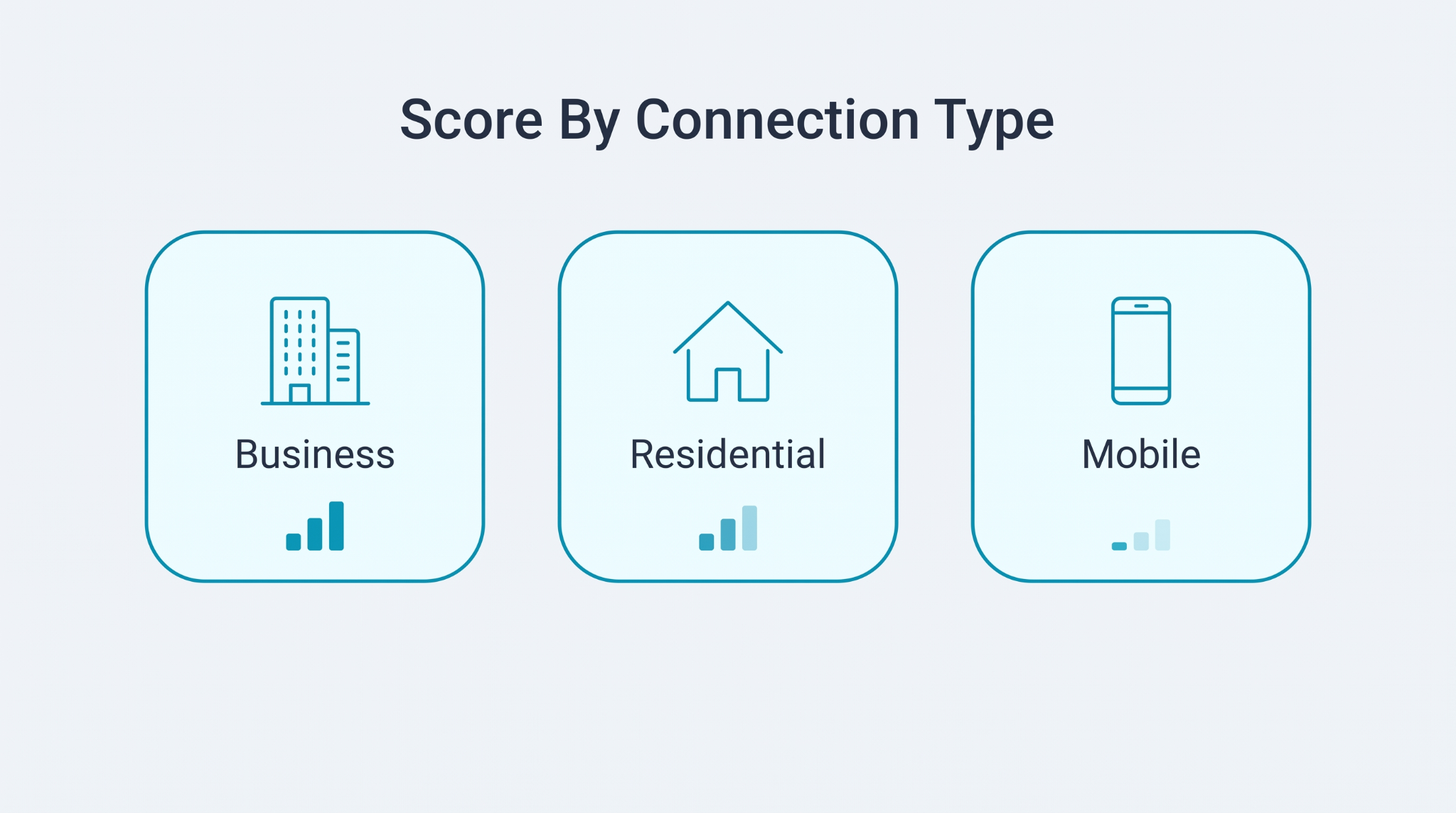
Not every real lead is worth the same point value. The kind of connection behind the IP tells a lot about intent. A corporate or business ISP usually means someone looking around at work, which is exactly who you want for B2B. A home line is a consumer on the sofa. Mobile is someone half-paying attention on the move.
This one is less about binning fakes and more about ranking the keepers. An IP that maps to a company network is a quiet little vote of confidence for a B2B lead. It is implicit lead scoring in action, since the lead never typed a word of it.
One more data point bumps a genuine prospect up the list, no extra questions asked. Combine this signal with engagement and company fit to identify marketing-qualified leads worth passing to sales.
The difference becomes clearer wherever one product gets bought by two completely different crowds. On one side, a homeowner is buying a few fixtures. On the other, a commercial account is ordering in large quantities. Same form and same product. Wildly different value.
Scoring them identically means your reps waste hours on small orders while the whale waits in the queue.
To understand this better, take this company selling drought-resistant grass that goes to homeowners and big commercial buyers alike. A backyard order might be a few hundred square feet. A golf course or a sports-field contractor orders by the truckload over and over. Those two leads look identical on the form, but one is worth a hundred times the other.
Here's the issue. The form can't tell them apart, because anyone can type a company name into a box. But the connection type can. A homeowner shows up on a residential line. A grounds crew or a landscape firm connects from a business network.
Score that business IP up, and the acre-sized lead jumps the queue on its own. Now the big order gets a fast callback instead of growing cold behind 50 backyard inquiries.
How To Do It:
- Add points when the IP clearly belongs to a registered business network
- Score residential IPs as neutral unless some other signal looks clearly off
- Move mobile-only leads down a little for your high-value B2B offers specifically
- Map the ISP type automatically rather than guessing it from the address
5. Screen Every IP Against Live Threat Blocklists
Some IPs are already infamous. They have been reported for spam or fraud and now appear on public blocklists. A lead comes from one of those, and there is nothing left to wonder about. Somebody already caught it misbehaving. Running leads past these lists is free reputation data, and skipping it would be daft.
There is a real issue the second you do this at volume, though. Those blocklists are gigantic, and they shift by the minute. Every lead means one more live query against millions of records that never stop updating.
Fine on a slow day. But fire a campaign and watch traffic spike. All those lookups start hammering the same database running your lead forms and your CRM.
Now the queries queue and latency climbs. Two ugly things can happen. Either the form itself lags and you lose the real buyer waiting on it, or the reputation check times out and a fake sails silently through unchecked.
Keeping those lookups fast is pure database work, not marketing. It is indexing the reputation tables, caching the hot ones, and tuning queries to respond in milliseconds under load. Most teams have nobody in-house for that.
DBA managed services do exactly this. They keep the blocklist tables fast and readily available, so your scoring never stalls or silently skips a check because the query timed out.
For any business running IP checks on heavy lead volume, that steady back end is what keeps the whole filter trustworthy. Get the database right, and every other IP signal on this list runs faster too.
How To Do It:
- Screen every IP against several reputable blocklists at once, not just one
- Refresh your blocklist feeds every day so the reputation data stays current
- Weight a listed IP heavily, since someone else already proved it bad
- Log every blocklist hit so you can audit any false positives later
6. Flag Rapid-Fire Submissions From One IP Range
One person fills your form once. Twice, tops. A bot fills it 200 times before its coffee gets cold. When a wave of submissions gushes out of one IP or one tight subnet in minutes, that is not a sudden crowd of interest. It is a script stuck on repeat. The rhythm gives it away long before the fake names do.
This velocity check protects your ad spend too, not just your CRM. A lot of this junk rides in on the exact fraud that bleeds paid campaigns dry. Spider AF reckons 51.8% of ad budgets are wide open to it. Spot the burst early, and you quit paying to haul in sales leads that were never going to buy.
There is a bonus in watching this closely. The same velocity data outs coordinated attacks, not just lone bots. Fifty different leads sharing one subnet inside an hour is one attacker, not a marketing campaign working. Scoring the pattern rather than every single form is what makes it hold.
How To Do It:
- Cap how many form submissions a single IP can send per hour
- Watch whole subnets as well, since bots rotate across many nearby addresses
- Score any burst with perfectly identical timing as automated, not human interest
- Add a short cooldown before the same IP can submit the form again
7. Weight Leads By Whether The IP Sits In Your Market
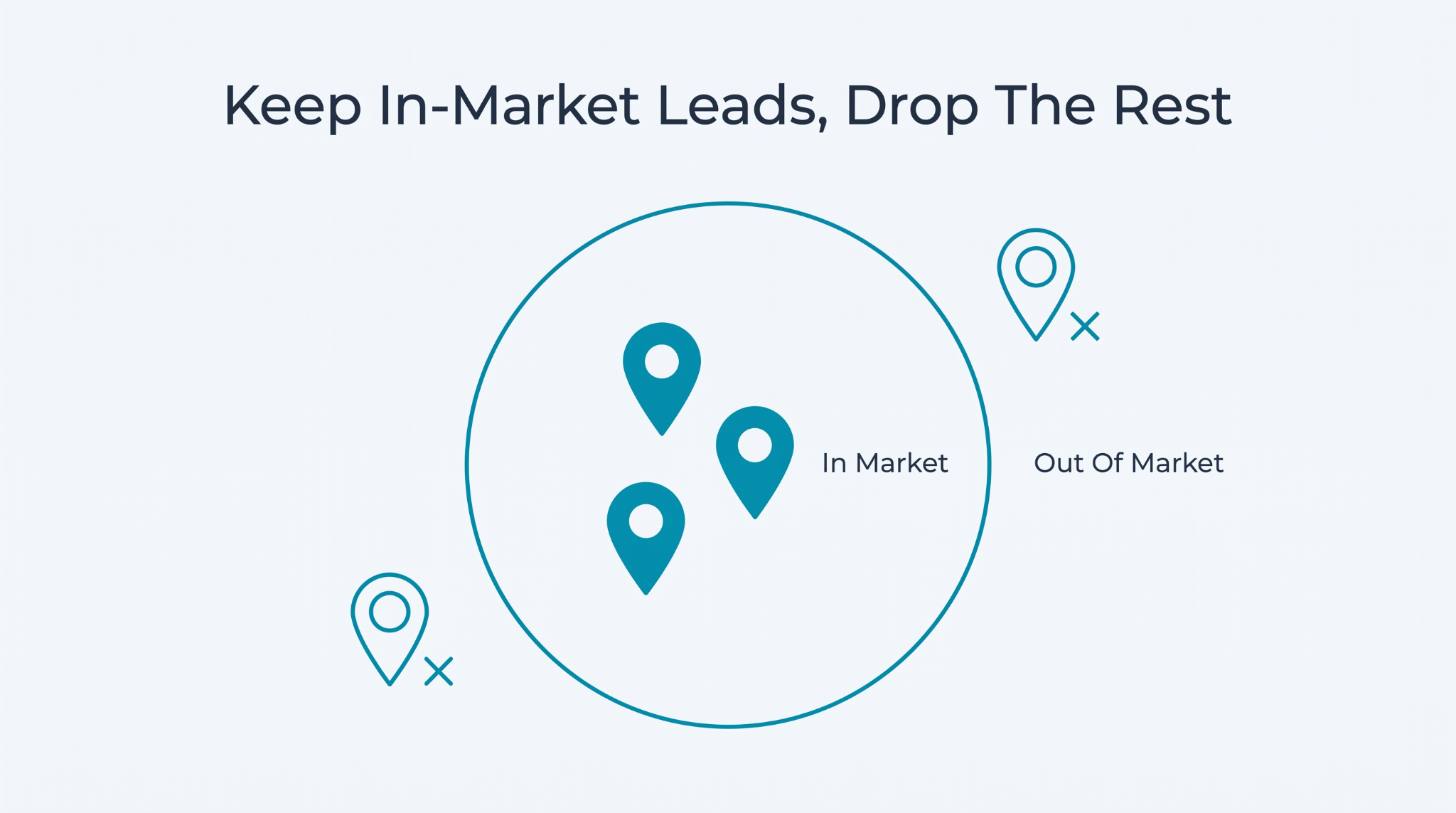
Here is a fake that is not even trying to scam you. It is just useless to you. A lead whose IP is parked somewhere you don’t sell is wasted lead generation effort, however real the human behind it.
Say you only serve one metro or one country. A form fill from the far side of the world is pure irrelevant traffic. The IP tells you that before a rep ever dials.
This turns into make-or-break for local service businesses. The ones who can only ever help people inside a set radius. Something dies at 11 pm in January, and the homeowner wants a tech at the door in two hours, not a national hotline. Out-of-area leads flood those forms anyway, pushed by bots and sloppy lead sellers.
Home repair services are the clearest case going. A crew like this water heater installation company handles same-day emergency calls across a metro area, with two-hour windows and a real person answering the phone. A lead from three states over is worth nothing to them. Worse than nothing, actually.
Every minute a tech spends on it is a minute stolen from a neighbor whose house is freezing. And the form text alone can’t save them, since anyone can type a local-looking address into a box. The IP is the honest answer, since it shows the real city the request came from.
So the move is simple. In the radius, fast-track it. Outside the radius, drop the score or bin it. Any business where the work is performed at the customer's address leans heavily on this.
Change it around, though, and it is worth a quick note. If you genuinely sell across borders, that foreign IP is not junk at all. It is a real prospect you ought to be serving in their own language, which is a whole multilingual strategy of its own. Score against your actual footprint, not a lazy blanket rule.
How To Do It:
- Define your real service area clearly before you score a single lead
- Drop the score for any IP outside the regions you actually sell to
- Route verified in-area leads into a faster lane than all the rest
- Keep separate scoring rules per region if you serve several distinct markets
8. Resolve Business IPs To The Real Company Behind Them
The last one changes the whole game to offense. Instead of only tossing out fakes, you confirm the keepers. A reverse IP lookup can usually name the actual company behind a business connection. That anonymous form fill suddenly reads as a known org, maybe a real enterprise looking around. No stronger proof of a genuine lead comes off an IP.
And this is also the moment IP data stops playing pure defense. Naming the company lets you enrich the lead and auto-fill the firmographics. Then route it to the right rep in seconds. Piping those IP-aware signals into your CRM turns a bare IP into real context your sales team can run with straight away.
How To Do It:
- Run a reverse IP lookup to name the real company behind leads.
- Boost the score sharply when the IP maps to a target account.
- Auto-fill the firmographics from the resolved company to save reps manual work.
- Route a named-company lead straight to the right sales rep almost instantly.
4 Lead Scoring Mistakes That Let Fake Leads Slip Through
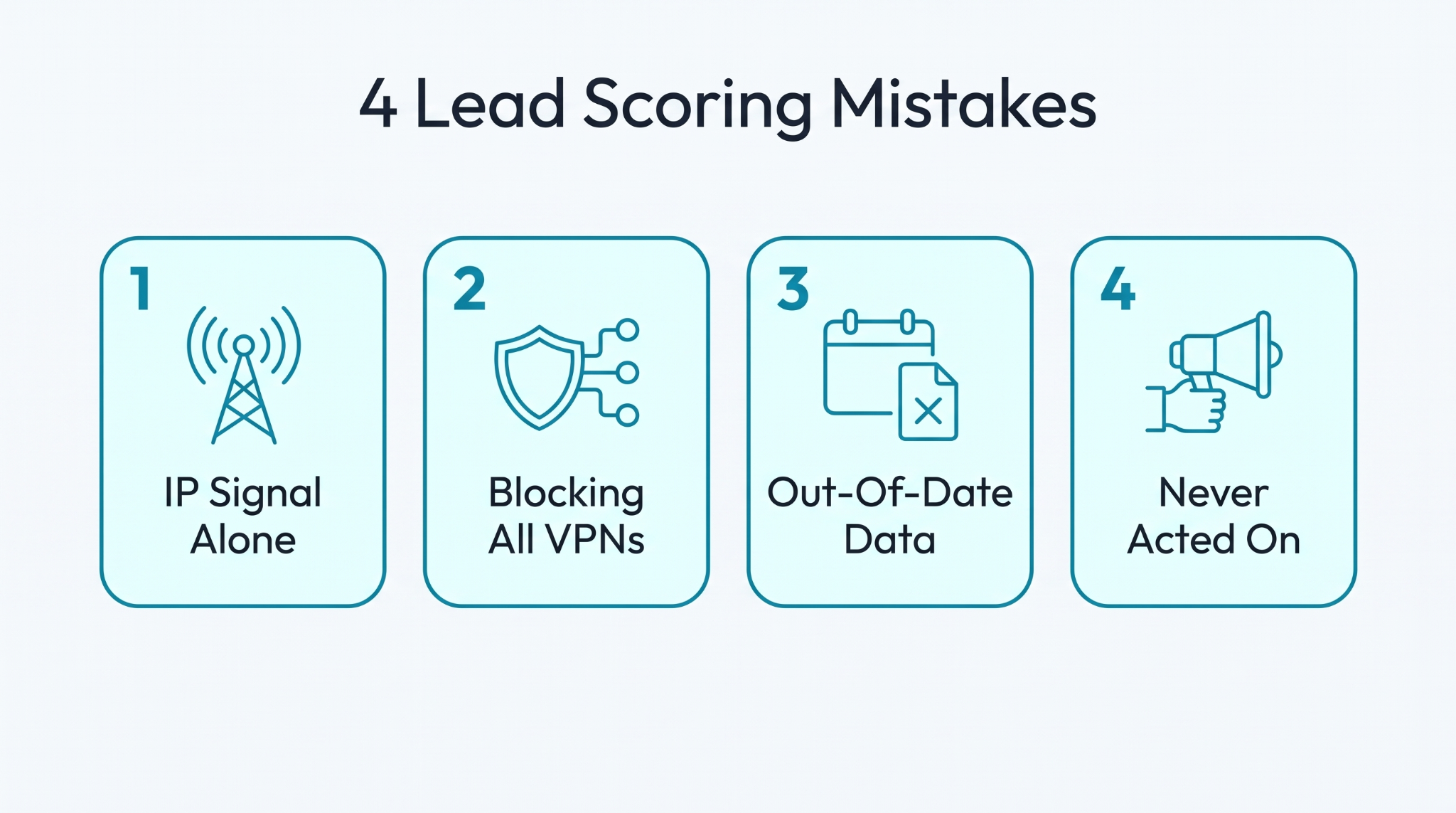
IP signals pack a punch, but they are easy to botch. These 4 mistakes let fakes creep back in.
1. Implementing Lead Scoring Model Based On IP Signals Alone
IP data is a brilliant filter. It was just never built to work solo. Lean on it alone, and you will blow calls in both directions. A real buyer on some flagged coffee-shop WiFi gets booted. A sharp bot on a clean home IP strolls right past. The IP is one layer of a bigger marketing and sales process, not the whole judge and jury.
How to Fix: Blend the IP signal with customer data like behavior and firmographics; don’t swap them out for it. Let a strong company fit or a real engagement score outweigh one jumpy IP flag. Compare lead scores alongside firmographic and behavioral data before deciding which prospects deserve attention. The IP should tweak the score, never hand down the whole verdict alone.
2. Hard-Blocking Every VPN And Proxy User
This mistake costs you actual money. Treating every VPN as fraud feels careful, but heaps of real buyers use one. Remote workers. Privacy nerds. Entire corporate networks that route through a VPN by default. Block the lot, and you are bolting the door on qualified leads whose only crime is caring about privacy. The fakes you stop are not worth the deals you torch.
How to Fix: Knock a few points off VPN traffic; do not auto-block it. Pair that flag with other signals before you reject a soul. Save the hard no for Tor, or for IPs that also flunk a reputation check.
3. Running Your Lead Scoring System On Out-Of-Date Blocklists And Old IP Data
IP reputation is not a one-time deal. Addresses get handed to new owners constantly. A dirty IP from last year might belong to a legit company today. A clean one might have been hijacked last week. Run your checks on old data, and you get the worst of both. You block fresh real leads and wave brand-new threats on through.
How to Fix: Pull live blocklist and geolocation feeds, not a file you downloaded once and forgot. Refresh your IP data on a set schedule to keep it aligned with reality. Re-check your big leads at decision time instead of trusting some old score.
4. Flagging Fake Leads But Never Wiring It Into The Workflow
You can build the sharpest IP filter alive and still waste the whole thing. If the score hides in a report nobody opens, reps keep dialing the junk regardless. The entire point is to change what sales does come Monday morning. A flag that never reaches the CRM or the routing rules is just a fun fact. Scoring fakes means nothing until it actually stops a rep from calling one.
How to Fix: Feed the IP score straight into your CRM and your routing, not a dashboard. Auto-suppress or deprioritize the flagged leads so reps never lay eyes on them. Make the filter run itself, so nobody has to remember to look.
Conclusion
So where does this leave your lead scoring? In a far stronger spot, honestly. You don’t need all 8 filters live by Friday. Pick the two that kill the most junk for you. For most, that is data-center IPs and out-of-market location. Add the rest over time. Every fake you stop early is a real conversation handed back to your sales team.
Doing all this by hand is a nightmare, which is exactly why we built the free tools at iplocation.net. Paste in any IP address, and you'll see its location and ISP right away. You also see whether it is a VPN, a proxy, or a data-center address. Then a fraud score on top.
It is the same IP intelligence this whole guide leans on, with no sign-up and no bill. Next time a lead looks a bit too perfect, run its IP and see.
Comments
Comments are available to signed-in users and are moderated to keep the discussion useful and respectful. Spam, automated submissions, and low-value promotional comments are removed. Outbound links may be approved when they are relevant and genuinely helpful to readers, but they are displayed as plain text rather than clickable hyperlinks.
No comments have been published yet.
Please sign in to submit a comment.