

IP-Aware Salesforce Apps: Fraud Prevention, Bot Defense, and Privacy-First Network Signals
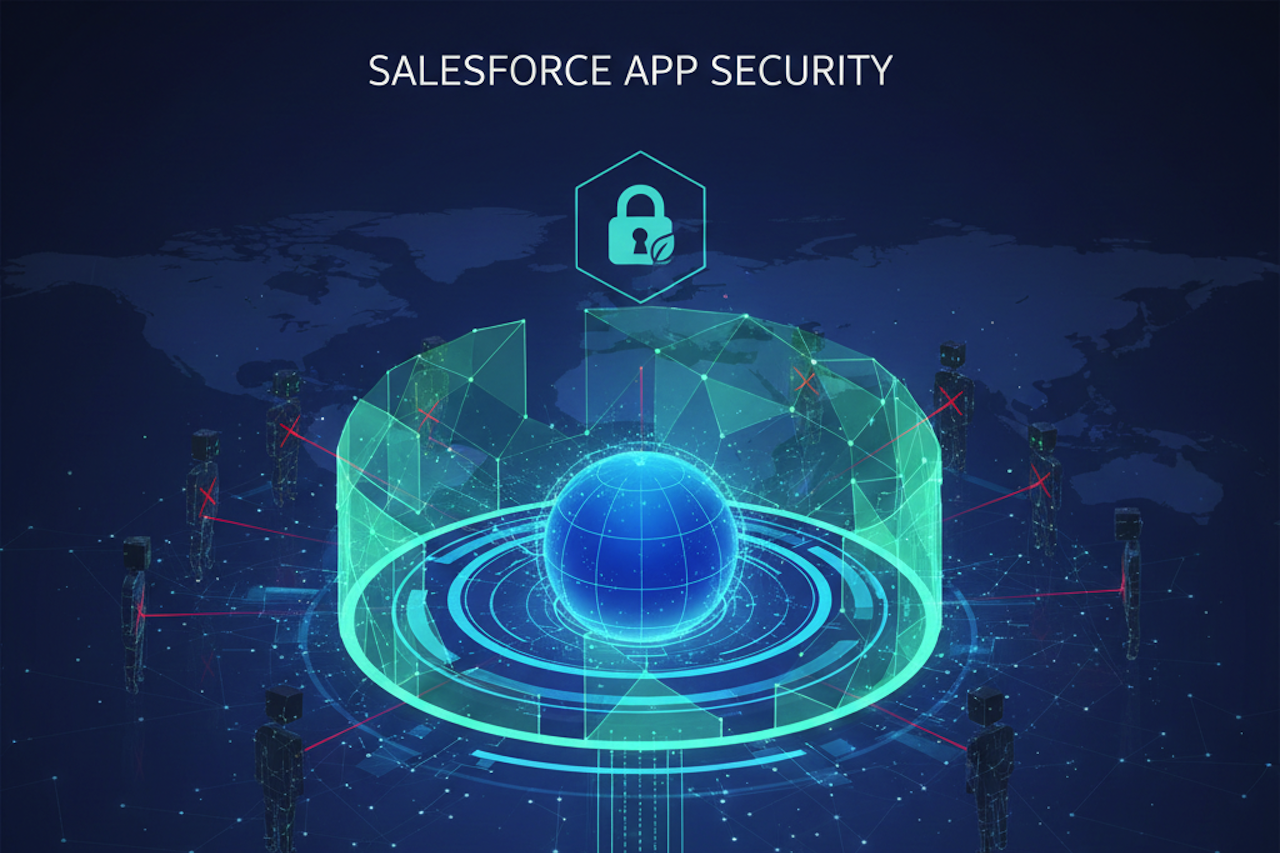
Salesforce apps increasingly sit on the public internet - via Experience Cloud portals, customer onboarding flows, partner tools, and API-driven integrations. That exposure invites bots, credential stuffing, fake registrations, and abusive API traffic. A Salesforce app development company (or any internal team building on Salesforce) can reduce that risk by using IP and network signals in a privacy-first way, treating IP as a risk signal rather than a precise location tracker.
This article explains what IP data can (and can’t) do, how to apply it safely, and where Salesforce’s own controls, especially Connected App policies, fit into the picture.
What IP Signals Can Realistically Tell You
IP-based signals are helpful, but they’re not magic. IP geolocation is approximate and shouldn’t be used to infer a person’s exact physical location. Major geolocation providers explicitly note that IP geolocation data is not precise enough to identify a household, individual, or street address, and it can’t reliably geolocate the person using the IP.
What is practical to derive from IP and network context (depending on your tooling) includes whether traffic looks like it’s coming from expected regions, whether the ISP/ASN is unusual for your user base, whether a request likely originates from a datacenter/VPN/proxy, and whether traffic volume patterns resemble automation.
Used correctly, these signals help you decide when to allow a flow, when to throttle, when to request additional verification, and when to block.
A Privacy-First Approach to Using IP Data
If your app handles sensitive customer data, you want the minimum set of signals that still meaningfully reduces risk. A privacy-first approach typically includes three core principles:
- Focus on security outcomes, not user tracking. You don’t need exact location data to stop credential stuffing or bot signups. What matters is anomaly detection, rate limiting, and behavioral signals.
- Minimize what you store. In many cases, you can avoid storing full IP addresses long term by using short retention windows, partial IPs, or derived attributes (such as “country-level mismatch” or “high-risk network”) instead of raw values. Since IP addresses may be considered personal data under some privacy frameworks, minimization reduces both compliance burden and breach impact.
- Be transparent and document intent. Even if end users never see implementation details, your organization should clearly document what data is collected, why it is collected, and how long it is retained.
Where IP Signals Show Up in Salesforce App Architectures
In Salesforce-centric apps, IP and network signals are typically applied in three key areas:
-
Interactive user access
This includes users logging into the Salesforce UI, Experience Cloud portals, or custom front ends backed by Salesforce. Profile-level login IP ranges and session security settings can support allowlisting strategies, particularly for administrators and other privileged roles. -
OAuth-based access via Connected Apps
Connected Apps are commonly used by mobile applications, middleware, and external services. IP and network policies applied here help control how OAuth tokens are issued and used across distributed environments. -
Integration and API layers
API gateways, middleware, and custom services that sit between external systems and Salesforce are natural enforcement points for IP validation, rate limiting, and anomaly detection.
The key design decision is where enforcement occurs: during authentication, at request time, within the gateway, or across multiple layers. In most real-world environments, effective protection combines more than one of these controls.
Using Salesforce Connected App Policies to Control IP Behavior
If your “app” uses OAuth (mobile clients, external web apps, middleware, Postman-style integrations), Connected App OAuth policies matter.
Salesforce supports OAuth access policy options that enforce the org’s IP restrictions while selectively relaxing them in defined cases, such as allowing refresh token flows to bypass IP restrictions or relaxing IP restrictions for “activated devices.” These options exist because strict “same IP always” rules can break legitimate mobile and distributed use cases.
There’s also an interaction that trips teams up during rollouts. If you relax IP restrictions for a connected app and your org enables “Enforce login IP ranges on every request,” users may be blocked from accessing OAuth-enabled connected apps under certain conditions. Salesforce documents this behavior as a security-related restriction that may affect OAuth-enabled connected apps, including mobile apps.
Practically, that means IP policy design for Salesforce apps should be tested early with your exact authentication flows (auth code, refresh token, device activation, SSO), not assumed.
Fixed egress IPs: the most reliable way to make IP allowlisting work for integrations
For system-to-system traffic, IP controls are strongest when the source network is stable. If an integration runs in cloud infrastructure, you can route outbound requests through a NAT gateway, firewall, or proxy so requests originate from a known set of IP addresses. Those IPs can then be allowlisted reliably, and “unexpected IP” becomes a meaningful indicator of compromise.
Without stable egress, teams often face a bad tradeoff: either don’t enforce IP restrictions, or set them so broadly they lose value. Designing stable egress avoids that trap and makes it easier to separate integrations by purpose, thereby limiting the blast radius if any credentials leak.
Bot Defense Patterns That Work Well With Salesforce Apps
Bots tend to show their hand through behavior: repeated attempts, high-volume requests, predictable sequences, and abnormal error patterns. IP is one of several proper signals.
A practical pattern for public-facing signup and login flows is layered friction. Allow regular traffic through, but when risk signals increase - high request velocity, repeated failures, unusual network context - add friction such as CAPTCHA, email verification, step-up authentication, or temporary blocks. The key is to avoid punishing legitimate users by default and instead trigger friction only when the risk score justifies it.
For API traffic, rate limiting and resource controls become essential. OWASP calls out “lack of resources & rate limiting” as a common API security risk, noting that APIs without appropriate rate limiting can be exploited and driven into denial-of-service conditions. Even if Salesforce itself enforces limits, your own gateways and middleware should still apply limits that align with our business logic and threat model.
Fraud Reduction: Using IP as a Signal, Not a Verdict
Fraud prevention is where IP misuse is common. Teams sometimes block entire countries or infer identities from IP addresses. That often backfires because geolocation isn’t precise, VPNs are widely used, and legitimate users travel.
A safer approach is scoring. IP and network context can contribute to a risk score, but it shouldn’t be the sole reason for a permanent denial unless your use case demands it (for example, legal geoblocking). Better outcomes usually come from combining signals such as login history, device/session patterns, behavioral signals, and IP/network anomalies. When the score exceeds a threshold, you trigger verification rather than immediate rejection.
Monitoring and Incident Response: Making IP Signals Actionable
IP data becomes far more useful when it’s tied to clear response actions. For example, if you detect a spike in failed logins from diverse IP addresses, it can trigger temporary throttling and step-up authentication, and also trigger a security alert for credential stuffing attempts.
Similarly, unusual network context for privileged users (a new network type, unusual access time, repeated token errors) is often a strong reason to revoke sessions, rotate secrets, or review connected app access. If your team can’t respond quickly, the monitoring signal loses value.
Implementation Checklist for a Privacy-First IP-Aware Salesforce App
A good “done” definition usually includes:
- Define your risk events (credential stuffing, fake signup bursts, scraping, API abuse) and the user journeys they affect.
- Decide where enforcement lives (Connected App OAuth policies, org/session settings, gateway rate limiting, app-level risk scoring).
- Engineer stable egress for integrations where possible, because it allows anomaly detection to be far more reliable.
- Use Salesforce Connected App OAuth policies intentionally, and test interactions with “Enforce login IP ranges on every request,” especially for mobile and OAuth flows.
- Minimize retention of raw IP data; store only what you need to operate your controls and investigations.
- Add rate limiting and resource protection for APIs and endpoints that are prone to abuse.
Conclusion
IP and network signals can significantly improve the security of Salesforce apps, especially those exposed to the public internet. The trick is to treat IP as context, not identity: use it to score risk, trigger verification, slow down abuse, and tighten the boundaries around integrations.
When you pair Salesforce’s Connected App OAuth policies with stable egress for integrations and privacy-first monitoring, you can reduce fraud and bot traffic without turning your app into invasive tracking or breaking legitimate users in the process.
Featured Image generated by Google Gemini.
Related Articles

April 7, 2026
How E-commerce Sites Use IP Intelligence to Prevent Fraud
Fraud doesn’t look obvious anymore. It hides behind VPNs, residential proxies, and bot traffic that behaves like real users.
Read More
April 17, 2024
The Role of Facial Recognition in Identity Verification and Fraud Prevention
Facial recognition is changing the world at an unprecedented rate from locking doors on our phones to securing boundaries. It does have a practical significance in establishing ide...
Read More
February 20, 2024
Top 10 Essential Fraud Prevention Strategies for E-commerce Businesses
Retailers are not new to the experience of theft. Historically, it was shoplifting, and today it’s online fraud. Did you know that e-commerce businesses handle 206,000 cyber attack...
Read More
Comments
Comments are available to signed-in users and are moderated to keep the discussion useful and respectful. Spam, automated submissions, and low-value promotional comments are removed. Outbound links may be approved when they are relevant and genuinely helpful to readers, but they are displayed as plain text rather than clickable hyperlinks.
No comments have been published yet.
Please sign in to submit a comment.