

Monetizing online traffic remains one of the most common challenges for website owners and content creators. While traditional methods such as display ads and sponsored content can generate revenue, they often require high traffic volumes or can disrupt user experience. Affiliate marketing offers a more integrated alternative, one that allows publishers to earn by recommending relevant products and services within their existing content.
Affiliate marketing has grown into a multi-billion-dollar industry, with global spending projected to exceed $15 billion in recent years. Studies suggest that affiliate channels account for roughly 15–20% of all eCommerce revenue, highlighting how widely adopted and effective this model has become. From independent bloggers to large media platforms, many publishers rely on affiliate partnerships as a core monetization strategy.
At its core, affiliate marketing is a partnership model. An affiliate promotes a product or service using a unique tracking link, and earns a commission when a user completes a specific action such as making a purchase or signing up for a service. This structure allows businesses to expand their reach while enabling publishers to monetize content without creating or managing products themselves.
How Affiliate Marketing Works in Practice
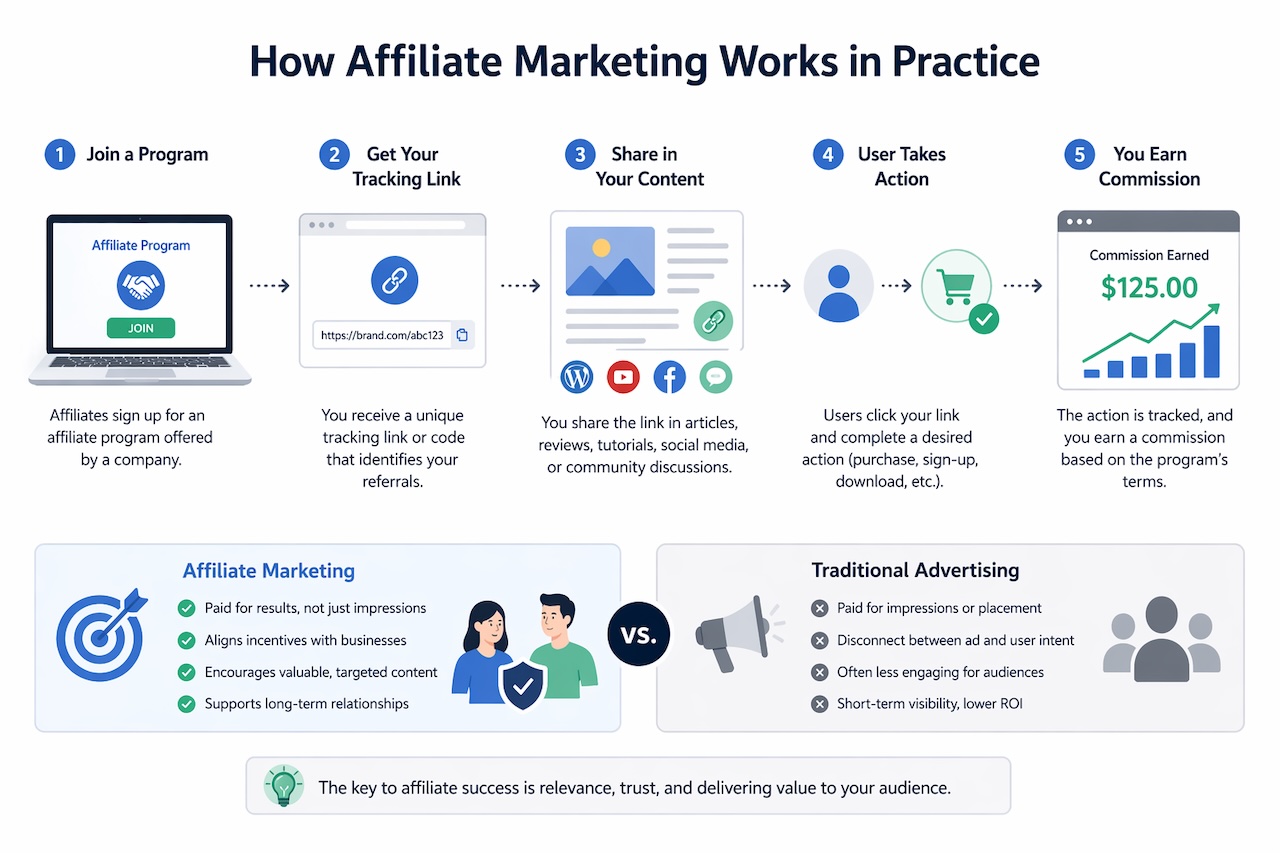
Although the concept is simple, the effectiveness of affiliate marketing depends heavily on execution. After joining a program, affiliates receive tracking links or codes that identify their referrals. These links are then integrated into content such as articles, reviews, tutorials, or community discussions. When users engage with these links and complete a defined action, the affiliate earns a commission.
Unlike traditional advertising, affiliate marketing aligns incentives between the publisher and the business. Instead of being paid for impressions alone, affiliates are rewarded based on performance, which encourages more thoughtful and targeted content.
Real-World Application: IP Intelligence and Privacy Tools
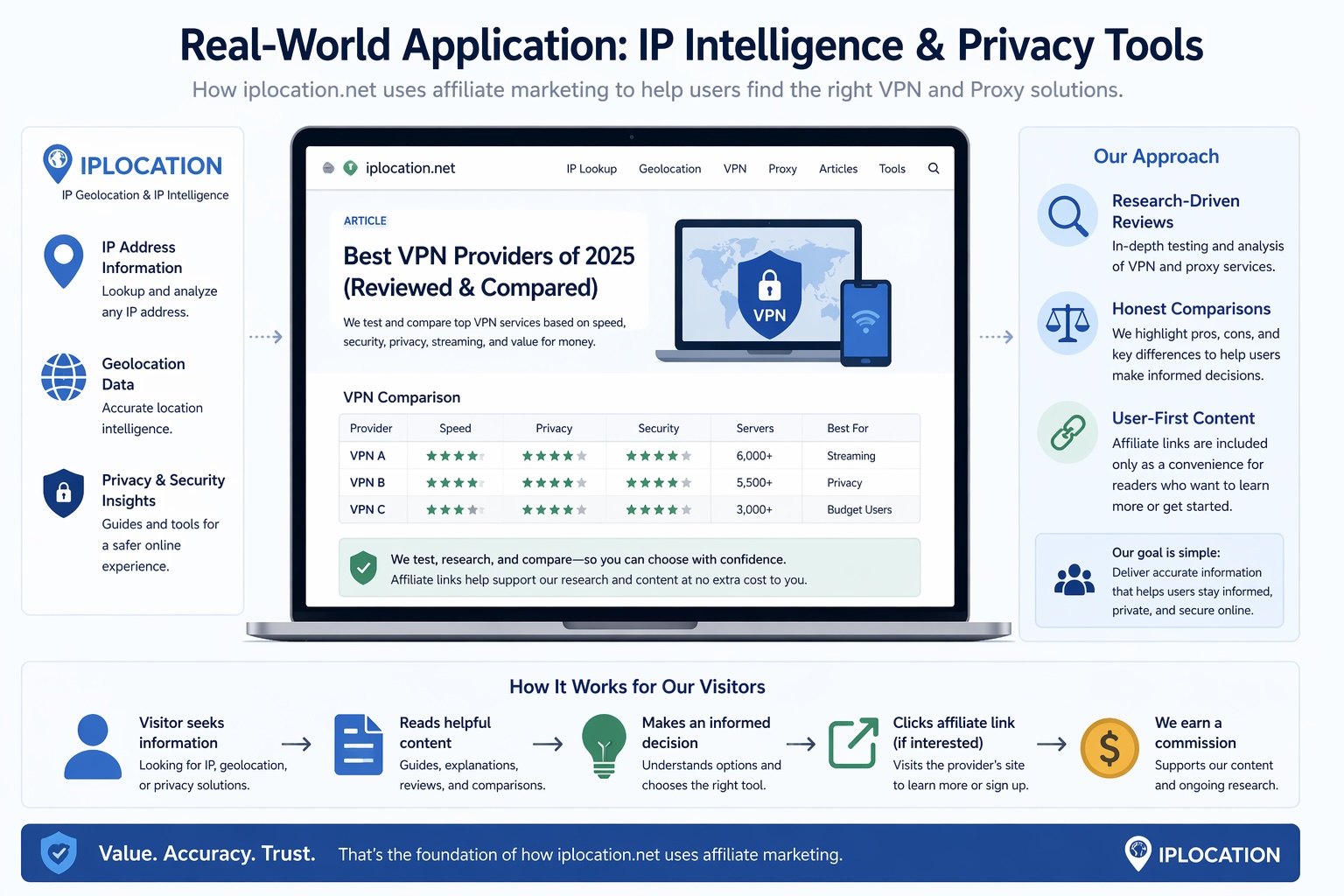
On platforms like iplocation.net, affiliate marketing is used in a practical and user-focused way. The site attracts visitors looking for information about IP addresses, geolocation, and online privacy. Naturally, this audience often has an interest in tools such as VPNs and proxy services.
Rather than promoting these tools purely for commission, the approach focuses on providing detailed, research-based reviews and comparisons. Articles typically explain how VPNs work, how proxies differ, and what users should consider when choosing a service. Affiliate links are then included as a convenience for readers who decide to explore those options further.
This model works because it aligns with user intent. Visitors are already seeking solutions, and the content helps them make informed decisions. The affiliate relationship becomes secondary to the primary goal of delivering accurate and useful information.
Who Benefits from Affiliate Marketing?
Affiliate marketing is highly flexible and can be adapted to different types of audiences and platforms. Social media users, bloggers, and community moderators can all participate, provided they have an engaged audience. Even smaller publishers can see meaningful results, as conversion rates often depend more on trust and relevance than sheer traffic volume.
For example, individuals who actively participate in niche communities can share insights, recommendations, and experiences that resonate with their audience. Similarly, content creators who specialize in deals or product comparisons can build consistent traffic by curating useful and timely information.
Key Advantages of Affiliate Programs
One of the primary advantages of affiliate marketing is its accessibility. Most programs are free to join and do not require upfront investment. There is no need to manage inventory, handle customer service, or process payments, making it an efficient monetization method for content-driven platforms.
In addition, affiliate income can be both flexible and scalable. Some programs offer one-time commissions for actions such as sign-ups, while others provide recurring revenue for subscriptions. As content continues to attract traffic over time, it can generate ongoing income without significant additional effort.
Many affiliate programs also provide marketing resources, including tracking dashboards, promotional materials, and performance analytics. These tools help affiliates refine their strategies and better understand what resonates with their audience.
Factors That Influence Success
While affiliate marketing is accessible, success is not automatic. Several factors play a role in determining performance. Audience relevance is one of the most important—products should align naturally with the interests and needs of the audience. Content quality also plays a critical role, as users are more likely to engage with clear, informative, and trustworthy material.
Consistency is another key factor. Regularly publishing content helps build credibility and maintain visibility, while diversified platforms—such as blogs, social media, and email newsletters—can expand reach and reduce dependency on a single traffic source.
Ethical Considerations and Trust
One of the most important aspects of affiliate marketing is maintaining trust. While it may be tempting to promote higher-commission products, long-term success depends on credibility. Recommending products solely based on commission potential can lead to poor user experiences and damage audience trust.
For this reason, it is important to provide balanced, truthful reviews that highlight both strengths and limitations. On platforms like iplocation.net, this means evaluating VPN and proxy services based on factors such as performance, privacy policies, usability, and real-world use cases—rather than simply promoting the highest-paying options.
Transparency also plays a role. Clearly indicating that affiliate links may generate commissions helps maintain honesty with readers and aligns with industry best practices.
Maximizing Long-Term Value
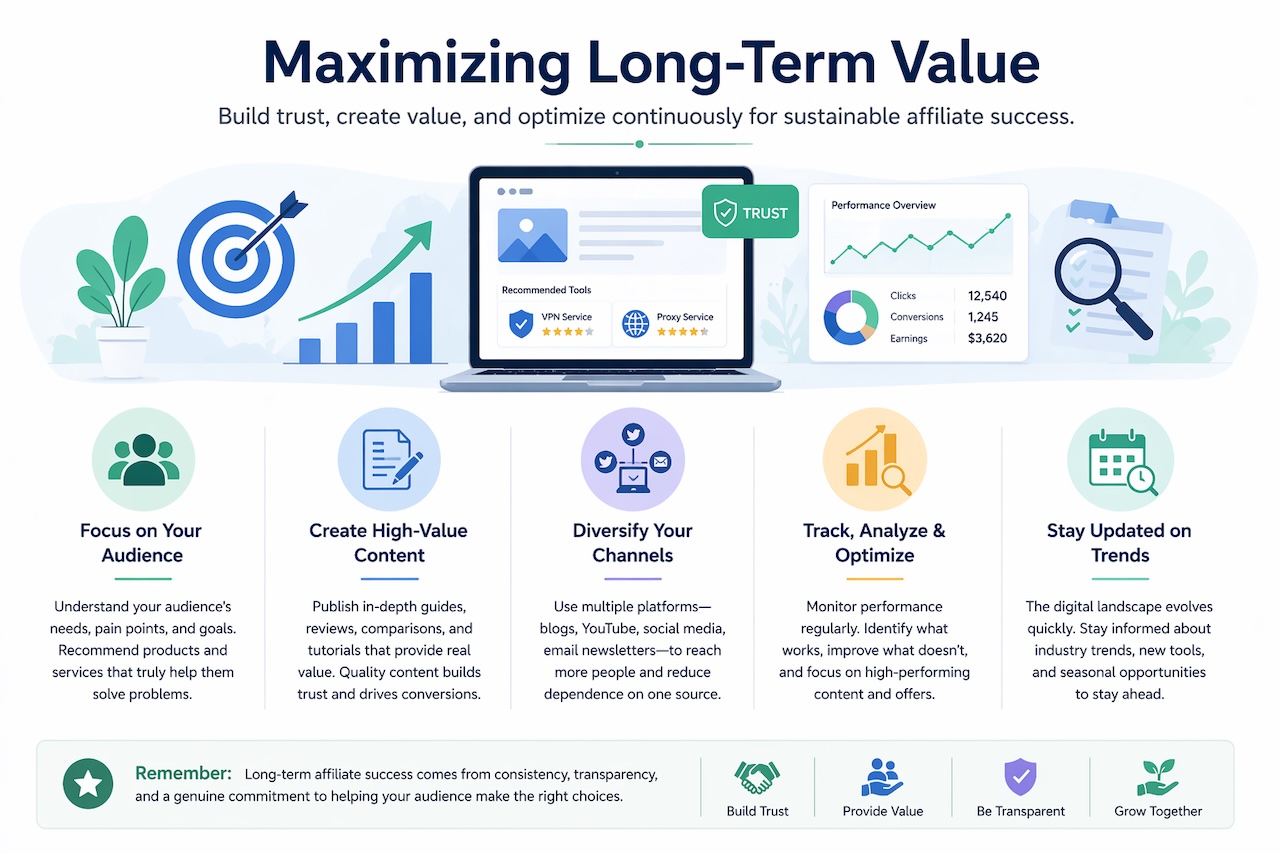
To maximize affiliate revenue over time, it is often more effective to focus on value rather than volume. High-quality content that addresses specific user needs tends to perform better than broad or overly promotional material. This includes detailed guides, comparisons, and real-world insights that help users make informed decisions.
Tracking performance is equally important. By analyzing which content generates clicks and conversions, affiliates can refine their approach and focus on what works best. Staying updated on trends—such as emerging technologies, seasonal demand, or changes in user behavior—can also provide a competitive advantage.
 FAQs
FAQs
Affiliate marketing can be profitable, but it is often misunderstood. While some publishers generate meaningful income, results typically depend on traffic quality, audience trust, and content relevance. It is not a guaranteed or quick income stream.
It varies widely. Some affiliates may see small results within weeks, but consistent earnings usually take months of content development, SEO, and audience building.
Trust depends on transparency and content quality. If recommendations feel biased or overly promotional, users are less likely to engage. Honest reviews and clear disclosures help maintain credibility.
It can if done poorly. Overloading content with promotional links or recommending low-quality products may reduce trust. When used responsibly, affiliate links can complement informative content without harming credibility.
No. A smaller, highly targeted audience with clear intent (e.g., searching for VPNs or proxies) often converts better than large but less engaged traffic.
Not necessarily. Promoting higher-paying products that are not relevant or trustworthy can reduce conversions and damage long-term credibility. Relevance and user value tend to matter more.
Most affiliate programs use cookies that track users for a limited time (e.g., 7–30 days). If the user returns and completes an action within that window, you may still receive credit.
It can become partially passive over time, especially with evergreen content. However, maintaining rankings, updating content, and adapting to changes require ongoing effort.
Affiliate links themselves do not harm SEO when used properly. However, excessive or low-quality content created solely for monetization can negatively impact rankings.
It is generally better to rely on hands-on experience or thorough research. If direct experience is not possible, clearly stating that your review is based on analysis, comparisons, and available data helps maintain transparency.
Final Thoughts
Affiliate marketing offers a practical and scalable way to monetize online content. Its effectiveness lies not just in the structure of commissions, but in how well it aligns with user intent and delivers real value.
As demonstrated by our platform, the most sustainable approach is to prioritize accuracy, transparency, and user benefit. By focusing on honest recommendations rather than short-term gains, affiliates can build long-term trust and consistent revenue.
Ultimately, affiliate marketing works best when it serves both the audience and the publisher—connecting users with the right solutions while maintaining credibility and integrity.
Featured Image generated by ChatGPT.
Share this post
Author

Read the latest articles from Scott Seong
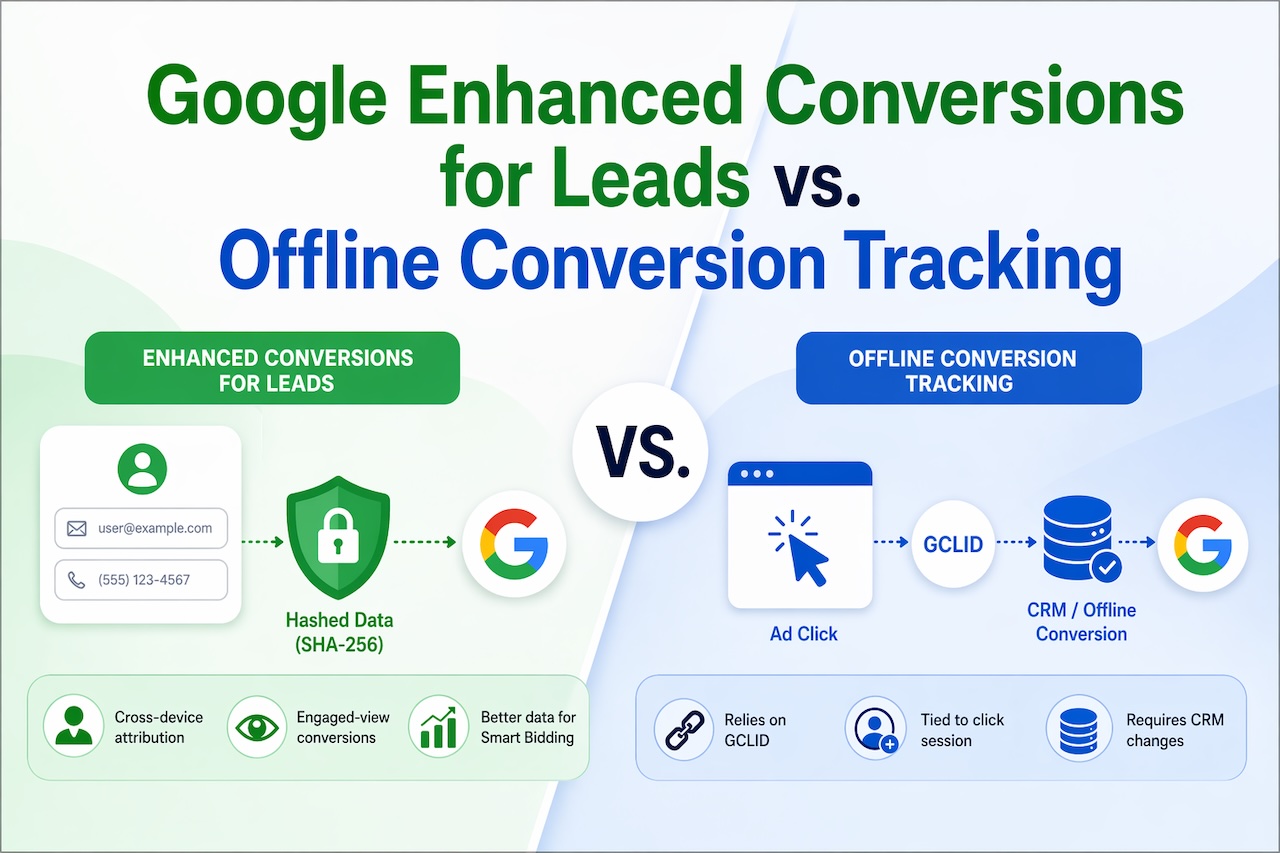
What are the differences between Google Enhanced Conversions for Leads vs. Offline Conversion Tracking?
April 24, 2026
These two features solve the same fundamental problem — lead gen advertisers can't see what happens after someone fills out a form — but they use different mechanisms to do it. Think of Offline Conversion Tracking (OCT) as the original solution, and Enhanced Conversions for Leads (EC4L) as its upgraded replac [...]
Learn moreComprehensive Review of Fotor Photo Editing Platform

September 16, 2024
Fotor is a versatile online photo editing platform that has garnered widespread popularity for its powerful tools, user-friendly interface, and innovative AI-powered features. Whether you’re a professional photographer, a web designer, or a content creator, Fotor offers a variety of tools to enhance your visual [...]
Learn moreLeave a comment
All comments are moderated. Spammy and bot submitted comments are deleted. Please submit the comments that are helpful to others, and we'll approve your comments. A comment that includes outbound link will only be approved if the content is relevant to the topic, and has some value to our readers.
Comments (0)
No comment