
Retail in 2026 feels faster, louder, and far less forgiving than even a few years ago. Inventory moves unpredictably, customer journeys stretch across five or six channels, and internal systems break whenever two platforms decide to stop cooperating.
Retailers need technology that stays steady during chaos, not software that only works during a polished demo. That’s why many companies lean toward software development approaches designed to strengthen operations rather than decorate them.
Below are the seven retail software development approaches that actually matter in 2026.
1. Custom Retail Software Development
Custom retail software has become essential for companies that have outgrown generic tools. Many retailers deal with multi-location inventory, unpredictable order spikes, inconsistent PoS behavior, and processes held together by spreadsheets.
Ready-made platforms rarely solve these issues cleanly. Custom-built retail applications, such as those commonly seen in Forbytes retail software development projects, allow teams to design platforms that match real workflows instead of forcing businesses into rigid templates.
Custom development gives retailers full ownership of their operations and eliminates the frustration created by mismatched tools. The aim is to build software that strengthens the entire retail ecosystem rather than adding another fragile component.
This development work often involves:
- Building platforms designed around actual operational logic
- Creating modules not available in any off-the-shelf product
- Replacing legacy tools with scalable, modern architecture
- Implementing automation to remove unnecessary manual tasks
- Designing interfaces that reduce employee training time
Custom software frequently becomes the foundation for every other improvement, giving retailers a stable core that supports growth rather than restricting it.
2. Retail System Integration and Unified Data Development
Retailers now rely on so many tools that keeping them aligned feels nearly impossible: PoS terminals, ERP, CRM, warehouse systems, marketplace dashboards, and whatever the marketing team adopted last month. Each one holds a piece of the puzzle and none of them agree unless someone forces them to.
Integration-focused development unifies these components into one functional ecosystem. When executed well, the result feels like a store finally getting its eyesight back. Inventory updates sync everywhere. Orders align across platforms. Reports stop contradicting each other. Teams actually trust the numbers again.
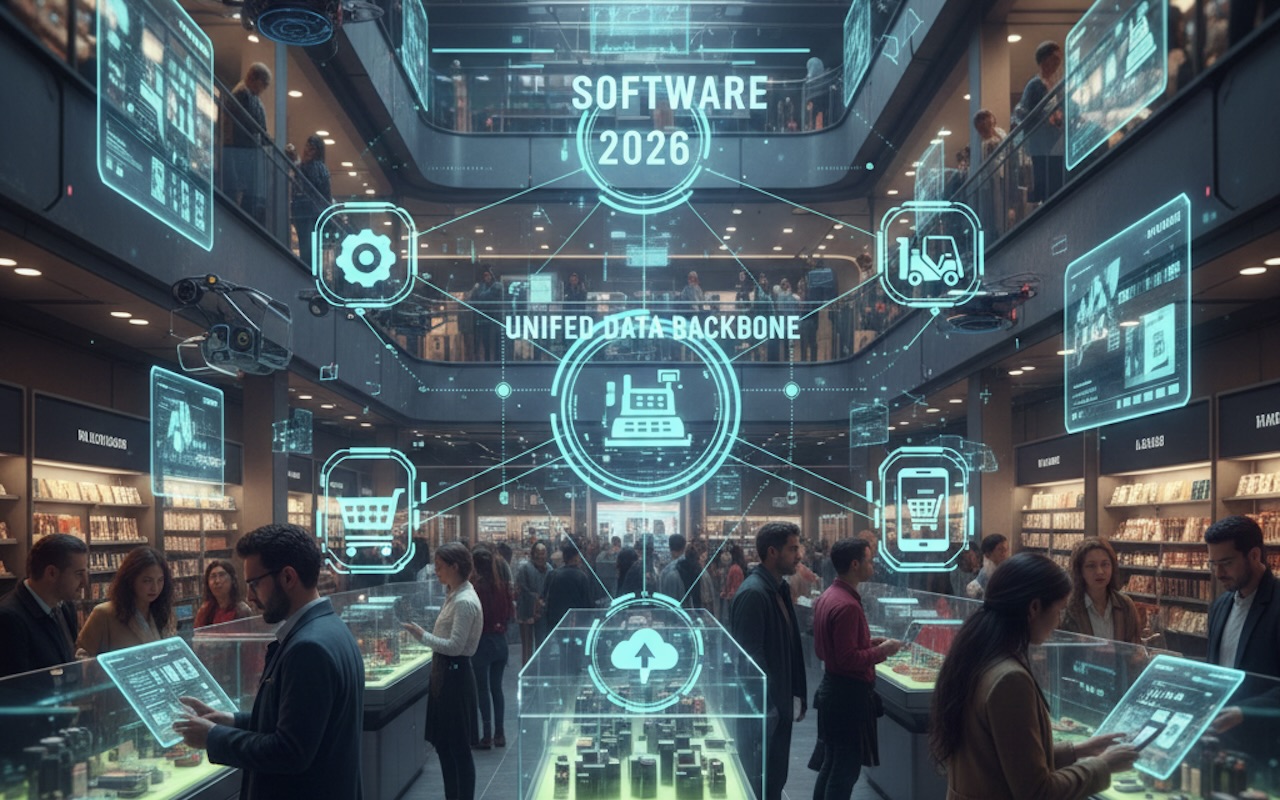
A unified data backbone transforms chaos into something manageable and in 2026, that’s practically a superpower.
3. Retail Modernization and Legacy Software Replacement
A surprising number of retailers still rely on systems old enough to have their own retirement plans. These tools freeze during high-volume days, refuse to integrate with modern platforms, and sometimes crash for reasons no one understands.
Modernization replaces this aging infrastructure with fast, cloud-ready software designed for today’s retail pace.
This development area typically involves:
- Migrating data into cleaner, modern environments
- Replacing fragile legacy components with cloud-friendly architecture
- Untangling workflows cluttered by years of patch fixes
- Redesigning interfaces for smoother day-to-day use
- Improving performance so systems survive peak traffic
For many businesses, modernization feels like removing a weight they’ve dragged for years.
4. Predictive Analytics and Retail Forecasting Development
Retailers sit on mountains of data, but most of it remains untouched. Predictive analytics finally puts it to work. Instead of guessing demand or hoping last year’s pattern repeats, retailers can see what’s coming before it happens.
These development approaches combine sales history, real-time behavior, seasonal trends, and market signals to create forecasts that are actually usable. The result: fewer stockouts, fewer overorders, and fewer last-minute panics.
When demand shifts as fast as it does today, being able to predict even half of it feels like cheating.
5. E-commerce and Omnichannel Platform Development
E-commerce in 2026 no longer operates as a standalone channel. Customers move constantly between online stores, mobile apps, social shopping, marketplaces, and physical locations.
Omnichannel software development creates consistent experiences across all touchpoints.
This development work typically includes:
- Online storefronts optimized for high-volume performance
- Integrations with warehousing, CRM, and ERP systems
- Multi-channel checkout flows that stay stable under pressure
- Catalog and inventory syncing across marketplaces
- Mobile-ready shopping experiences that convert well
A strong omnichannel setup has become a survival requirement because customers expect seamless reliability wherever they shop.
6. PoS, Retail ERP, and Back-Office Software Development
PoS and ERP platforms remain the operational backbone of retail. Development efforts in this area focus on improving how retailers track inventory, manage orders, coordinate logistics, and handle everyday workflows.
Common development priorities include:
- Modern PoS platforms that remain stable even under extreme load
- ERPs that unify stock, sales, and finance data
- Workflow automation connecting purchasing, warehousing, and accounting
- Real-time dashboards showing operational status
- Secure data structures that protect transactions and customer information
These improvements are felt immediately because smoother internal software reduces friction across nearly every task.
7. Continuous Software Optimization and Performance Enhancements
Retail environments change constantly, and software that worked last year may not work today. Continuous optimization ensures that retail platforms remain reliable, secure, and efficient as business needs evolve.
This development area includes:
- Performance tuning
- New module development
- Security improvements
- UX enhancements
- Updates driven by emerging market requirements
Ongoing refinement helps retailers adapt without replacing their entire tech stack. It stabilizes both online and in-store operations and reduces costly downtime during peak periods.
Why These Retail Software Development Approaches Matter
Retail teams don’t care about glossy pitches or vague “innovation promises.” They care about software that holds up during real-world pressure — crowded stores, unstable Wi-Fi, aggressive order surges, short staffing, and everything else retail throws at them.
These development approaches matter because they solve everyday challenges: inventory that won’t sync, data that contradicts itself, legacy platforms that crash, workflows that take too long, and tools that fall apart the moment demand spikes.
Strong retail software helps teams move faster, lose fewer sales, avoid expensive mistakes, and deliver smoother customer experiences. It stays reliable when pressure spikes and in 2026, that reliability is worth more than any flashy feature ever could be.
Conclusion
The future of retail depends on building software that can keep up with rapid change, shifting customer expectations, and increasingly complex digital ecosystems. By focusing on strong development practices, from custom applications to unified data, modernization, analytics, and omnichannel experiences, retailers gain the stability and flexibility they need to operate confidently in 2026 and beyond. The retailers that invest in resilient, well-designed software will be the ones best equipped to handle uncertainty, scale efficiently, and deliver the seamless experiences customers now expect.
Featured Image generated by Google Gemini.
Share this post
Author

Read the latest articles from Taras Tymoshchuk
AI-Enhanced Selfies: Fake Identity or Authentic Self-Expression?

May 27, 2026
Taking a selfie in the past and taking it now are two wildly different things. Before, it was enough to point a camera at yourself, snap a picture, and share it with your friends and family. Today, a lot of people use a ton of filters to adjust lighting, smooth their skin, change their hairstyles, and so on.
Learn moreHow to Build an Unbreakable Industrial Network in 2026

April 23, 2026
A three-minute network outage on an automated production line used to be an IT problem. Now, it costs millions of dollars in lost productivity and triggers severe safety hazards. When the connection drops, teleoperated machinery stops.
Learn moreLeave a comment
All comments are moderated. Spammy and bot submitted comments are deleted. Please submit the comments that are helpful to others, and we'll approve your comments. A comment that includes outbound link will only be approved if the content is relevant to the topic, and has some value to our readers.
Comments (0)
No comment