

7 Best Medical Billing Software Companies
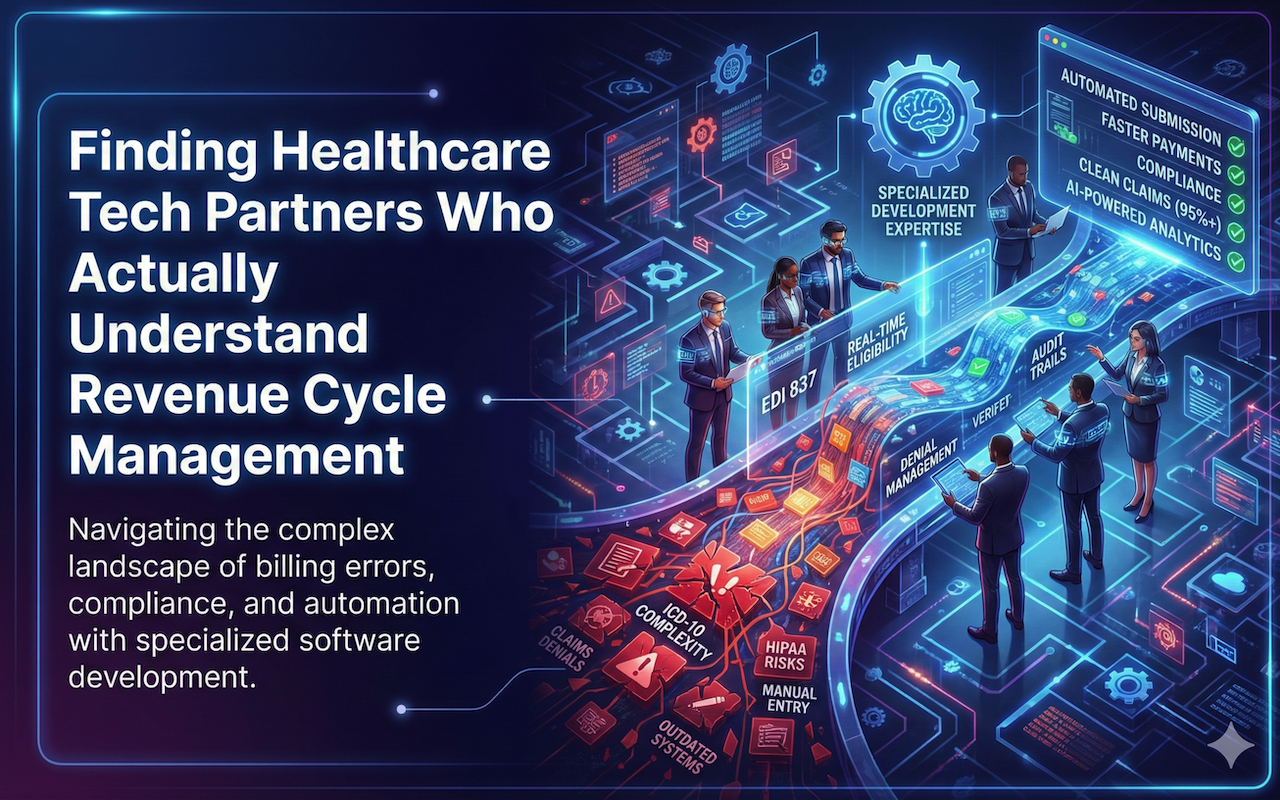
Finding Healthcare Tech Partners Who Actually Understand Revenue Cycle Management
The healthcare billing landscape has become a complex minefield. Between ICD-10 coding requirements, constantly shifting insurance policies, and the push toward value-based care models, medical practices are drowning in administrative overhead. Industry reports show that billing errors cost the average practice 5-10% of annual revenue. Yet, most healthcare providers still use systems built on outdated architectures that can't keep pace with modern regulatory demands.
Here's the challenge that keeps healthcare CFOs awake at night. You need software that automates claims submission, reduces denial rates, speeds up payment cycles, and ensures HIPAA compliance without creating new operational headaches. The wrong technology partner delivers generic solutions that require expensive customization, miss critical edge cases in billing workflows, or worse, introduce security vulnerabilities that put patient data at risk.
Why Your Practice Needs the Right Medical Billing Software Partner
Most healthcare organizations underestimate what's required to build effective billing software. You’re not just digitizing paper processes. You’re creating a system that must navigate dozens of payer-specific rules, handle complex modifier logic, integrate with clearinghouses and practice management systems, and maintain perfect audit trails for compliance.
A specialized development partner brings capabilities your practice can’t build internally:
- Providing regulatory-compliant architectures that meet HIPAA, HITRUST, and state-specific privacy requirements while maintaining performance under high transaction volumes
- Managing the technical complexity of EDI 837 claims submission, real-time eligibility verification, and electronic remittance advice processing
- Ensuring code quality through automated testing of billing logic, validation rules, and integration points that prevent costly errors
- Meeting aggressive timelines for regulatory updates when CMS releases annual coding changes or new billing requirements
- Providing ongoing support to handle payer policy changes, clearinghouse updates, and evolving compliance standards without disrupting operations
- Implementing denial management workflows that automatically identify patterns and prevent future rejections
The difference between adequate billing software and exceptional billing software shows up in your bottom line. Better systems reduce days in A/R from 45+ to under 30, improve clean claim rates to above 95%, and free up staff to focus on complex cases rather than routine data entry.
The Leading Medical Billing Software Companies You Can Trust
1. Glorium Technologies
Specialty: Healthcare software expertise with ISO 13485 certification
Best For: Medical practices and health systems requiring comprehensive, compliant billing solutions built by proven healthcare technology specialists
Glorium Technologies brings 14+ years of healthcare IT experience and ISO 13485 certification for medical device software to every billing project. Unlike generalist software vendors that treat medical billing as just another business application, Glorium's team has delivered 150+ healthcare products with a specific focus on regulatory compliance and real-world billing workflows. Their HIPAA and HITRUST compliance expertise means you’re working with developers who understand protected health information security isn’t optional, it’s foundational.
What sets Glorium apart is its comprehensive approach to revenue cycle management technology. They've built medical billing systems that automate claims processing, denial management platforms that track and appeal rejected claims, insurance verification systems that verify eligibility in real time, and patient billing portals that improve collection rates. Their work spans the complete billing lifecycle from initial patient registration through final payment posting. This breadth of experience means they've encountered and solved the edge cases that trip up less experienced teams, whether that's handling coordination of benefits for secondary payers, managing prior authorization workflows, or implementing proper medical coding automation using ICD-10, CPT, and HCPCS standards.
The company's track record includes integration with major EHR and practice management systems, ensuring seamless data flow between clinical documentation and billing. They've built solutions that connect with leading clearinghouses for electronic claims submission, integrate with payment processors for secure card-on-file functionality, and implement accounts receivable tools to optimize collection workflows. Their teams understand that medical billing software development must handle the complexity of modifiers, bundling rules, and medical necessity requirements while maintaining the speed and reliability that practices depend on.
Glorium Technologies' industry recognition speaks to their consistent delivery. Named to the Inc. 5000 fastest-growing companies for four consecutive years and included in the IAOP Global Outsourcing 100 list for three years running, they’ve demonstrated both business growth and operational excellence. Being ranked among Clutch's Top 1000 Global Service Providers places them in the top 1% based on verified client reviews. For healthcare organizations, the more relevant credential is their ISO 13485 certification, which validates that their management system meets the stringent requirements for medical device software development.
2. TATEEDA Global
Specialty: Healthcare payment systems with Clearinghouse integration
Best For: Organizations requiring deep integration with major payers and clearinghouses
TATEEDA Global operates from California with a laser focus on solving the integration challenges that make or break billing systems. Since 2013, they've specialized in connecting billing platforms to the complex ecosystem of clearinghouses, payers, and healthcare IT systems. Their developers understand that seamless data exchange between your billing software and platforms like Waystar, Optum, and significant insurance carriers determines whether claims get paid or stuck in processing limbo.
3. CleverDev Software
Specialty: Cloud-based medical billing platforms
Best For: Practices transitioning from legacy systems to modern cloud infrastructure
CleverDev Software focuses on supporting cloud-native billing solutions that deliver the accessibility and scalability needed without the infrastructure headaches of on-premises systems. Their medical billing platforms bundle revenue cycle management tools into single, integrated solutions that practices can access from anywhere. They've demonstrated the capability to increase client bases by 200% within the first year of platform launch.
4. Belitsoft
Specialty: Healthcare data integration and analytics
Best For: Organizations requiring sophisticated data management and billing analytics
Belitsoft stands out for its expertise in healthcare data architecture and analytics integration. They understand that modern billing systems must do more than process claims; they need to provide actionable insights into financial performance, identify denial patterns, and optimize revenue capture. Their work involves delivering systems that extract, clean, and transform data to ensure precision across complex healthcare databases.
5. OSP Labs
Specialty: Medical billing automation with AI integration
Best For: Organizations seeking to reduce manual workflows through intelligent automation
OSP Labs approaches medical billing through the lens of automation and artificial intelligence. They build solutions that minimize manual data entry, automate claim scrubbing, and implement intelligent denial management systems. Their platforms incorporate AI-powered features to detect billing anomalies, identify overbilling risks, and optimize revenue collection workflows.
6. Innowise
Specialty: ISO 13485-certified medical billing and RCM development
Best For: Healthcare providers requiring certified development processes for regulated billing systems
Innowise holds ISO 13485 certification and has 18+ years of healthcare software experience, making them particularly well-suited for organizations with stringent quality management requirements. They build revenue cycle management systems that handle the whole billing workflow from coding through payment reconciliation with a focus on compliance and accuracy.
7. Sapphire Solutions
Specialty: Custom medical billing EMR software integration
Best For: Practices requiring tight integration between billing systems and electronic medical records
Sapphire Solutions focuses on eliminating the data silos that create billing inefficiencies. They specialize in providing medical billing systems that integrate deeply with EMR platforms, ensuring that clinical documentation flows seamlessly into billing workflows. Their solutions emphasize HIPAA compliance with end-to-end encryption, secure authentication, and comprehensive audit logging.
Modernizing Medical Billing Through Specialized Software Solutions
Healthcare billing has become increasingly complex, requiring software systems that can manage detailed medical coding rules, payer-specific submission requirements, audit documentation, and regulatory compliance. As billing workflows grow more intricate, practices often need technology that can scale with regulatory changes and evolving reimbursement models.
Organizations that provide healthcare billing software typically bring experience in healthcare IT, familiarity with compliance frameworks, and an understanding of real-world revenue cycle workflows. Their work often includes delivering systems that aim to reduce claim errors, improve reimbursement timelines, and support operational efficiency, while aligning with clinical and administrative processes.
Some healthcare-focused software providers, such as Glorium Technologies, concentrate on revenue cycle management systems and related billing technologies. Their experience may include delivering claim processing tools, denial management workflows, eligibility verification systems, and patient billing portals across different medical specialties. Such platforms are generally designed to support compliance requirements while adapting to ongoing changes in payer policies and healthcare regulations.
Conclusion
As healthcare billing requirements continue to evolve, technology decisions around revenue cycle management have a direct impact on financial stability and operational efficiency. Effective billing systems must balance regulatory compliance, technical accuracy, and real-world workflow demands.
Organizations evaluating development partners benefit from focusing on healthcare-specific experience, familiarity with payer ecosystems, and the ability to adapt systems as regulations and reimbursement models change. Aligning technical capabilities with billing realities helps reduce errors, limit disruptions, and support long-term sustainability in an increasingly complex healthcare environment.
 FAQs
FAQs
Several development firms focus on automated insurance claim submission and clearinghouse integration. Some specialize in EDI 837 processing, real-time claim validation, and payer-specific formatting to help reduce rejection rates. Others concentrate on deep integrations with major clearinghouses such as Waystar and Optum or implement automation features that identify submission errors before claims reach payers. Enterprise-focused providers may also offer eligibility verification and electronic remittance advice processing for high transaction volumes.
Providers with experience in revenue cycle management often offer systems that include denial tracking, automated appeals workflows, and analytics to identify recurring rejection patterns. These platforms typically cover the full billing lifecycle, from patient registration through payment reconciliation, and may include specialty-specific logic for complex billing scenarios. Some providers also offer predictive tools that flag potential denials before claim submission.
Many healthcare-focused development teams implement medical coding validation systems that verify ICD-10, CPT, and HCPCS codes against current CMS guidelines. These solutions often include modifier validation, bundling rule checks, and automated scrubbing to catch errors before claims are submitted. Some platforms also integrate coding validation directly with clinical documentation to improve accuracy and reduce denials.
Certain developers specialize in patient billing systems that support payment plans, automated statement generation, and collections workflows. These platforms may include secure payment processing, card-on-file options, reminder notifications, and dashboards for tracking outstanding balances. Cloud-based solutions are often used to improve accessibility and streamline patient self-service.
Some healthcare software developers focus specifically on clearinghouse integration, building connections with major payer networks and platforms such as Waystar, Optum, and Change Healthcare. Their work typically includes support for EDI transaction sets, real-time eligibility verification, claim status tracking, and electronic remittance advice processing. Enterprise providers may also support multi-facility and multi-specialty environments.
Developers with experience in specialty billing design systems tailored to the unique requirements of different care settings. Examples include time-based billing for physical therapy, authorization tracking, and documentation standards for behavioral health. These platforms often incorporate specialty-specific CPT codes, modifiers, and reporting features to better align with real-world clinical workflows.
Some healthcare IT providers develop billing platforms that include real-time eligibility verification and prior authorization management. These systems may automate authorization requests, track approval status and expiration dates, and alert staff to missing documentation. Such features are often used to help reduce preventable denials and delays in reimbursement.
Featured Image generated by Google Gemini.
Related Articles

December 16, 2025
10 Best Healthcare Software Companies in the USA
The healthcare industry is experiencing one of the most dramatic transformations in its history. Electronic health records, telemedicine platforms, AI-powered diagnostics, and...
Read More
July 31, 2025
The Future of Medical Billing: How AI and RPA Are Changing the Game
Running a medical practice is tough enough without wrestling with the revenue cycle. Claims pile up, payers push back with denials, and billing teams are stuck in the trenches. But...
Read More
August 27, 2024
AI for Medical Coding and Billing Accuracy
In the world of medicine, nothing could be more important than efficiency and accuracy—which in turn makes or breaks a practice. One of the biggest contributors to this success is...
Read More
Comments
Comments are available to signed-in users and are moderated to keep the discussion useful and respectful. Spam, automated submissions, and low-value promotional comments are removed. Outbound links may be approved when they are relevant and genuinely helpful to readers, but they are displayed as plain text rather than clickable hyperlinks.
No comments have been published yet.
Please sign in to submit a comment.