
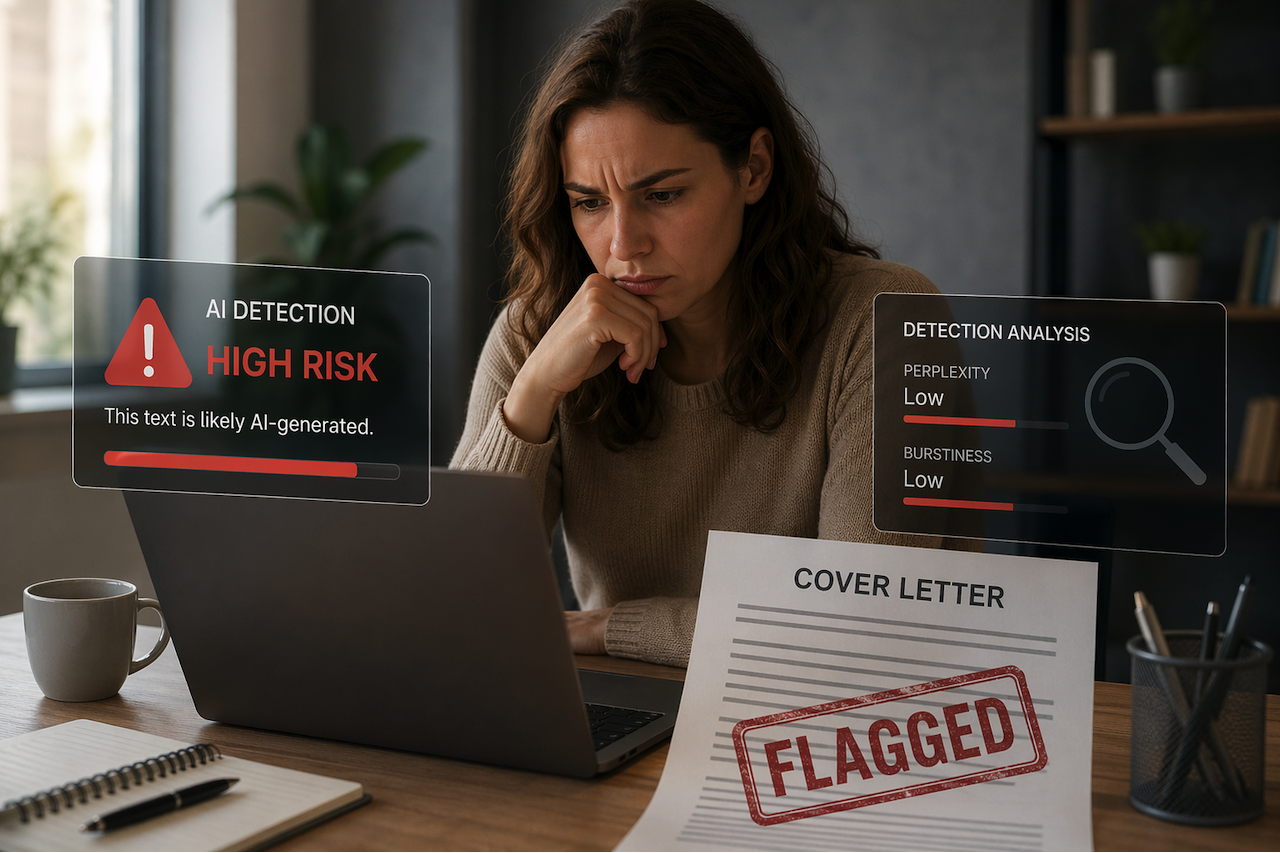
In 2025, a TopResume survey of hiring managers found that 80% of them would discard a job application they believed was fully AI-generated. Roughly one in five (19.6%) said they would automatically reject any candidate whose application got flagged by an AI detection tool. 81.6% reported they had already encountered AI-written cover letters in their inbox. The decision to flag, downgrade, or reject is now happening before a human even reads what you wrote.
If you've been sending out applications recently and watching the responses dry up, this is a meaningful explanation worth taking seriously. The same screening logic now sits between you and almost any role above entry-level. And here's the part that should worry every applicant: the AI detection tools driving these rejections have a documented 4-15% false-positive rate for writing produced by real humans. The system flags genuine human writing as AI roughly that often, and there is no appeal process when a recruiter quietly moves your application to the rejection pile.
This piece breaks down what's actually happening in the modern hiring funnel, why your writing might be getting flagged regardless of whether you used AI, the specific signals recruiters and detection tools look for, and what to do about it.
What the Data Says About AI in 2026 Hiring
Three pieces of 2025 research, taken together, describe the new reality of job applications.
- Job seekers are using AI heavily: 29.3% of job seekers used AI to write or customize applications in 2025, up from 17.3% in 2024. 70% used generative AI at some point in their search process. The behavior is mainstream and accelerating.
- Hiring managers are actively screening for it: 43% of organizations worldwide used AI for HR and recruiting tasks in 2025, up from 26% in 2024. 33.5% of hiring managers reported they could detect AI-generated resumes within 20 seconds. Many recruiters now run applications through AI detection tools as part of their default workflow.
- Rejection rates are high: When detection happens, 80% of hiring managers say they discard the application. 19.6% would automatically reject the candidate. Most rejections are silent.
The compounding pressure is the part that matters. Job seekers are using AI more, hiring managers are screening for AI more, and the gap between "I used AI for help" and "my application got auto-rejected" has narrowed to almost nothing.
The False Positive Problem Nobody Talks About
Here is where the system breaks for honest applicants.
AI detection tools work by analyzing statistical patterns in writing. The two main metrics are perplexity (how predictable each word is given the context) and burstiness (how varied the sentence structure is across a passage). Human writing tends toward higher perplexity and burstiness. AI writing tends toward lower values for both.
The problem is that not all human writing follows the high-perplexity, high-burstiness pattern. Specifically:
- Non-native English speakers: They get flagged at dramatically higher rates. The Liang et al. (2023) Stanford study, published in the journal PatternsAI detectors. The average false positive rate was 61.22%, and 18 of those essays were unanimously flagged as AI by all detectors.
- Formal or structured writers: People trained to write in clean, professional, well-organized prose (which is exactly what cover letters demand) often produce patterns that resemble AI output. A strong professional writing style can unintentionally mirror what AI models generate.
- Neurodivergent writers: Research has documented elevated false positive rates for writers with autism, ADHD, or dyslexia, whose writing may include repetition, limited lexical variety, or structural consistency that detectors associate with AI.
- Users of grammar correction tools: Grammarly, Microsoft Editor, ProWritingAid, and similar tools smooth out irregularities that typically signal human writing. Heavily edited text becomes more polished and uniform, which can resemble AI-generated patterns.
If you fall into any of these categories (and many qualified applicants do), your application can get flagged as AI even if you wrote every word yourself with no AI assistance. The detection tool doesn't know your background. The hiring manager doesn't either. The rejection happens anyway.
This reflects a broader pattern often associated with AI detector false positives. These patterns help explain why some applications may be flagged or filtered during screening, even when written by humans.
What Hiring Managers Actually Look For
Beyond the algorithmic detection, hiring managers themselves have developed pattern recognition for AI-written applications. Some of the cues they call out in surveys:
- The giveaway vocabulary: Words and phrases that have become flagged as "AI-sounding" because ChatGPT and similar models overuse them. The current shortlist that hiring managers identify in surveys includes "realm," "intricate," "showcasing," "pivotal," "delve," "adept," "tech-savvy," "cutting-edge," "navigating," "fostering," "leveraging," and "robust." If your cover letter contains several of these, recruiters' pattern recognition often kicks in.
- The formulaic template structure: Cover letters that follow the same paragraph structure ("I am excited to apply for [role] at [company]. With my experience in X, Y, and Z, I am confident I would be an asset...") can read as AI-generated even when written by humans. The structure is so standardized in AI output that it often gets pattern-matched.
- The lack of specificity: AI-written letters tend to make general claims about transferable skills rather than reference specific projects, numbers, or real experiences. The absence of concrete detail is one of the strongest signals recruiters use to identify non-human writing.
- The polished consistency: Real cover letters often include natural variation in tone, rhythm shifts, and occasional awkward phrasing. Writing that appears perfectly smooth and consistent from start to finish can raise suspicion.
The Yahoo and HuffPost coverage of recruiter perspectives in 2025 highlighted a consistent theme: the more "perfect" a cover letter sounds, the more likely a hiring manager is to assume AI involvement and downgrade it accordingly. Polished writing has become a liability.
The Two Situations Applicants Are Caught In
Most job seekers in 2026 fall into one of two situations, and the response is different for each.
Situation 1: You Used AI to Write or Heavily Edit Your Application
This is the situation about 30% of job seekers are now in. The risk profile is the highest because both detection tools and human pattern recognition will flag your work if you don't process it carefully.
The responsible workflow looks like this:
- Use AI to generate a first draft based on your background and the job description
- Heavily personalize the draft with specific stories, numbers, and project details only you would know
- Run the result through a humanization tool to break the statistical patterns that AI detectors flag
- Read the final version out loud to check for AI vocabulary giveaways and replace them with your natural word choices
- Have one person who knows you read it and confirm it sounds like you wrote it
The middle step (humanization) is the technical layer most applicants miss. Tools like UndetectedGPT restructure the perplexity and burstiness patterns that detection tools measure, so the writing reads as natural human prose to both algorithms and humans. This isn't deception. The application is still based on your real experience and your real qualifications. The tool corrects for the statistical fingerprint left by AI generation.
Situation 2: You Wrote the Application Yourself but Worry It Might Still Be Flagged
This is the harder situation because the issue isn't AI use; it's a writing style that statistically resembles AI output. ESL writers, formally trained writers, neurodivergent writers, and anyone using grammar correction tools fall into this category.
The defensive workflow:
- Write the application yourself as you normally would
- Run it through a detection tool (GPTZero, Originality.ai) to see how it scores
- If it flags above 20%, run it through a humanization tool to introduce more natural variation in sentence structure and word choice.
- Personalize with even more specific details only you could know, since concrete specifics are the strongest non-AI signals.
- Submit the version that scores low on detection tools
This approach feels frustrating because you wrote it yourself. The reality is that the detection layer between you and the hiring manager doesn't know that, and neither does the recruiter who scans your application for 20 seconds. The only practical defense is to ensure your writing reads as confidently human to the system screening it.
A Side-by-Side Example
Consider two opening paragraphs for the same cover letter, applying for a marketing manager role.
Version A (Flags as AI)
I am writing to express my strong interest in the Marketing Manager position at [Company]. With over five years of experience leveraging data-driven strategies to drive growth and foster engagement across diverse audiences, I am confident that my expertise would be a pivotal asset to your team. Throughout my career, I have demonstrated the ability to navigate complex marketing landscapes and deliver measurable results.
This opening hits nearly every flag the screening systems and human recruiters look for. "Leveraging," "drive growth," "foster engagement," "pivotal," "navigate," "showcase." The structure is templated. There are no specific projects, numbers, or moments. It reads as polished and uniform from start to finish. A detection tool will score it high. A hiring manager will recognize it instantly.
Version B (Reads as Human)
Last March, I ran a B2B campaign for a fintech client that had been stuck under 2% reply rate for nine months. We rebuilt their messaging around a single insight from their churn interviews and pushed open rates to 41% in six weeks. That kind of "go look at the actual problem before optimizing the funnel" thinking is what your job posting reminded me of, and it's why I'm reaching out.
Same applicant. Same role. Same five years of experience underneath. But the second version uses specific numbers, a concrete project, a personal voice, and a connection to the job posting that requires actually having read it. Detection tools will score it low. Hiring managers will keep reading.
The difference isn't AI versus no-AI. The difference is in the statistical pattern. A human could have written version A, but it sounds AI-generated because it uses the patterns AI models default to. Version B might have been drafted with AI help, but the rewriting process broke those patterns and replaced them with human-specific detail.
That's the work. That's what gets your application past both layers of screening.
What This Means Beyond Cover Letters
The same detection logic now applies to almost every form of professional written communication. LinkedIn posts get scanned. Sales outreach emails get flagged. Customer service replies get rated. Even internal documents get cross-checked at companies with AI policies.
The 2025 Orbit Media survey found that 95% of content creators now use AI at some point in their workflow. The Edelman Trust Barometer and similar B2B research consistently show that authenticity has become a measurable trust signal. The professional world is in a transition period in which AI use is widespread, AI detection is improving, and the cost of being flagged is rising across nearly every public-facing context.
Practical Implications for Job Seekers
- Treat applications as high-stakes contexts: The cover letter and resume are the most sensitive to detection. A blog post being flagged may hurt engagement, but an application being flagged can end your candidacy. The risk justifies extra attention to how your writing is perceived.
- Write LinkedIn content carefully: Recruiters often review candidate profiles. Content that reads as obviously AI-generated can affect perceived authenticity and carry over into how your application materials are judged.
- Be aware of your writing style: If you have never tested your writing with an AI detection tool, running a quick check can provide useful insight, especially for those more likely to experience false positives.
- Use AI tools thoughtfully: AI tools can be useful and widely adopted, but relying on them without refining the output can introduce risks. Careful review and personalization help ensure the final content reflects a natural, human voice.
The Bottom Line
The hiring funnel in 2026 includes a layer of AI detection that didn't exist when most current job seekers learned how to apply for jobs. The tools driving the screening have documented false-positive rates that harm qualified applicants who write in formal, structured, or non-native English styles. The rejections are silent, the detection tools are imperfect, and the cost of being flagged is the cost of every door that doesn't open.
If you've been applying with no responses, look at your last few applications and ask yourself two questions. First, would a detection tool flag the writing as AI? Run it through one and find out. Second, if you used AI for help, did you process the output to break the statistical patterns that screening tools look for?
The job market in 2026 rewards applicants who understand that hiring managers and detection tools are now in the loop together, and who prepare their materials accordingly. The system isn't fair, but it's the system. The candidates who navigate it deliberately are the ones still getting interviews.
Disclaimer
This article is provided for informational and educational purposes only. It does not constitute professional, legal, or career advice and should not be relied upon as a substitute for guidance from qualified professionals.
References to tools, platforms, or third-party resources are included for explanatory context only and do not represent endorsements or recommendations. The accuracy, availability, and performance of such tools may change over time.
AI detection systems, hiring practices, and recruitment technologies vary by organization. Outcomes related to job applications may differ based on multiple factors beyond the scope of this article.
iplocation.net is not liable for any actions taken based on the information provided in this article, nor for any losses, damages, or consequences resulting from the use or interpretation of this content.
Featured Image generated by ChatGPT.
Share this post
Leave a comment
All comments are moderated. Spammy and bot submitted comments are deleted. Please submit the comments that are helpful to others, and we'll approve your comments. A comment that includes outbound link will only be approved if the content is relevant to the topic, and has some value to our readers.
Comments (0)
No comment