
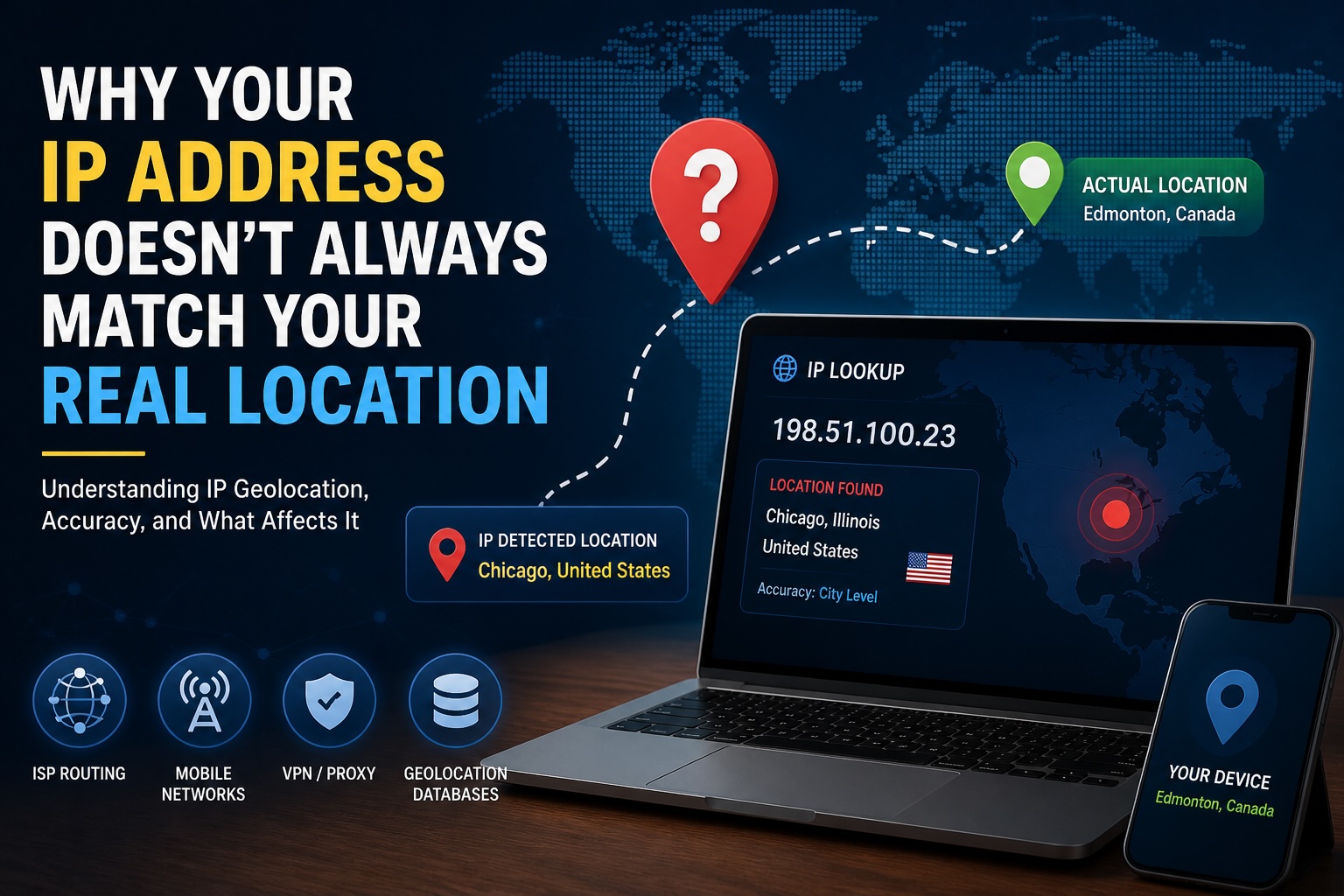
Have you ever checked your IP address location and noticed it shows a different city than where you actually are?
This is a common experience. You might be in one city, but a website thinks you’re somewhere else entirely. It can affect everything from search results to ads and even streaming content.
The short answer is that IP addresses are not designed to pinpoint your exact physical location. To understand why, it helps to look at how IP addresses are assigned and how geolocation actually works.
What an IP Address Actually Represents
An IP address is a unique identifier assigned to your device when it connects to the internet. However, it doesn’t directly represent your home address or even your exact city.
Instead, your IP address is assigned by your internet service provider (ISP). In many cases, it reflects the ISP’s network infrastructure rather than your precise location.
This means your IP address is often tied to a broader region, such as a city hub or even a neighboring area, depending on how your provider manages its network.
How IP Geolocation Works
IP geolocation relies on databases that map IP address ranges to geographic locations. Companies like MaxMind and IP2Location collect and maintain this data using a mix of:
- ISP-provided information
- Network routing data
- User-generated data and corrections
These databases attempt to estimate where an IP address is being used, but they are not always perfectly accurate.
At a high level, geolocation accuracy looks like this:
- Country-level: very accurate
- Region/city-level: moderately accurate
- Exact address: not possible
The closer you try to get to a precise location, the more unreliable the data becomes.
Why Your IP Location Can Be Wrong
There are several reasons why your IP address might show a different location than where you actually are.
ISP Network Routing
One of the most common reasons is how ISPs route traffic through their networks.
Your internet traffic doesn’t always originate from infrastructure located in your immediate area. Instead, it may pass through centralized hubs in nearby cities or regions.
Because IP geolocation databases often associate your IP with these hubs, your location can appear offset.
This can vary depending on the provider and how their network is structured. For example, users comparing internet providers in Edmonton may notice different IP location results depending on which ISP they use, since each provider routes traffic differently and maintains separate IP address blocks.
Mobile Networks
Mobile networks are another major factor.
When you use mobile data, your IP address is often assigned dynamically and may be linked to a regional gateway rather than your exact location. This can cause your IP to appear in a different city, especially if your carrier routes traffic through centralized infrastructure.
VPNs and Proxies
If you’re using a VPN or proxy, your IP location will reflect the server you’re connected to, not your real location.
This is intentional. VPNs are commonly used to mask location, access geo-restricted content, or improve privacy.
Carrier-Grade NAT (CGNAT)
Many ISPs use Carrier-Grade NAT (CGNAT), which allows multiple users to share a single public IP address.
In this setup, your IP is not unique to your household. Instead, it represents a group of users connected through the same gateway.
This makes precise geolocation even more difficult and can sometimes result in inconsistent or misleading location data.
Outdated Geolocation Databases
IP geolocation databases are constantly being updated, but they’re not always perfectly in sync with real-world changes.
IP address allocations can shift, networks can expand, and infrastructure can be reconfigured. When that happens, databases may temporarily reflect outdated information.
This is especially common in fast-growing regions where network infrastructure is evolving quickly.
How Accurate Is IP Geolocation Really?
IP geolocation works well for broad estimates, but it has clear limitations.
At the country level, IP geolocation accuracy is typically above 95%. At the city level, it can vary widely depending on the ISP, the database, and how the network is structured.
Pinpointing an exact address using an IP alone is not realistic.
That’s why many websites combine IP data with other signals, such as GPS (on mobile devices), Wi-Fi positioning, or user input, to improve accuracy.
Why This Matters for Users
Even though IP geolocation isn’t perfect, it still plays a big role in how the internet works.
It’s commonly used for:
- Content localization (showing relevant language or region-specific content)
- Advertising and targeting
- Streaming restrictions
- Fraud detection and security
- Search engine personalization
Because of its limitations, users may occasionally see mismatches, such as incorrect local results or content intended for a nearby city.
Conclusion
If your IP address shows the wrong location, it’s usually not an error, it’s simply a reflection of how internet infrastructure works.
IP addresses are tied to ISP networks, routing paths, and shared systems rather than precise physical locations. As a result, geolocation tools provide estimates, not exact answers.
The accuracy of your IP location depends heavily on your provider, the structure of their network, and the quality of the geolocation database being used.
As networks continue to evolve and technologies like IPv6 become more widely adopted, geolocation accuracy may improve over time. However, it will likely always have some limitations.
For everyday users, the key takeaway is simple: your IP address can tell a general story about where you are, but it won’t tell the whole picture.
Featured Image generated by ChatGPT.
Share this post
Leave a comment
All comments are moderated. Spammy and bot submitted comments are deleted. Please submit the comments that are helpful to others, and we'll approve your comments. A comment that includes outbound link will only be approved if the content is relevant to the topic, and has some value to our readers.
Comments (0)
No comment