
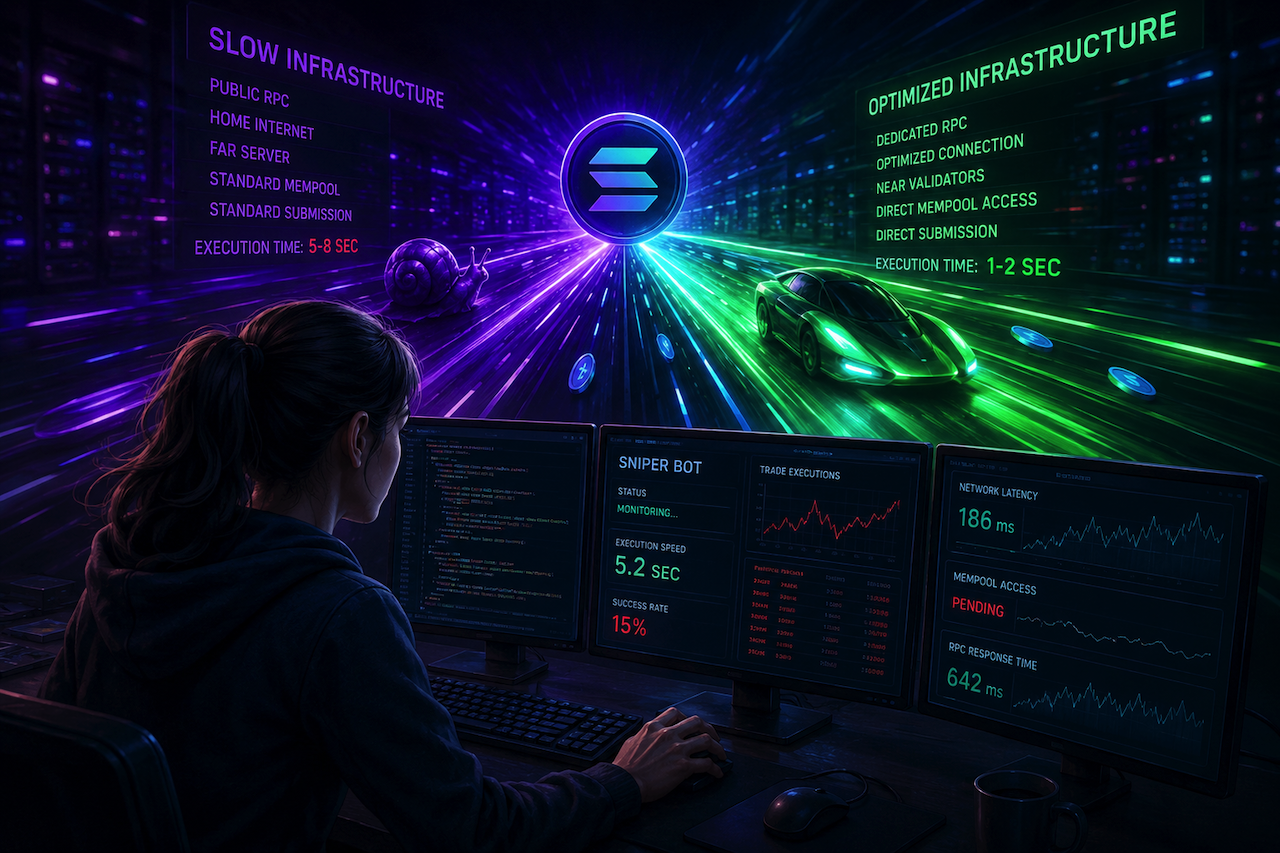
Consider a developer named Sophia who believed she had built the best Solana sniper bot on the market. She'd spent months perfecting every detail. But when she launched it, she discovered something unexpected: other competitors with simpler logic were outperforming hers. They were winning more trades. They were making more profit. She was confused. Her bot was better. So why were they winning? Then she realized the answer: they had better infrastructure.
This is the story of how infrastructure became the defining factor in competitive sniper bot trading, and why many developers focus on the wrong thing.
Building the Perfect Bot
Sophia had been a software engineer for ten years. When she decided to build a Solana sniper tool, she approached it with the rigor of a professional engineer. She spent the first month researching sniper strategies, so she understood the game: detecting token launches, analyzing liquidity, and executing buy orders at the optimal moment.
She spent the next two months building her bot. She implemented sophisticated detection logic that could identify token launches faster than most competitors. She implemented advanced analytical logic to evaluate liquidity and price with precision. She implemented optimized execution logic that could submit transactions with minimal overhead.
She spent the final month testing and optimizing. She ran her bot against historical data. She measured performance. She identified bottlenecks. She optimized every function. She removed unnecessary calculations. She streamlined her code.
By the time she launched, her sniper was a masterpiece of engineering. Every line of code was optimized. Every function was efficient. Every algorithm was sophisticated.
She deployed it to the mainnet with confidence.
Losing to Faster Competitors
Within the first week, Sophia realized something was wrong. Her bot was executing trades, but it was losing. Competitors with simpler logic were beating her. Those with less sophisticated algorithms were winning more trades.
She started analyzing the situation. What she found was surprising: their logic wasn't more sophisticated. It was actually simpler. Their algorithms weren't more advanced. They were actually more basic.
She was confused. How could simpler bots be outperforming hers?
Sophia started measuring execution times. She measured how long it took her bot to detect a token launch. She measured how long it took to analyze the opportunity. She measured how long it took to submit a transaction.
Then she measured the same metrics for the competitors beating her.
The results were clear: competitors were outperforming her primarily because their infrastructure was faster and more optimized.
The Infrastructure Contrast
Sophia realized that she'd been optimizing the wrong thing. She'd optimized her code, but she hadn't optimized her infrastructure. Here's what she discovered:
| Infrastructure Component | Sophia's Setup | Winning Bots' Setup | Speed Impact |
|---|---|---|---|
| RPC Endpoint | Free public endpoint | Dedicated RPC node | 2-5 seconds faster |
| Network Connection | Standard home internet | Optimized data center connection | 100-500ms faster |
| Server Location | Her apartment | Data center near validators | 200-800ms faster |
| Mempool Access | Standard RPC mempool | Direct validator mempool access | 500-1000ms faster |
| Transaction Submission | Standard RPC submission | Direct validator submission | 1-3 seconds faster |
| Total Execution Speed | 5-8 seconds | 1-2 seconds | 3-6x faster |
| Trade Success Rate | 15% | 75% | 5x improvement |
TL;DR: Sophia's optimized code couldn't overcome her infrastructure limitations. Winning bots were 3-6x faster because they used dedicated RPC nodes, optimized network connections, and servers near validators. In HFT trading, infrastructure determines success more than code quality.
Why Infrastructure Matters More Than Code
Sophia had a humbling realization: she'd been thinking about trading system development the wrong way. She'd assumed that the best trading system would be the one with the best code.
But that's not how the competition works. The one that can detect opportunities fastest and execute transactions fastest wins.
Code optimization matters, but only up to a point. Once your code is reasonably efficient, further optimization yields diminishing returns. But infrastructure optimization yields massive returns.
A sniper with mediocre code but excellent infrastructure will beat a bot with excellent code but mediocre infrastructure—every single time.
Prioritizing Infrastructure in the Second Try
Sophia decided to rebuild her bot, prioritizing infrastructure. She switched from a free RPC endpoint to a dedicated Solana RPC node. She moved her bot to a server in a data center close to Solana validators. She optimized her network connection for low latency.
She kept her sophisticated algorithms. She kept her optimized code. But now she added the infrastructure layer that would actually let her tool compete.
The results were dramatic. Her tool’s execution speed improved from 5-8 seconds to 1-2 seconds. Her trade success rate jumped from 15% to 75%. Her profitability increased 5x.
Suddenly, her sophisticated algorithms and optimized code could actually compete. The infrastructure had been the missing piece all along.
Infrastructure Is the True God of Speed
What Sophia learned is that building the best Solana execution engine isn't about writing the best code. It's about building the best infrastructure. Code quality matters, but infrastructure matters more.
The best trading systems in the world aren't necessarily the ones with the most sophisticated algorithms. They're the ones with the best infrastructure. They're the ones that can detect opportunities fastest and execute transactions fastest.
Disclaimer
This article is provided for informational and educational purposes only and should not be considered financial, investment, trading, or legal advice. Cryptocurrency trading, automated trading systems, sniper bots, and blockchain infrastructure involve substantial financial and technical risks, including potential loss of funds.
The example and characters referenced in this article are illustrative in nature and are intended to explain general infrastructure concepts related to automated trading systems and blockchain performance optimization.
Readers are solely responsible for complying with all applicable laws, regulations, exchange policies, blockchain network rules, and platform terms of service in their jurisdiction before using or developing any automated trading tools or cryptocurrency-related software.
iplocation.net does not develop, operate, endorse, promote, or guarantee any sniper bots, automated trading systems, RPC providers, cryptocurrency platforms, or third-party services mentioned or linked in this article. iplocation.net is not liable for any financial losses, technical failures, trading outcomes, security incidents, legal issues, or damages resulting from the use of any tools, platforms, software, or information discussed in this content.
Featured Image generated by ChatGPT.
Share this post
Leave a comment
All comments are moderated. Spammy and bot submitted comments are deleted. Please submit the comments that are helpful to others, and we'll approve your comments. A comment that includes outbound link will only be approved if the content is relevant to the topic, and has some value to our readers.
Comments (0)
No comment