

Given how fast-paced and dynamic users’ expectations have become today, retail commerce businesses can no longer afford downtime. Even a minute of the platform’s unavailability will translate into a humongous revenue loss within seconds. While software is a crucial aspect in shaping the architecture, physical systems designed to work flawlessly under pressure also contribute to the overall success. However, seasonal peaks, flash sales, and global traffic surges often expose the hidden weaknesses of a fragile eCommerce infrastructure. What businesses need to acknowledge is that hardware reliability underpins every request processed and every transaction finalized. That’s why it’s one of the most quintessential yet underestimated elements of a modern eCommerce architecture.
Understanding Hardware Infrastructure in eCommerce
In the eCommerce context, hardware infrastructure refers to the physical systems that support every digital interaction between the user and the platform, from product discovery to payment confirmation. These resources operate behind the shrouds of application logic and cloud abstractions. Yet, they continue to be a determinant of the platform’s ability to respond immaculately and frictionlessly to real-world demand fluctuations. The note here is that hardware systems often introduce fixed constraints—latency boundaries, throughput limits, and failure probabilities—that the software architecture must work within rather than override.
Below, we have listed the key elements shaping hardware reliability for an eCommerce platform today.
- Computer resources: Directly influencing response times during sudden traffic surges through request processing, pricing logic, encryption, and checkout workflows
- Networking hardware: Shaping fault tolerance and latency by handling bandwidth availability, traffic routing, and cross-system communication
- Storage infrastructure: Facilitating data consistency and recovery by working cohesively with inventory states, databases, order histories, and logs
- Physical reliability factors: Influencing the application’s uptime based on power stability, component wear, and cooling efficiency
While software elements optimize the overall usage, it is the hardware infrastructure that sets the operational floor. Businesses can leverage a stable physical layer to enable predictable scaling and deliver consistent, omnichannel user experiences.
How Does Hardware Reliability Affect Performance and Availability?
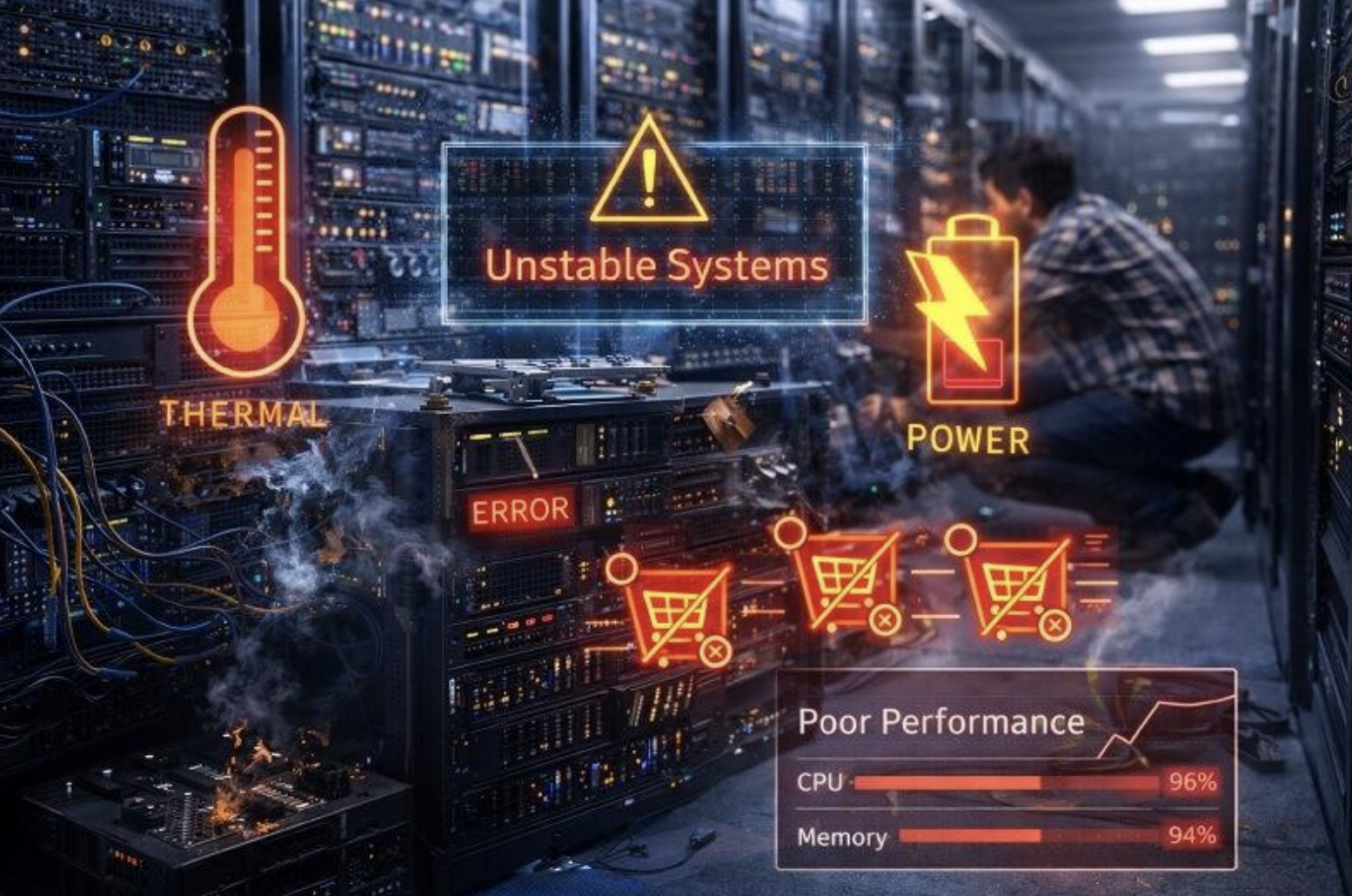
There’s no doubt that the physical architecture and eCommerce performance stability walk hand in hand. Regardless of the applications’ design, every order request or payment transaction depends on the hardware elements responding consistently under fluctuating load. Hence, performance issues surface once the hardware reliability is put to the test. Here’s how.
- Thermal constraints, failing components, and power irregularities can trigger intermittent outages.
- The response time exceeds the threshold once memory, processors, or storage subsystems approach the sustained utilization limits.
- Unstable components lead to compounded system stress by forced rerouting or retries across dependent services.
- Even the shortest disruptions can break user trust, as availability is assumed as a baseline, not a conditional promise.
Security and Data Integrity Depend on a Stable Infrastructure
Hardware instability often creates unpredictable operating conditions, thereby introducing security and data risks. Once physical systems degrade or fail without prior warning, safeguards cannot function as expected. Recovery processes often expose the gaps that otherwise remain hidden. That being said, we have further explained how hardware reliability fosters traceability, consistency, and controlled behavior during both adverse and regular events.
- Data integrity requires uniform behavior of the physical infrastructure during concurrent reads, writes, and synchronization events.
- Transactional accuracy depends on reliable write operations across memory and storage layers.
- System monitoring and auditing rely on uninterrupted hardware operation to ensure accurate logs.
- Predictable recovery paths reduce the likelihood of partial updates or corrupted inventory states.
- Failure isolation shows higher efficacy against localized hardware faults than against systemic ones.
From a risk perspective, the physical infrastructure acts as a stabilizing control, reducing the likelihood that operational failures will escalate into integrity or security incidents.
Scalability Challenges Without Reliable Hardware
In most eCommerce businesses, scalability hurdles surface gradually. But once they do, acceleration occurs without warning. With surging traffic, the hardware infrastructure that once appeared sufficient begins to reveal the hidden constraints. For example:
- Performance degradation during peak business hours results in failed transactions and abandoned shopping sessions.
- Hardware bottlenecks put multiple constraints on performance scaling, thereby forcing multifarious systems to operate near saturation points.
- Unplanned maintenance and failures cause recurring interruptions, which ultimately compound over time.
Early growth planning in the eCommerce sector requires businesses to treat hardware reliability as a prerequisite for scalability. Only a stable infrastructure can foster predictable expansion and prevent growth from becoming a source of instability.
Real-World Context: Infrastructure Supporting eCommerce Operations
Across the entire eCommerce platform’s lifecycle, from launch to maturity, hardware stability underpins daily operations. Inventory synchronization, order processing, analytics, and customer interactions depend on the consistent performance of the physical systems. As platforms evolve, it’s necessary that the infrastructure also adapt without introducing even minor instability. Here’s why.
- Operational continuity gravitates towards minimizing failure rates across the core physical components.
- Sustained performance is possible only with a physical architecture that can handle continuous workloads without degradation.
- Data handling consistency improves once storage and networking remain stable over time.
- System responsiveness is maintained through predictable load distribution.
Whether it’s supporting a global marketplace or a computer and electronics retailer, dependable hardware sets the baseline for reliability, performance, and operational confidence.

Key Takeaways for eCommerce Platform Planning
It is only through a forward-looking discipline, not a reactive response, that businesses can make eCommerce infrastructure planning successful and results-yielding. Aligning its capacity and reliability with platform evolution can slash operational risks and limit disruptive adjustments later on. Here’s how.
- Proactive planning allows redundancy, capacity, and reliability to be built in before demand surges can expose the weaknesses.
- Growth alignment ensures hardware resources scale with traffic, transaction complexity, and data volume.
Conclusion
Data protection, performance consistency, and scalable growth—all depend on physical systems operating predictably under real-world conditions. While the software architecture defines the user experience and feature richness, the eCommerce infrastructure determines whether these capabilities remain available and trustworthy at scale.
Share this post
Leave a comment
All comments are moderated. Spammy and bot submitted comments are deleted. Please submit the comments that are helpful to others, and we'll approve your comments. A comment that includes outbound link will only be approved if the content is relevant to the topic, and has some value to our readers.
Comments (0)
No comment