
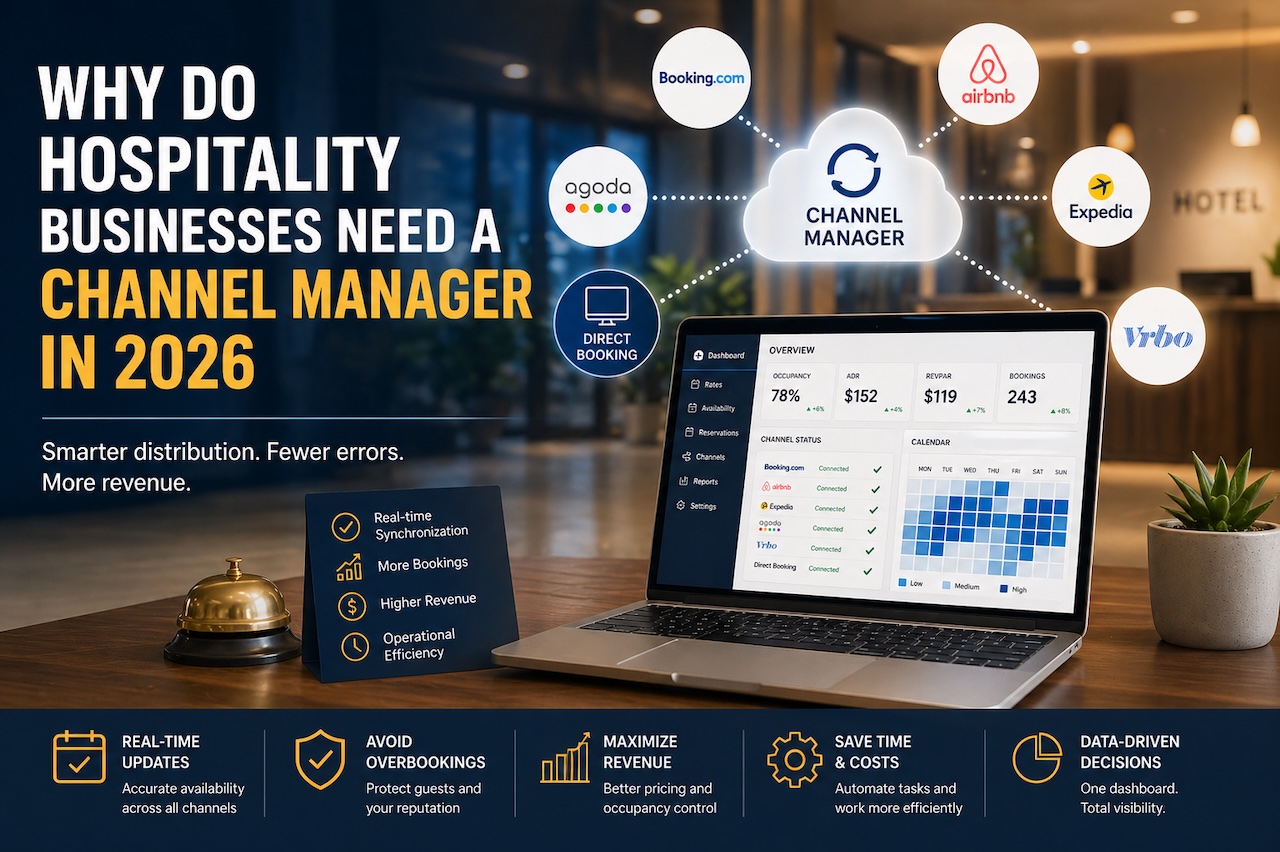
Hospitality businesses in 2026 are operating in a growing market, but operational pressure is increasing. Recent StayFi’s vacation rental statistics show that U.S. short-term rental listings are projected to reach 1.77 million in 2026, up from 1.69 million in 2025, while demand is expected to grow by 4.1% year over year and ADR by 1.5%. In practice, that means more inventory competing across the same channels and more pressure to keep pricing and availability accurate at all times.
When performance depends more on execution than on pure demand growth, distribution control becomes a critical factor. A channel manager plays a central role here by keeping listings synchronized, reducing booking errors, and helping operators react faster across OTAs and direct channels.
Why Do Your Businesses Need a Channel Manager?
A channel manager is software that connects a property’s booking channels and keeps availability, rates, and reservations synchronized in one place. It updates OTAs, direct booking engines, and other sales channels automatically, so hospitality businesses can reduce overbookings, avoid pricing mismatches, and manage distribution with more control.
A channel manager has become essential because hospitality distribution now moves too fast and across too many platforms to stay accurate through manual updates alone. Without one system coordinating those updates, availability, and pricing start to drift out of sync very quickly.
Channel Synchronization
Inventory now changes continuously, not a few times a day. New bookings, cancellations, reopened dates, and pricing adjustments can happen at any hour, especially during short booking windows. A channel manager keeps those changes synchronized across connected platforms, so the property does not lose control as activity increases.
Faster Booking Pace
Booking speed leaves little room for delay. If one channel updates later than another, the property can end up showing outdated rates or availability for long enough to create a costly mistake. Automation reduces that exposure by pushing changes immediately instead of relying on staff to correct them manually.
Stronger Revenue Control
Channel management now affects more than operations. It also supports pricing discipline, occupancy strategy, and the balance between direct and third-party bookings. In practice, that makes it part of revenue control, because distribution decisions influence both how rooms are sold and how profitably they are sold.
How Does a Channel Manager Improve Revenue Performance?
In a market where supply is rising and competition is tighter, revenue often depends on execution quality as much as on demand itself. A channel manager strengthens revenue performance by helping the property react faster, sell more accurately, and keep pricing aligned across every active channel.
- Protects inventory from double-selling: Real-time updates prevent the same unit from being booked on multiple platforms.
- Maintains rate consistency: Pricing changes are applied across all channels without delay.
- Supports faster pricing decisions: Teams can adjust rates quickly during demand shifts.
- Improves conversion: Guests are more likely to book when availability and pricing are reliable.
- Reduces revenue leakage: Fewer errors mean fewer cancellations, refunds, and missed bookings.
What Problems Does Manual Channel Management Create?
Manual channel management introduces inefficiencies and risks that grow with the number of channels and the speed of bookings. While manual updates may work at a very small scale, they quickly become unreliable once distribution expands.
Overbookings
Overbooking creates problems well beyond one failed reservation. It can trigger guest relocation, refund costs, service recovery work, and negative reviews that damage trust. If the same issue happens repeatedly, it can also weaken platform performance and make future bookings harder to secure.
Time Pressure
Manual updates across several extranets take time away from more valuable work. Instead of focusing on pricing decisions, reporting, or guest communication, staff end up handling repetitive distribution tasks. This reduces overall efficiency and makes it harder for the business to respond quickly in a competitive market.
Fragmented Data
When every channel is managed separately, performance data becomes harder to interpret as a single picture. Teams have to compare different dashboards, timestamps, and booking states, which slows analysis and decision-making. That makes it more difficult to spot trends, evaluate channel quality, and improve distribution strategy.
How Does a Channel Manager Fit into a Modern Hospitality Tech Stack?
A channel manager serves as the link between booking platforms, operational systems, and revenue tools, creating a unified workflow. Instead of working with isolated systems, hospitality businesses in 2026 rely on integrated tools that exchange data in real time.
- Connects with PMS: Reservations flow directly into operations without manual input.
- Supports pricing tools: Rate updates are applied consistently across all channels.
- Aligns direct booking with OTAs: Website availability stays synchronized with external platforms.
- Improves data consistency: Teams work from one accurate source of truth.
- Supports broader strategy: Distribution data can be combined with marketing and guest data systems.
What Features Define the Best Channel Managers in 2026?
The best vacation rental channel managers are defined by reliability, speed, and their ability to simplify complex distribution workflows. Choosing a system requires focusing on how it performs in real conditions, not just how many features it lists.
Synchronization Speed
Fast synchronization remains one of the most important requirements because availability and rate changes need to reach every connected channel before they create a conflict. If updates move too slowly, the system leaves the property exposed to overbookings, outdated pricing, and missed revenue opportunities.
Integrations
The value of an integration depends on how stable and usable it is in daily operations. A platform with fewer but better-maintained connections is often more effective than one with a long list of unreliable partners. Strong integrations reduce mapping issues, improve data flow, and help the system work smoothly with PMS and pricing tools.
Rate Control
Rate and restriction management should be easy to apply without constant manual correction. The system needs to support practical control over minimum stays, closed dates, stop-sell settings, and date-based adjustments across channels. When that control is clear and efficient, teams can react faster to market changes without creating extra operational friction.
How Does a Channel Manager Reduce Operational Costs?
A channel manager lowers operating costs by eliminating repetitive distribution tasks, reducing the financial impact of preventable mistakes, and making inventory growth easier to manage without adding additional administrative effort. Over time, these efficiencies support more stable operations and better use of internal resources.
- Reduces Manual Workload: Staff spend less time updating each channel separately and more time on higher-value tasks.
- Prevents Error-Related Costs: Fewer overbookings mean fewer refunds, guest recovery costs, and compensation cases.
- Improves Staff Efficiency: More working time remains available for pricing, reporting, and guest communication.
- Supports Multi-Property Management: Standardized workflows become easier to maintain across several properties.
- Enables Scalable Growth: Adding inventory does not require a proportional increase in admin effort.
Conclusion
A channel manager has become a core system for hospitality businesses in 2026 because distribution is more complex, faster, and more competitive than before. Market data shows that supply continues to grow, while performance depends increasingly on execution rather than demand alone.
Properties that rely on manual processes struggle to keep pace with this environment. Those that implement centralized distribution control gain better accuracy, faster response times, and stronger revenue performance.
Featured Image generated by ChatGPT.
Share this post
Leave a comment
All comments are moderated. Spammy and bot submitted comments are deleted. Please submit the comments that are helpful to others, and we'll approve your comments. A comment that includes outbound link will only be approved if the content is relevant to the topic, and has some value to our readers.
Comments (0)
No comment