
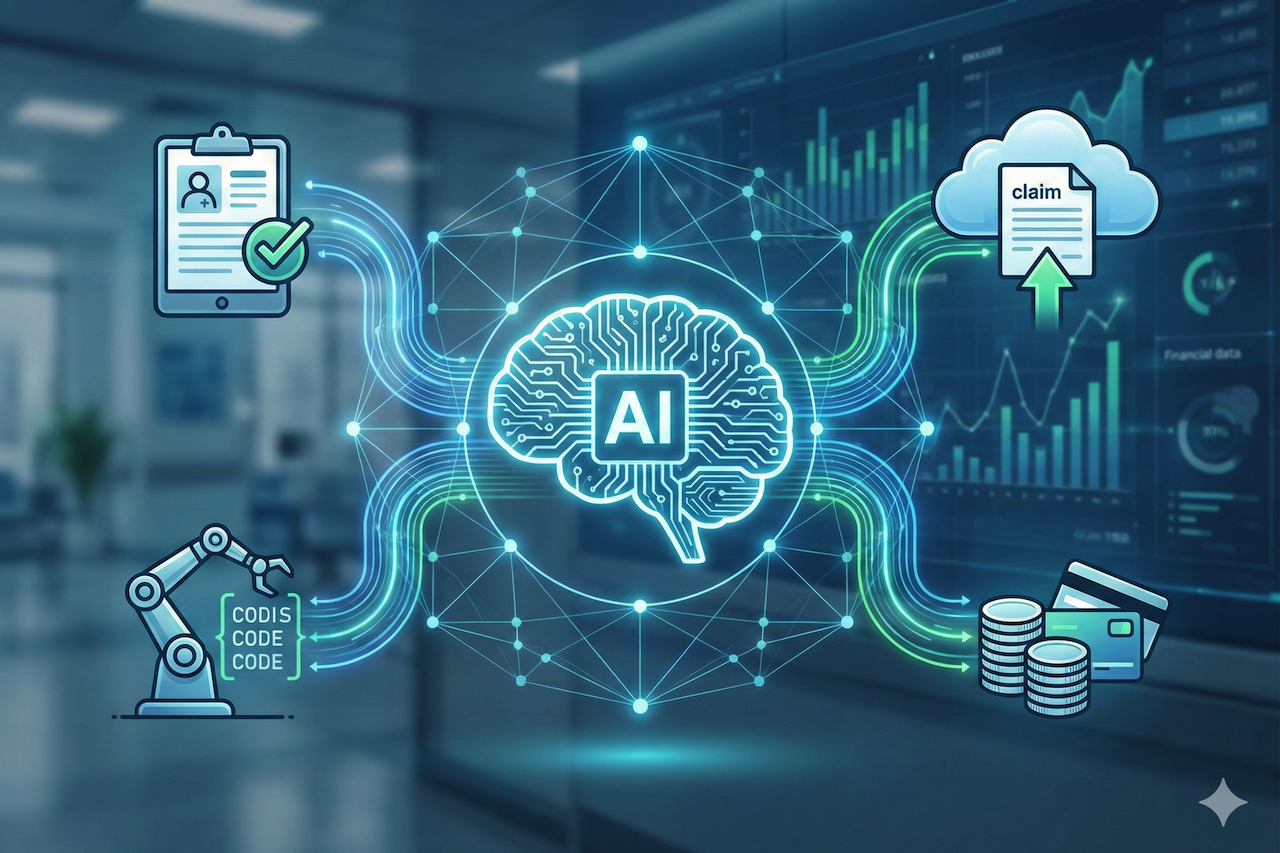
Healthcare organizations worldwide are under increasing financial pressure. Rising patient volumes, complex payer rules, workforce shortages, and administrative burdens are stretching revenue cycle management (RCM) teams to their limits. The existing automation tools provide some assistance to businesses, but their operational functions remain physically separated and require continuous human monitoring.
Agentic AI introduces a novel category of artificial intelligence systems capable of executing complete workflows through autonomous decision-making. Agentic AI systems function as digital intelligent agents that handle work assignments while improving operational efficiency through their ongoing performance analysis.
RCM organizations currently use agentic AI as their preferred method to enhance financial results, minimize operational expenses, and accelerate revenue collection. This article provides an overview of agentic AI, its significance in revenue cycle management, and its potential applications for financial transformation within healthcare organizations.
Understanding Revenue Cycle Management Challenge
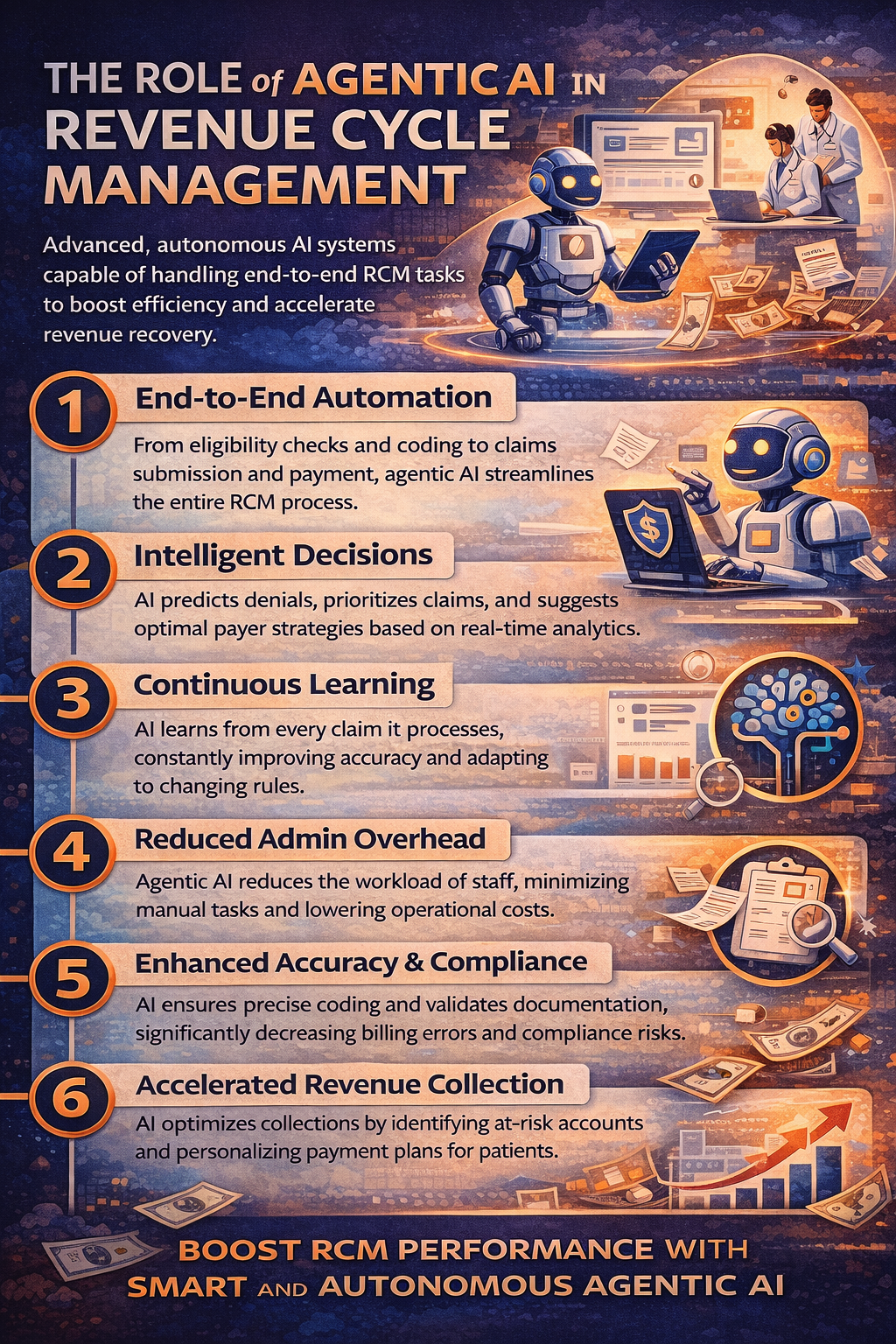
Image generated by ChatGPT.
The financial cycle of a patient begins with their appointment and eligibility check and continues through their medical coding and billing until payment collection. The digital health record system, together with billing software systems, has developed better functions, yet RCM still requires manual processes that remain separate from its existing operations.
The most common challenges that organizations face include:
1. Manual and Repetitive Tasks
The process of verifying eligibility, submitting claims, handling denial follow-up, and posting payments requires workers to repeat the same tasks frequently, consuming valuable staff time and increasing the risk of errors.
2. Increasing Claim Denials
Stricter reimbursement guidelines from payers have led to a rise in rejected claims, where even minor documentation or coding errors can delay revenue collection and increase administrative costs.
3. Workforce Shortages
Healthcare organizations continue to face shortages in billing and administrative staff, while hiring and training qualified RCM specialists requires significant time and financial investment.
4. Complex Payer Regulations
Frequently changing payer rules, compliance requirements, and billing code updates create ongoing challenges in maintaining accuracy and operational efficiency.
What Is Agentic AI?
Agentic AI refers to artificial intelligence systems that function as self-sufficient agents, capable of creating plans, making decisions, and carrying out their chosen activities. Agentic AI systems operate differently from rule-based automation and machine learning models because they can perform tasks that have not been programmed as predefined functions.
- Understand goals and constraints
- Break tasks into steps
- Execute actions independently
- Learn from feedback and improve over time
- Collaborate with other AI agents or human teams
In RCM, an agentic AI system can manage workflows such as verifying insurance eligibility, submitting claims, following up on denials, and optimizing collections strategies—all without constant human intervention.
Why Agentic AI Is the New Standard for RCM
1. End-to-End Automation of the Revenue Cycle
Traditional RPA (Robotic Process Automation) tools focus on isolated tasks, whereas agentic AI can manage the entire revenue cycle as a connected, end-to-end process.
For example, an agentic AI system can:
- Verify patient eligibility before appointments
- Flag documentation gaps for providers
- Assign correct medical codes
- Submit claims automatically
- Monitor claim status and initiate follow-ups
- Negotiate payer disputes using historical data
- Optimize patient payment plans
This holistic automation helps reduce cycle times and improve overall cash flow.
2. Intelligent Decision-Making in Real Time
Agentic AI systems rely on predictive analytics and contextual understanding to make informed decisions without waiting for constant human input.
These systems can:
- Predict claim denial risk and adjust coding strategies
- Prioritize high-value claims for faster processing
- Suggest alternative reimbursement pathways
- Optimize payer mix strategies
This real-time intelligence allows organizations to address revenue leakage proactively rather than reacting after losses occur.
3. Continuous Learning and Optimization
One of the defining characteristics of agentic AI is its ability to learn continuously. As it processes more claims and interactions, it identifies patterns and refines its strategies over time.
For example:
- If a payer frequently denies claims for a specific procedure, the AI learns to flag documentation requirements earlier.
- If certain patient segments delay payments, the system adjusts communication methods and payment plans accordingly.
This adaptive learning improves RCM efficiency without requiring manual system updates.
4. Reduced Administrative Burden and Staffing Costs
Administrative overhead represents a significant cost for healthcare organizations. Agentic AI reduces the need for manual intervention, allowing staff to focus on higher-value, patient-centric work.
As a result, organizations may experience:
- Lower staffing costs
- Faster onboarding
- Reduced training expenses
- Improved employee satisfaction
5. Enhanced Accuracy and Compliance
Errors in coding, documentation, and billing are a major source of claim denials and compliance risk. Agentic AI systems use natural language processing and coding intelligence to improve accuracy.
They can:
- Validate documentation against payer requirements
- Detect inconsistencies in clinical notes
- Ensure correct ICD and CPT code assignment
- Monitor regulatory compliance automatically
This helps reduce audit risk and protects organizations from financial penalties.
Key Use Cases of Agentic AI in RCM
Eligibility and Prior Authorization Automation
The process of automated eligibility verification and prior authorization system testing. The agentic AI system enables automatic insurance verification and prior authorization request processing without needing human intervention. The system reduces appointment wait times while protecting against claim denials arising from authorization issues.
Intelligent Coding and Documentation Support
The AI agents analyze clinical documentation to help them select suitable medical codes for their coding tasks. This process reduces coding errors while enhancing the accuracy of reimbursement payments.
Automated Claims Submission and Tracking
Agentic AI can submit claims while tracking their progress and initiating follow-up processes. The system enables identification of payer response patterns that lead to submission strategy adjustments.
Denial Management and Appeals
Denials are one of the most significant sources of revenue loss. Agentic AI systems can:
- Analyze denial reasons
- Generate appeal letters
- Submit supporting documentation
- Track appeal outcomes
This significantly improves denial recovery rates.
Patient Collections and Engagement
Agentic AI agents can personalize payment reminders, offer flexible payment plans, and predict patient payment behavior. This improves patient satisfaction while increasing collection rates.
Business Impact of Agentic AI on Organizations
Improved Cash Flow and Revenue Capture
By eliminating delays and errors, agentic AI can speed up reimbursement cycles and salvage revenues that would otherwise be lost.
Scalability Without Workforce Expansion
Agentic AI systems can expand their operations when patient volumes increase because they do not need to hire additional staff at the same rate as their operations grow.
Enhanced Patient Experience
Patients experience higher levels of trust and satisfaction because the system provides fast billing, clear communication, and various payment methods they can choose according to their needs.
Overcoming Adoption Challenges
Big AI promises to deliver a striking scale of gains. But enterprises that deploy these need to foresee a fairly matched scale of challenges.
Data Integration
RCM systems often rely on fragmented data across EHRs, billing platforms, and payer portals. Integrating agentic AI requires unified data pipelines and interoperability frameworks.
Security and Compliance
Healthcare data is highly sensitive. Organizations must ensure AI systems comply with data privacy regulations and maintain robust cybersecurity measures.
Change Management
Staff may resist AI adoption due to fear of job displacement. Practical training and communication are essential to demonstrate that AI enhances human roles rather than replacing them.
Governance and Ethical Oversight
Organizations should establish governance frameworks to ensure AI decisions are transparent, ethical, and aligned with organizational policies.
The Future of RCM with Agentic AI
Agentic AI is not just an incremental improvement; it represents a paradigm shift in healthcare financial operations. As AI agents become more sophisticated, they will evolve from task automation tools to strategic financial advisors for healthcare organizations.
Future developments may include:
- Autonomous negotiation with payers
- Predictive financial modeling for healthcare organizations
- AI-driven contract optimization
- Personalized financial pathways for patients
Healthcare organizations that adopt agentic AI early may gain a competitive advantage through improved margins, stronger patient satisfaction, and greater operational resilience. Some revenue cycle management service providers, such as P3Care, incorporate end-to-end RCM capabilities—including coding, billing, claims management, and denial resolution—as part of broader efforts to reduce errors, streamline reimbursement processes, and support financial performance.
Conclusion
The revenue cycle management process has reached an essential point of change. Modern healthcare systems require more advanced solutions than traditional automation and manual workflows can provide. The financial operations of businesses can be transformed through agentic AI, which enables organizations to run their operations through intelligent, self-sufficient systems that learn and adapt.
Agentic AI establishes a revenue cycle management benchmark by automating end-to-end operational processes, enhancing decision-making, and supporting ongoing process improvements. Organizations that adopt this technology today will gain a competitive advantage in managing regulatory requirements and financial challenges while meeting the changing needs of patients.
Featured Image generated by Google Gemini.
Share this post
Leave a comment
All comments are moderated. Spammy and bot submitted comments are deleted. Please submit the comments that are helpful to others, and we'll approve your comments. A comment that includes outbound link will only be approved if the content is relevant to the topic, and has some value to our readers.
Comments (0)
No comment