
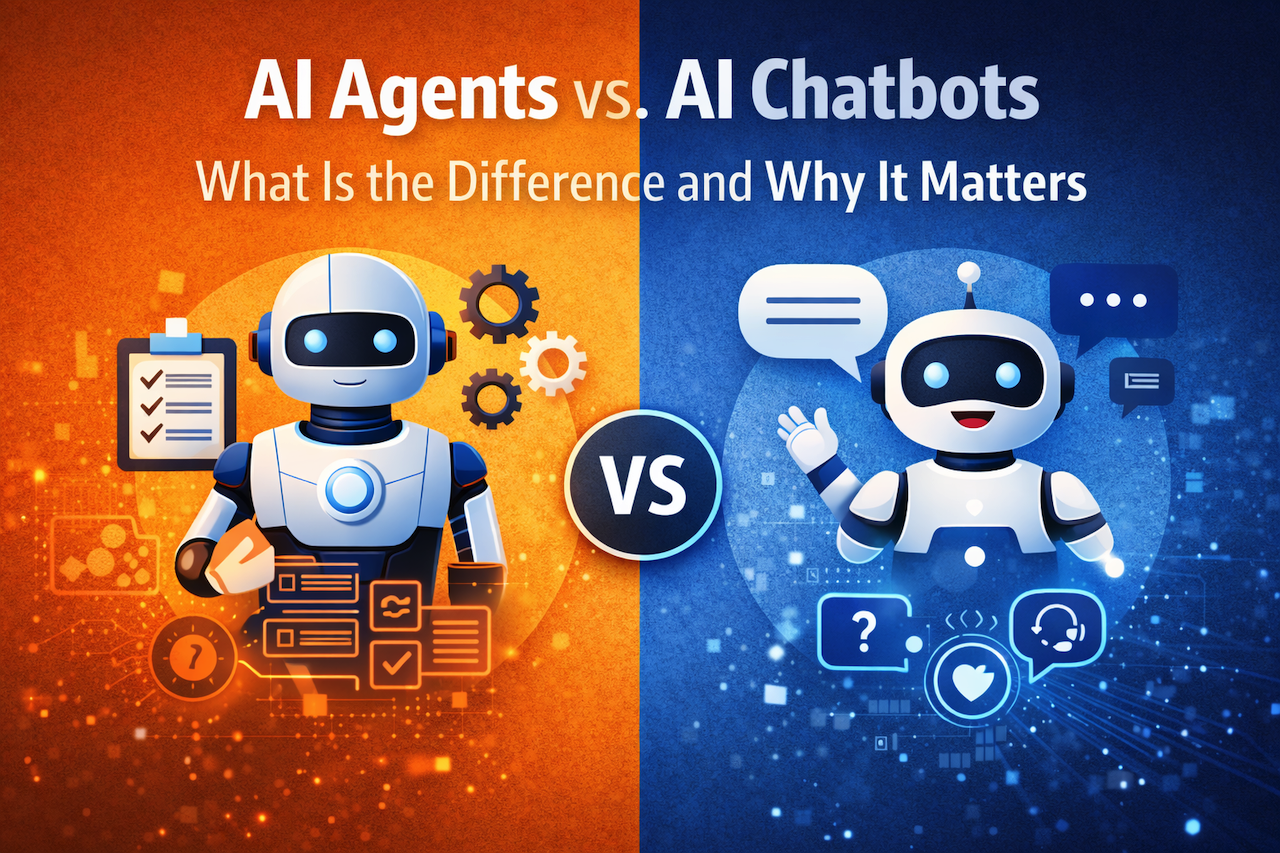
AI chatbots and AI agents are both forms of AI technology that uses similar high-level models and are often confused with one another. Still, they differ in characteristics, functions, and applications for your business.
A key distinction between chatbots and agents is that chatbots exist for the purpose of facilitating conversation between users and a computer. In contrast, agents generally respond to your actions as a user.
By identifying these chatbot vs. agent features, your company can implement the right AI solution. This article will describe the differences between chatbots and agents, provide a brief overview of the specific benefits that chatbots and agents offer, and ultimately demonstrate how proper implementation of chatbots or agents can lead to positive outcomes for your business.
What Is an AI Agent?
AI agents (artificial intelligence agents) are sophisticated autonomous systems capable of perceiving and interacting with the world around them. They use their sensors to perceive (or otherwise receive), evaluate, and choose an action based on what they have perceived. They then use their actuators to carry out the required actions. You may develop your own generative AI to automate these tasks.
Unlike chatbots, which are limited to simple conversations, AI agents can do far more than engage in simple conversations with each other because their ability to plan, implement, examine, and adapt in real time enables them to function independently in highly complex environments.
Key Characteristics of AI Agents
AI agents typically exhibit:
- Goal-Oriented Behavior: AI agents are programmed to perform tasks to achieve specific outcomes rather than simply responding to requests.
- Autonomous Behavior: AI agents can initiate actions without external intervention.
- Decision-Making Ability: AI agents evaluate multiple possible actions and select the one that best aligns with their defined goals.
- Using Tools: AI agents can call application programming interfaces (APIs), execute scripts, interact with other software applications, and trigger workflows.
- Environmental Awareness: AI agents can observe system status, detect data changes, and understand how user actions affect their operation.
Some examples are:
- Autonomous workflow automation systems
- AI agents managing cloud computing
- Sales or marketing agents conducting end-to-end campaigns
- AI agents coordinating supply chain logistics
- Personal AI agents managing schedules, research, and tasking
What Is an AI Chatbot?
An AI chatbot is a system designed to interact with users via text or voice. It primarily responds to questions, provides information, or assists with specific, predefined tasks within the scope of a conversation.
Key Characteristics of AI Chatbots
The defining characteristics of AI chatbots are:
- Reactive behavior: Responds only after receiving user input.
- Conversation-oriented: The primary purpose is to engage in dialogue.
- Restricted independence: Does not operate outside the boundaries of a conversation.
- Rule-based or model-based logic: Operates using predefined workflows or large language models (LLMs).
- Limited long-term memory: Context is typically retained only for the duration of a session.
Examples of AI chatbots are:
- Chat widgets that provide customer support
- FAQ bots on business websites
- Virtual assistance where the assistant responds to general questions asked by the user
- Helpdesk support AI chatbots that scale across a variety of messaging platforms
Chatbots vs. AI Agents: Understanding the Key Differences
The biggest difference between chatbots and AI agents is their purpose.
Chatbots are used for communication. They communicate reactively and assist users by answering questions, responding to input, and guiding them through the interactive experience.
Conversely, AI-powered agents are used for actions. They are primarily designed to make predefined task decisions and perform tasks without human intervention. Agents will take action based on programmed guidance rather than predefined prompts. They also use tools to complete specific tasks or achieve specified goals. Agents will also adapt their actions based on changing conditions.
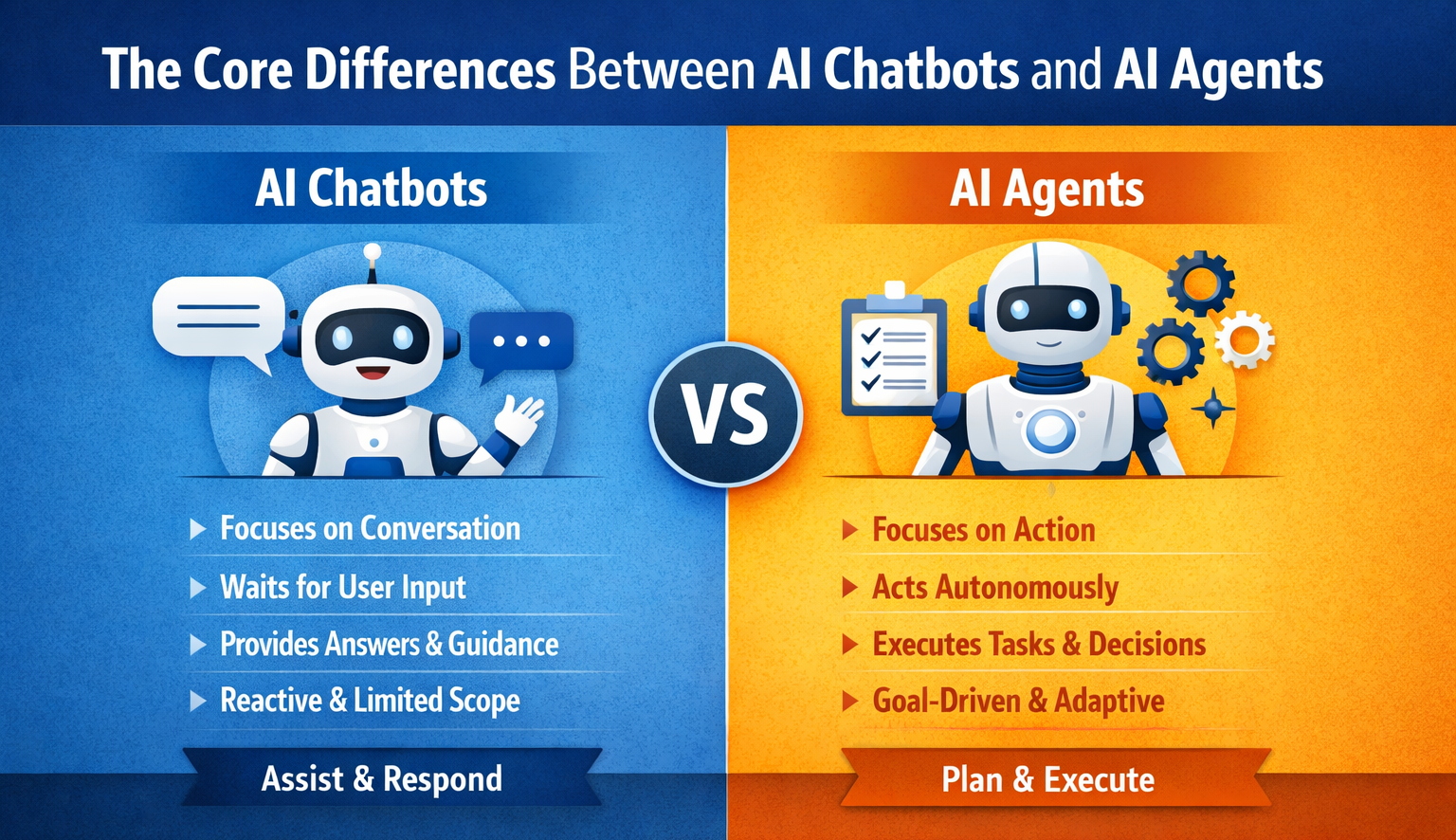
To summarize, chatbots provide an interactive environment where users can get assistance or answers to their questions. In contrast, AI agents automate many back-office processes and support task completion by allowing users to provide overall direction and letting the agent handle the details.
Use Cases: When to Use Each
Choosing between an AI chatbot and an AI agent depends largely on the problem you’re trying to solve.
Recommended Applications for AI Chatbots
AI chatbots perform best in situations where:
- The main objective is to facilitate a user’s interaction with an organization
- The desired tasks of the user will require repeated and consistent execution by the organization
- An immediate response is more important than completing the task properly
- The organization provides some human oversight
Common industries:
- Customer Support
- E-Commerce
- Banking FAQs
- Healthcare Appointment Scheduling
- HR Self-Service Systems
Recommended Applications for AI Agents
AI agents work very well for conducting tasks that:
- Have multiple steps or are more complicated than a user simply asking a question
- Require constant operation of the system
- Require that decisions adapt to changing data
- Are designed to automate large numbers of processes without human intervention
Common industries:
- SaaS (Software as a Service)
- Enterprise Operations
- FinTech/Trading Systems
- Logistics/Supply Chain Management
- Marketing Automation
- DevOps/Infrastructure Management
Why We Should Consider This Difference When Thinking About Business
The decision to use a chatbot or an AI Agent affects:
- Price: AI agents typically cost more to build and maintain than chatbots.
- Risk: Autonomous systems require stronger governance and oversight than traditional AI tools.
- ROI: Agents can replace entire processes rather than simply interacting with users.
- Scale: As operational demands increase, agents can support growth more effectively than standard automation.
Many AI projects have failed because businesses anticipated agent-like results from chatbot-like tools.
Final Thoughts
There is no competition between AI chatbots and AI agents. Both have automated features, though they differ. Chatbots can be effective at answering questions and assisting users in using their functionality, so if that's the primary benefit your organization is looking for, the solution is to use a chatbot.
However, if the organization's primary focus is to achieve intended outcomes or to make processes more efficient through automation, an AI agent would meet those outcomes.
Awareness of the differences between chatbots and AI agents enables organizations to develop a strong strategy and plan of action, and to understand and appreciate the actual benefits of AI for their organization.
Share this post
Author

Read the latest articles from Yuliya Melnik
FinTech App Development: Security Architecture, Compliance and Scalable Infrastructure
February 25, 2026
The process of developing FinTech applications differs from creating standard mobile and web applications. Financial platforms handle highly confidential personal information while conducting instant financial operations and adhering to comprehensive regulatory frameworks. The infrastructure within an org [...]
Learn moreHow to Choose a Business Model for a Software Startup?

March 14, 2024
Starting a new business venture resembles embarking on a thrilling journey into unexplored territories. However, like navigating unfamiliar waters, it carries risks without a clear plan. That's where a robust business model steps in. Think of it as the architectural design for your startup – it delineates how y [...]
Learn moreLeave a comment
All comments are moderated. Spammy and bot submitted comments are deleted. Please submit the comments that are helpful to others, and we'll approve your comments. A comment that includes outbound link will only be approved if the content is relevant to the topic, and has some value to our readers.
Comments (0)
No comment