

What is Mobile Optimization and Why It Makes Content Marketing Work Better
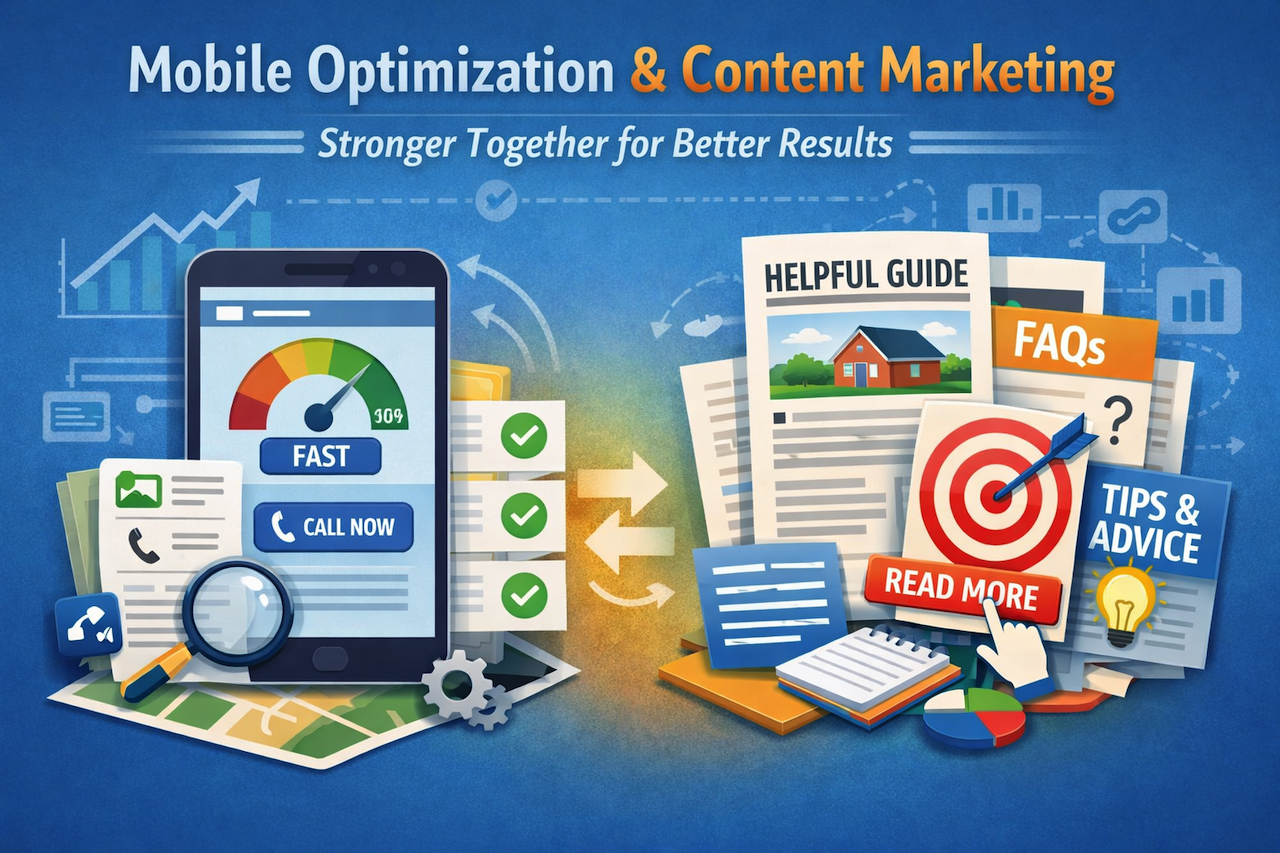
People are more likely to find you if your content is optimized for mobile. After all, it is no secret that more people use mobile devices to search for services than other devices.
What is mobile optimization in plain terms? It is the process of making a website work perfectly on a phone, not just "look okay." That includes how fast pages load, how easy it is to read and tap, and how quickly a visitor can take the next step.
This matters because most local service searches happen on mobile. For example, a homeowner may notice a roof leak, search for roofing services, open a result, and decide quickly whether to call. If your page loads slowly or feels awkward, visitors do not wait. They back out and click the next result. That is why it is not just a design preference; it is conversion protection.
A mobile-optimized site usually gets the basics right first, then improves the details that stop people from taking action.
- Pages load fast enough for visitors to stay.
- Text is readable without zooming.
- Buttons are easy to tap with a thumb.
- Forms feel short and simple.
- Phone numbers are clickable, so calls happen instantly.
If you want a quick self-check, open your site on a phone and try to request a quote with one hand. If it feels annoying, it is not optimized.
What Mobile Optimization Includes Beyond Responsive Design
Many businesses assume "responsive design" solves everything. It helps, but this goes further. It includes speed, layout stability, and the path to contact.
Start with speed because speed influences everything else. When a page is slow, the visitor never reaches your message, so even great writing becomes irrelevant.
Then focus on usability. The page should feel calm and predictable, not jumpy or cluttered. If the layout shifts while loading, users lose trust. If the navigation is busy, users get lost. If the call button is buried, users leave.
Finally, simplify action steps. Mobile visitors want a short path to contact because they are often multitasking. They may be moving around, checking an issue, or quickly comparing options. Your website should support that reality by making it easy to take the next step.
Here are common mobile issues that quietly kill leads.
- Long hero sections that push the call button below the fold.
- Heavy image sliders that slow down the first load.
- Forms that ask too many questions before the visitor trusts you.
- Text blocks that look fine on desktop but feel dense on mobile.
- Popups that cover the screen and frustrate the visitor.
When you fix these, mobile optimization improves quickly, and calls often rise even before rankings change.
How Mobile Optimization Affects SEO and Local Leads
It influences SEO because search engines watch user behavior. If people click your result and leave immediately, that's a negative signal. If they stay, scroll, and contact you, the signal is stronger.
More importantly, it improves lead quality by reducing friction. The easier it is to act, the more likely a serious visitor becomes a real inquiry.
Track outcomes that reflect real performance, not vanity metrics.
- Click-to-call taps from service pages.
- Form submissions from mobile devices.
- Time on page for high-intent pages.
- Bounce rate from mobile search traffic.
- Direction requests or profile actions if you rely on local listings.
When those numbers improve, you are not only improving usability. You are improving revenue efficiency.
Content Marketing
Content marketing is the practice of publishing useful, targeted content that attracts the right visitors and builds trust before the first interaction. It works best when it answers the real questions people ask when making a decision.
The mistake is treating it as "posting blogs." Random posts rarely rank and rarely convert. Instead, content should support a clear path—attract visitors, reduce uncertainty, and guide them toward a service page or contact step.
A practical approach usually covers three stages.
- Problem Recognition: The customer notices something wrong and wants clarity.
- Solution Comparison: They want options and realistic expectations.
- Hiring Intent: They want a trustworthy provider and a clear next step.
If your content aligns with these stages, it becomes a pipeline asset, rather than a writing task.
What Content Marketing Looks Like in Practice
This approach should feel like helpful guidance, not a sales pitch. The goal is to remove confusion and reduce hesitation. When visitors trust the information provided, they are more likely to take the next step because they better understand the process.
For example, in roofing and similar service industries, roofing content marketing that explains inspections, repairs, or maintenance can help potential customers make more informed decisions.
Content formats that tend to work well include the following.
- Short guides that explain how a service or process works.
- Articles that clarify common decisions in simple language.
- Seasonal or situational checklists that highlight what to look for.
- Photo-based examples that show real scenarios and outcomes.
- FAQ pages that answer the questions people are already searching for.
The key is specificity. Vague content attracts vague traffic. Specific content attracts people with real intent, which is the kind of visitor who is more likely to convert.
How Mobile Optimization and Content Marketing Reinforce Each Other
Content can bring the right visitors, but mobile experience determines whether those visitors stay long enough to trust you. These two disciplines should be planned together.
For example, a helpful article about leak diagnosis can rank well. However, if it loads slowly on mobile, the visitor leaves before reading the explanation. On the other hand, if the article loads quickly and reads easily, the visitor stays, clicks into the relevant service page, and calls.
This is also where internal linking matters. Your content should not exist as isolated pages. It should guide the reader toward action, so links should be intentional, and the mobile experience should make them easy to tap.
A simple connection pattern works well.
- The article answers the question clearly.
- The article links to the matching service page.
- The service page shows proof and process.
- The contact step is visible and easy on mobile.
When you build that chain, your content stops being "informational" and starts producing inquiries.
A Practical Way to Improve Both in the Next 30 Days
If you want a realistic plan, keep it small and consistent. Improve pages that already have intent, and publish content that supports them.
Week 1: Focus on Mobile Basics
- Improve load speed by compressing images and removing heavy elements.
- Make the phone number tappable and visible on key pages.
- Shorten forms so they feel quick to complete.
Week 2: Tighten the Structure
- Ensure each core service has a focused page.
- Add internal links from supporting pages to service pages.
- Remove distractions that block reading on mobile.
Week 3: Build Content That Matches Real Demand
- Publish one guide that answers a common customer question.
- Add a short FAQ section to the most visited service page.
- Include a simple call to action that matches the page's intent.
Week 4: Measure and Refine
- Review mobile conversions and adjust the weakest pages.
- Update the new content based on real user behavior.
- Repeat the process with the next highest-intent topic.
This approach remains practical because it uses what you already have, and then improves it with clear priorities.
The Takeaway
What is mobile optimization? It is the discipline of making your site easy to use on a phone, fast to load, and simple to contact from.
When you combine both, you get compounding results. Your content gets read. Your service pages convert. Your leads become more predictable because the full journey works on the device people actually use.
Featured Image generated by ChatGPT.
Related Articles
July 10, 2025
How to Optimize Website Content for Better SEO & Higher Google Ranking
Optimizing your web content is crucial for ranking high, especially on a search engine like Google, where millions of pages are competing for attention. Just publishing your conten...
Read More
November 12, 2024
5 Ways Content Marketing Can Help You Dominate Search Rankings
In today's digital landscape, many businesses recognize the importance of combining content marketing and SEO in their overall marketing strategy. These two closely linked aspects...
Read More
November 21, 2021
7 Effective Mobile Content Marketing Strategies
Marketing strategies center on getting your message to as large a percentage of your audience as possible. And since most people use mobile devices nowadays, creating content for m...
Read More
Comments
Comments are available to signed-in users and are moderated to keep the discussion useful and respectful. Spam, automated submissions, and low-value promotional comments are removed. Outbound links may be approved when they are relevant and genuinely helpful to readers, but they are displayed as plain text rather than clickable hyperlinks.
No comments have been published yet.
Please sign in to submit a comment.