
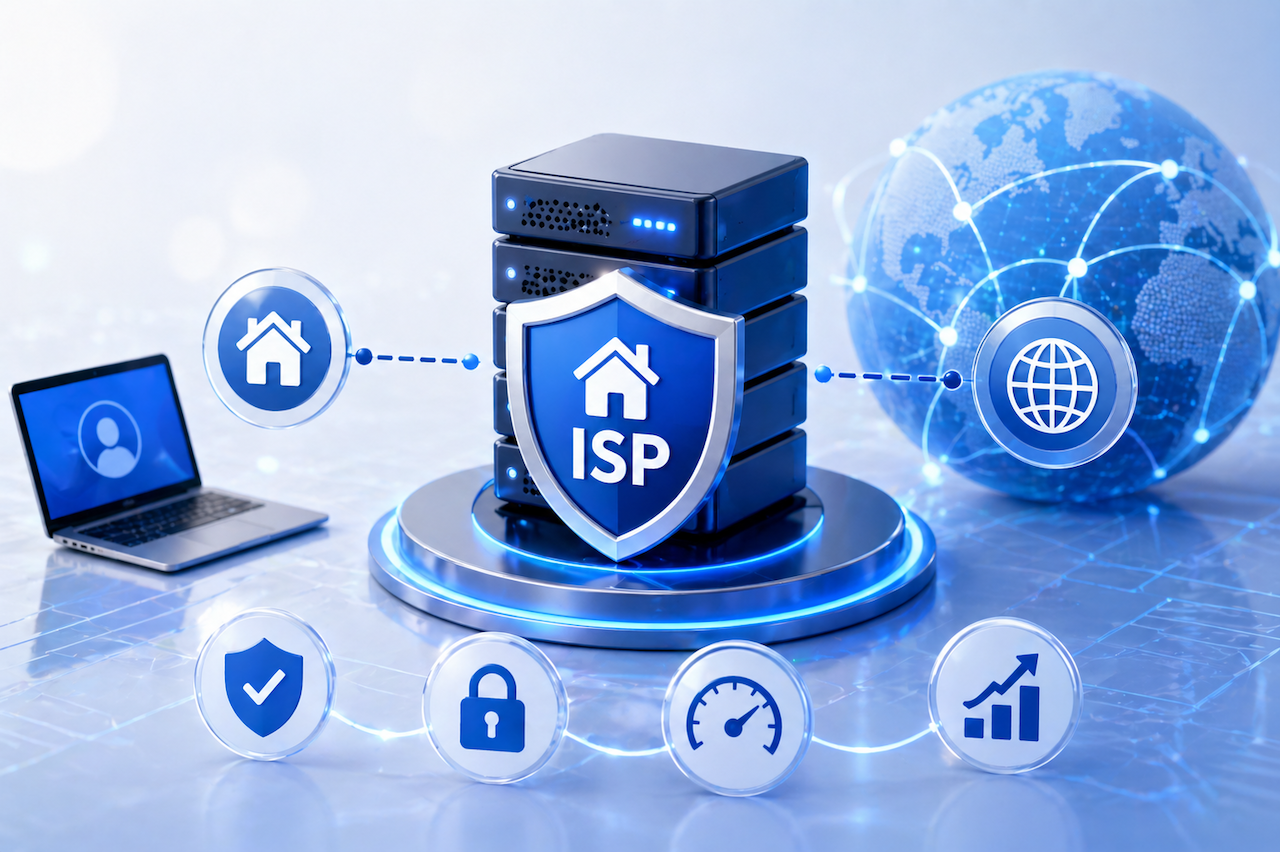
Not every proxy problem is about getting a new IP. Sometimes it is the opposite: you need to hold one identity long enough to finish the job without slowing down or tripping anti-bot systems. That is where ISP proxies fit. They are static IPs registered to an internet service provider but served from datacenter hardware, so the address stays put and the connection stays fast.
This guide covers what ISP proxies are, how they work, the benefits they offer, and the situations where they are most useful.
What Are ISP Proxies?
ISP proxies, also called static residential proxies, are IP addresses registered to a real Internet Service Provider but hosted on datacenter servers. To a target site, the IP looks like a normal home connection. The traffic actually runs on datacenter hardware, not a cable modem in someone's living room.
That split is the whole point. The site sees a residential IP and treats it like one. You get datacenter speed and uptime without sitting in an obvious datacenter IP range. The same IP stays assigned to you for weeks or months, which is what makes them useful for any workflow tied to session or account continuity.
How ISP Proxies Work
Websites sort incoming traffic by who owns the IP. Every address ties back to an ASN, a record that labels the block as a residential ISP, a hosting company, or a mobile carrier. Consumer ISPs pass the trust check. Datacenter ranges usually do not.
ISP proxies work inside that gap. The IP itself is leased from a real ISP, so the ownership records look residential, but the machine answering requests sits in a datacenter. The site does its lookup, reads a consumer ISP in the results, and handles the traffic as it would any home visitor. The server, meanwhile, gives you the speed and uptime a home connection cannot.
The static assignment is what ties it together. Your IP does not change between requests, so logins hold, cookies persist, and anything that tracks a visitor across multiple steps keeps seeing the same user.
Main Benefits of ISP Proxies
1. Stable sessions
Because the IP does not rotate, you can keep a login, cookie, or cart active for hours or days. That matters for anything tied to account state or multi-step workflows.
2. Better trust than standard datacenter proxies
Target sites check IP reputation. Datacenter ranges are flagged constantly. ISP ranges look residential, so requests pass through filters that would reject a plain datacenter IP on sight.
3. High speed and uptime
Traffic runs on datacenter hardware with proper peering. You avoid the variable speeds and dropped connections common with peer-sourced residential networks.
When to Use ISP Proxies
1. Account management
Running multiple accounts on platforms that fingerprint aggressively requires a consistent IP per account. ISP proxies give each account a stable identity that does not shift between sessions.
2. Long-session scraping
Some targets require you to hold a session for extended periods, browse like a real user, and avoid re-authentication. Rotating IPs break that behavior. Static ISP IPs do not.
3. Ad verification
Checking how ads render in specific geographies without getting filtered as a bot needs both residential-grade trust and predictable routing. ISP proxies provide both.
4. Price monitoring
Competitor pricing pages often serve different content to flagged IPs. A trusted static IP returns accurate pricing over time, which is essential if you compare day-to-day changes.
5. SEO and SERP monitoring
Search engines rate-limit and personalize aggressively. ISP proxies let you pull consistent SERP data from a specific location without triggering CAPTCHAs every few queries.
How ISP Proxies Compare to Residential and Datacenter Proxies
The three proxy types solve different problems. The right one depends on which trade-off you can live with. The table below is the summary. The reasoning follows it.
| Decision factor | ISP proxies | Residential proxies | Datacenter proxies |
|---|---|---|---|
| IP source | ISP-issued static IPs hosted in data centers | Real household IPs from consumer devices or networks | Server IPs from cloud or hosting providers |
| Trust level | High | Highest | Lowest |
| Detection resistance | Strong | Strongest | Weakest |
| Session stability | Strong | Moderate | Strong |
| Speed | Strong | Moderate | Strongest |
| Uptime consistency | Strong | Moderate | Strongest |
| IP rotation options | Limited to moderate | Strongest | Moderate |
| IP pool diversity | Moderate | Strongest | Moderate |
| Geo coverage | Moderate | Strongest | Moderate |
| Account-based tasks | Strong | Moderate to strong | Weak to moderate |
| Long-running sessions | Strong | Moderate | Moderate |
| High-volume scraping | Moderate | Strongest for hard targets | Strongest for easy targets |
| Cost efficiency | Moderate | Lowest | Strongest |
| Best use case | Stable identity with good speed and lower detection risk | Maximum legitimacy, rotation, and location diversity | Fast, cheap scale where detection is less strict |
Residential proxies win on diversity. The traffic goes through actual consumer devices, which is why the IP pool is enormous and covers almost any country or city you could ask for. That makes them the useful for high-rotation scraping or any job that needs to look like thousands of different users. The tradeoff is that real devices aren't reliable. Users drop connections, switch between Wi-Fi and cellular, or sit on a slow line for days.
Datacenter proxies are cheap. They're fast, and you can spin up a lot of them without much effort. The catch is visibility. Their IP blocks are well documented, and any site running modern anti-bot detection will usually flag them quickly.
ISP proxies are somewhere in between. The IP registers as residential to whatever site you hit, but the hardware behind it is a datacenter server, which keeps the connection stable and fast. The trade-off is rotation. You hold one IP for a long time instead of cycling through many, and you pay more per IP than you would for straight datacenter access.
How to Choose the Right ISP Proxies
It is easier to choose an ISP proxy provider once you know which details matter most. Below, I'll show you a few practical checks that separate a usable provider from a frustrating one.
- Dedicated or shared IPs. Dedicated IPs are used only by you, which makes them the better choice for account work, stable sessions, and anything reputation-sensitive. Shared IPs cost less, but you also share the risk.
- Real location coverage: Check whether the provider actually has IPs in the countries or cities you need. “Global coverage” means very little if the inventory is thin where you operate. Geotargeting depth matters more than a long country list.
- Billing model. Some plans are sold per IP, others by traffic. Per-IP pricing is easier to predict for steady session-based work. Traffic-based plans can work for lighter or less consistent usage. Also check whether bandwidth is truly unlimited or limited by fair-usage terms.
- Protocol and auth support. Confirm support for HTTP, HTTPS, and SOCKS5, plus the authentication methods your setup needs. A provider that misses one of these can create avoidable integration problems.
- IP replacement and session control. Static ISP proxies are built for longer sessions, but some IPs will still get flagged over time. A good provider should make replacements straightforward and keep session handling predictable.
As you've seen above, the right choice comes down on what you need most. ISP proxies are a great choice when you want a stable identity with more trust than datacenter IPs and more consistency than rotating residential proxies. If your priority is a fixed, reputation-friendly IP for ongoing sessions, that is where dedicated ISP proxies make the most sense.
Conclusion
Now, you know that ISP proxies are useful when you need something between residential and datacenter proxies. They give you the stability and speed of datacenter infrastructure with the trust profile of a residential connection. They are not the cheapest option and not the most diverse, but for tasks that demand persistent identity on protected websites, nothing else hits the same balance. All what's left is to choose a reliable provider, and Anonymous Proxies is worth considering.
Featured Image generated by ChatGPT.
Share this post
Leave a comment
All comments are moderated. Spammy and bot submitted comments are deleted. Please submit the comments that are helpful to others, and we'll approve your comments. A comment that includes outbound link will only be approved if the content is relevant to the topic, and has some value to our readers.
Comments (0)
No comment