
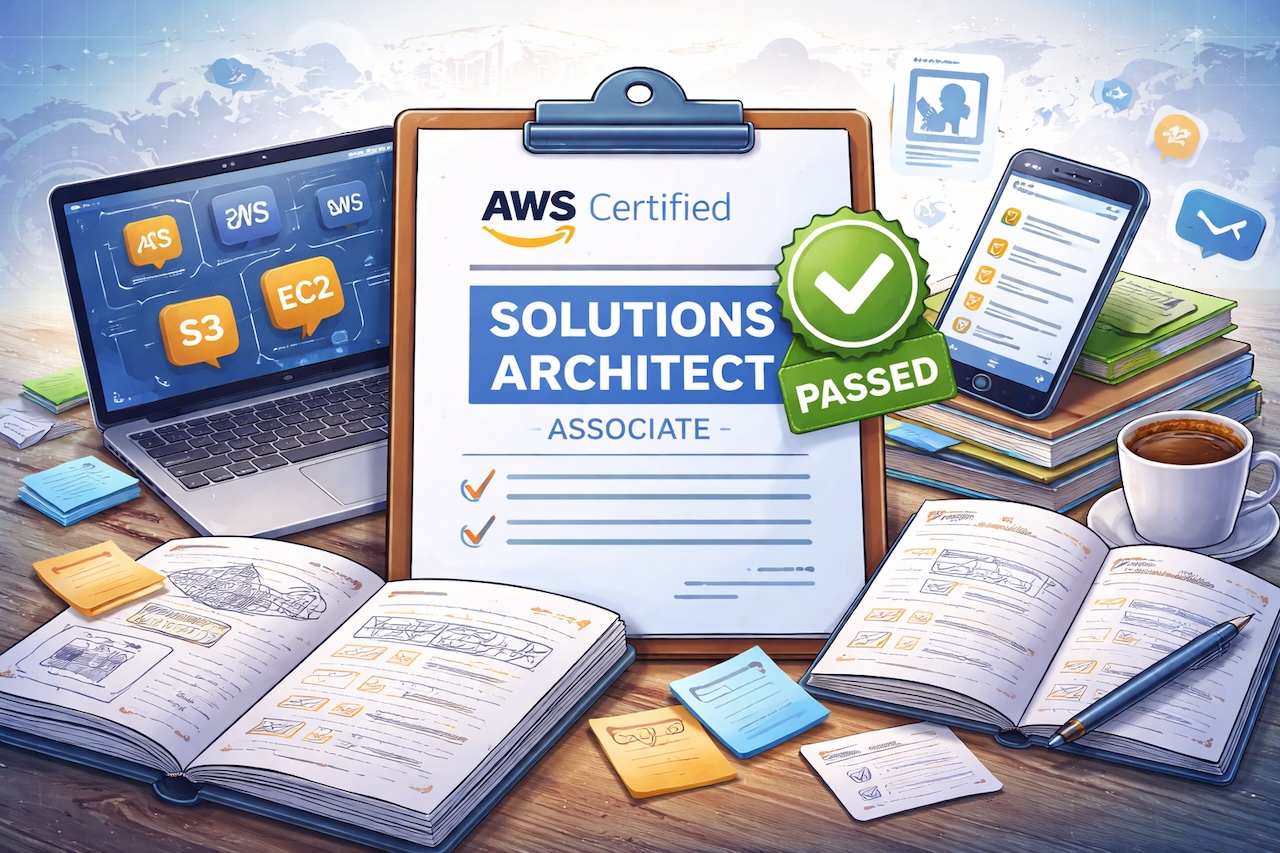
I failed the AWS Solutions Architect Associate exam the first time. Not by much, but enough. I’d spent two months watching video courses, reading whitepapers, and feeling increasingly confident that I understood how VPCs and IAM policies worked. Turns out I understood them the way you understand a city you’ve only seen on Google Maps.
The second time around I passed with a comfortable margin. Here’s what I did differently.
Stop watching videos on 2x speed and calling it studying
I’m not saying video courses are useless. I used Adrian Cantrill’s course and thought it was excellent. But I made the mistake of treating it like a Netflix series. Watch a section, nod along, move to the next one. By the time I’d finished the networking module I couldn’t remember what I’d learned in the IAM module three weeks earlier.
The problem with video is that it feels like learning. You’re absorbing information, following along with diagrams, hearing someone explain things clearly. But your brain is doing almost no work. It’s like watching someone else do reps at the gym and wondering why your arms aren’t getting bigger.
After my first failure, I started pausing after every section to write down what I’d just learned without looking at my notes. Brutal. I’d sit there trying to remember the difference between a NAT gateway and an internet gateway and realise I had no idea, even though I’d watched someone explain it twenty minutes ago. That uncomfortable moment of not knowing is where the actual learning happens.
The labs matter more than the theory
You can read about S3 bucket policies all day. You won’t really understand them until you’ve locked yourself out of your own bucket and spent forty minutes figuring out why. I set up a personal AWS account with a strict budget alert at $10 and just started building things. Badly, at first.
I deployed a WordPress site with an RDS backend, set up a VPC with public and private subnets, broke it, fixed it, broke it again. Every time something didn’t work I’d have to go figure out why, and that process taught me more than any course module.
If you’re studying for any AWS cert, free tier is your friend. Just set up billing alerts so you don’t accidentally leave a NAT gateway running for a month. That’s a mistake I only needed to make once.
Why I started doing practice questions from week one
First time around, I saved practice tests for the final week as a “readiness check.” By then it was too late to fix the gaps they revealed. Second time, I started doing practice questions from the beginning.
The AWS exam questions are oddly specific. They don’t just ask “what is an Application Load Balancer?” They give you a scenario with four requirements and ask you to pick the most cost-effective architecture from four plausible options. You need to think in trade-offs, not definitions.
I used a few different sources. Jon Bonso's practice exams on Tutorials Dojo were closest to the real thing in terms of question style. I also had a large pile of personal notes from the video course and wanted practice questions based on that material specifically, so I used Quizgecko to turn my notes into question sets. Faster than writing them by hand, and it caught gaps I didn't know I had. There was a whole section on ElastiCache that I thought I understood until a question forced me to explain the difference between Memcached and Redis use cases.
What matters isn’t your score on practice tests. It’s what you do after. Go back to every wrong answer, study that specific topic, then test yourself on it again a few days later. I kept a spreadsheet of topics I got wrong and revisited them on a rotation. Tedious but it worked.
Other things that helped
I joined a Discord server for AWS cert study. Not for the resources (most shared resources are the same ones you’ll find anywhere) but for the accountability. Seeing other people post their practice scores and study logs kept me showing up on days I didn’t want to.
I read the AWS Well-Architected Framework whitepapers. They’re dry, but the exam loves asking about best practices and the whitepapers are literally where those best practices come from. Don’t read them cover to cover. Skim them, focus on the sections relevant to whatever you’re weak on.
I also studied in the morning instead of the evening. This is personal and might not apply to everyone, but my retention was noticeably better when I studied with a fresh brain versus trying to cram after a full day of work. Even thirty focused minutes in the morning beat two foggy hours at night.
What I’d do differently if I started over
Spend less time on passive learning and more time actively testing myself from the start. The ratio that worked for me was roughly 40% watching or reading new material and 60% doing something with it, whether labs, practice questions, or explaining a concept out loud without looking at my notes.
I’d also pick a realistic timeline. Two months is tight for the Solutions Architect Associate if you’re working full time and don’t have much AWS background. Three months with consistent daily study is more reasonable. Don’t rush it just because someone on Reddit said they passed after two weeks of cramming. Those people either have years of experience already or they’re not telling the full story.
And honestly, failing the first time wasn’t a disaster. It cost me $150 and a Saturday morning. The exam breakdown tells you which domains you scored low in, so you know exactly where to focus for the retake. I learned more from analysing why I failed than from a lot of my actual studying.
Share this post
Leave a comment
All comments are moderated. Spammy and bot submitted comments are deleted. Please submit the comments that are helpful to others, and we'll approve your comments. A comment that includes outbound link will only be approved if the content is relevant to the topic, and has some value to our readers.
Comments (0)
No comment