

Web Scraping at Scale: How to Perform High-Throughput & Multi-Region Infrastructure
When Susan's first web scraping project started returning hundreds of reliable pricing records every hour, the engineer leading the effort celebrated with her team. Within weeks, however, the pipeline slowed, then stalled entirely as anti-bot systems detected the traffic surge and began blocking requests. This growing gap between initial success and long-term reliability is a common challenge for teams that attempt to scale without resilient infrastructure. In today’s data-driven economy, scraping micro-volumes of data is no longer the goal; scalable scraping that can execute thousands of requests per day across diverse geographic targets is what separates basic scripts from production-grade systems.
As industry research confirms, demand for web data continues to grow: 80% of enterprises reportedly use external web data for analytics and decision-making, while over half see increased usage year over year (2024 State of Data & Analytics). To support this demand while maintaining uptime and efficiency, scraping infrastructure must evolve from one-off scripts into distributed, multi-region deployments that can handle high volume without interruption.
1. What It Means to Scrape at Scale
At its core, scaling a scraping operation is about more than just increasing the number of requests sent per hour. It requires a shift in engineering mindset toward fault-tolerant and geographically distributed systems. Scraping at scale means reliably processing thousands or even tens of thousands of requests per day, ensuring that target APIs and HTML pages are consistently reached while avoiding blocks and minimizing latency. When scraped data drives real-time dashboards, competitive pricing decisions, or machine learning models, occasional failures are no longer acceptable. They must be engineered out from the start.
2. Building Blocks of Scalable Scraping Infrastructure
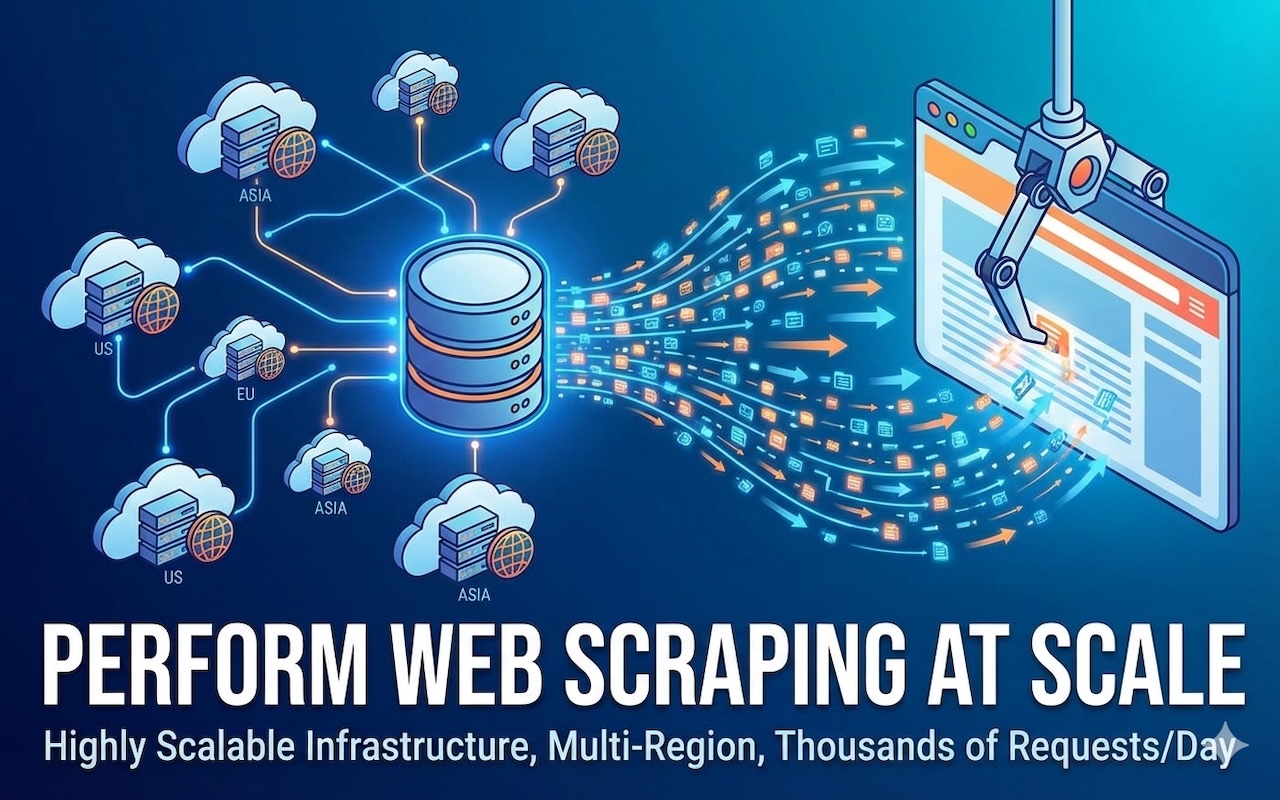
To accomplish this, modern scraping architectures rely on foundational layers that support reliability and scalability. The most critical of these is the design of a distributed worker library that allows the workload to be spread across multiple execution units. In practice, this often resembles containerized workers—each running instances of crawl logic—that consume tasks from a shared queue and report results to a centralized store. This modularity allows teams to increase throughput simply by adding more workers, horizontally scaling to meet demand without overwhelming any single component. Decoupling work generation from execution also ensures that if one worker fails or a proxy pool becomes temporarily blocked, others continue processing, maintaining continuity even as conditions change.
3. Multi-Region Deployment for Speed and Resilience
Deploying workers across multiple geographic regions is a proven strategy for improving scraping success rates and reducing latency. Cloud providers like AWS, Google Cloud, and Azure now maintain dozens of regions globally, making multi-region deployment accessible to organizations of all sizes. Locating workers closer to target servers minimizes round-trip times and improves both responsiveness and reliability, especially when scraping time-sensitive data such as retail prices or product inventory. Moreover, multi-region deployment reduces the risk of systemic blocks; if traffic in one region experiences elevated rejection rates, workloads can be rerouted to another region with distinct IP ranges and network behaviors. These patterns introduce redundancy and performance advantages that single-region implementations cannot match.
4. Handling Thousands of Requests per Day Reliably
Reliably executing thousands of requests per day requires careful orchestration of concurrency and scheduling. High-volume scraping cannot depend on fixed delays or static execution patterns; instead, it must incorporate adaptive throttling logic that reacts to real-time signals from target systems. For example, when success rates are high and latency is stable, concurrency can safely increase. When block signals such as HTTP 429 responses or CAPTCHA challenges begin to surface, the scheduler should back off, retry intelligently, and allow proxy cooldown periods before resuming. In practice, teams using multi-region proxy providers such as Decodo can implement these cooldowns at the proxy-pool level, temporarily shifting traffic to healthier IP ranges or regions while flagged addresses recover. Message queues like Kafka, RabbitMQ, or AWS SQS provide the durability and flexibility needed to coordinate these workloads, ensuring that jobs are never permanently lost and that retries do not overwhelm the system or the target.
5. Proxy Strategies to Maintain Access at Volume
No matter how well the workload is distributed, large-scale scraping depends on reliable proxy infrastructure. Proxies provide IP diversity, geographic variation, and resilience against localized blocks. At scale, rotating IPs or using a pool that includes residential, datacenter, and ISP-based options improves durability because it reduces deterministic request patterns that anti-bot systems detect. Proxy providers offering multi-region support allow scraper deployments to align proxy endpoints with worker locations, lowering latency further and reducing the risk of region-wide access loss. Monitoring IP reputation and proactively refreshing proxy pools helps ensure that the system remains capable of reaching high-value endpoints consistently.
6. Data Processing and Pipeline Integrity
Once data is retrieved successfully, robust processing pipelines are needed to manage transformations, deduplication, validation, and storage. At high volume, ad-hoc parsing followed by local saving is not sustainable—latency and I/O bottlenecks will accumulate. Stream-oriented and serverless architectures help distribute parsing workloads efficiently while reducing operational overhead. As data moves through the pipeline, transformations should maintain traceability so that anomalies such as missing records or parsing failures can be traced to their origins. Validating data integrity before long-term storage prevents downstream models or analytics tasks from ingesting corrupted datasets, ensuring that the value extracted from scraping remains trustworthy.
7. Observability and Block Detection
Monitoring becomes essential once scraping reaches production scale. Observability frameworks built using logging solutions like ELK or visualization tools like Grafana provide insights into performance trends, failure rates, and soft block indicators. Metrics such as request success rate, median latency, and proxy utilization help identify emerging block patterns before they escalate. Systems that automatically detect block signals can switch strategies—altering concurrency, rotating proxies, or shifting regions—long before human operators realize that throughput is degrading. This proactive approach is key to maintaining uptime in unpredictable environments where anti-bot defenses continuously evolve.
8. Legal and Ethical Considerations for Scaled Operations
Scaling scraping capabilities demands heightened awareness of legal and ethical obligations. Organizations must comply with relevant terms of service, regional data regulations, and best practices for respectful access. Excessive requests that impair service availability or harvesting personally identifiable information without consent can create legal exposure and reputational harm. Ethical scraping practices—such as honoring robots.txt where appropriate, using only the access needed for the task, limiting request rates to avoid disruption, and maintaining transparency in data use—help ensure that scraping remains a viable and collaborative method of accessing public information without harming the broader ecosystem.
Conclusion
Performing web scraping at scale is ultimately an engineering challenge that blends distributed systems design, adaptive scheduling, responsible data handling, and ongoing observability. Success depends not only on higher throughput but on building resilient infrastructure that reacts to real-world conditions, respects targets, and maintains accuracy at volume. Multi-region deployments, distributed workers, dynamic concurrency controls, and strategic proxy usage allow organizations to execute thousands of requests per day reliably while minimizing block risk. As anti-bot defenses evolve, scalable scraping requires intelligence and adaptation rather than brute force. Teams that embrace this discipline transform raw web data into strategic advantage while preserving trust, continuity, and compliance.
Featured Image generated by Google Gemini.
Related Articles

April 1, 2026
Data Scraping at Full Scale: How to Collect Information from Protected Websites Without CAPTCHA
Data scraping has evolved from a niche technical activity into a core business function. Companies rely on large-scale data collection for market intelligence, pricing analysis, SE...
Read More
December 30, 2025
Advanced Web Scraping: Unblock difficult targets and bypass blocking mechanisms
Imagine a data team that has just launched a new scraping pipeline to monitor prices across a major e-commerce platform. On the first day, everything works flawlessly. Requests ret...
Read More
October 24, 2025
How Rotating Proxies Work: The Hidden Engine Behind Reliable Web Scraping
In today’s data-driven world, web scraping has become the heartbeat of industries that depend on large-scale data analysis — from eCommerce and SEO to finance and market research....
Read More
Comments
Comments are available to signed-in users and are moderated to keep the discussion useful and respectful. Spam, automated submissions, and low-value promotional comments are removed. Outbound links may be approved when they are relevant and genuinely helpful to readers, but they are displayed as plain text rather than clickable hyperlinks.
No comments have been published yet.
Please sign in to submit a comment.