
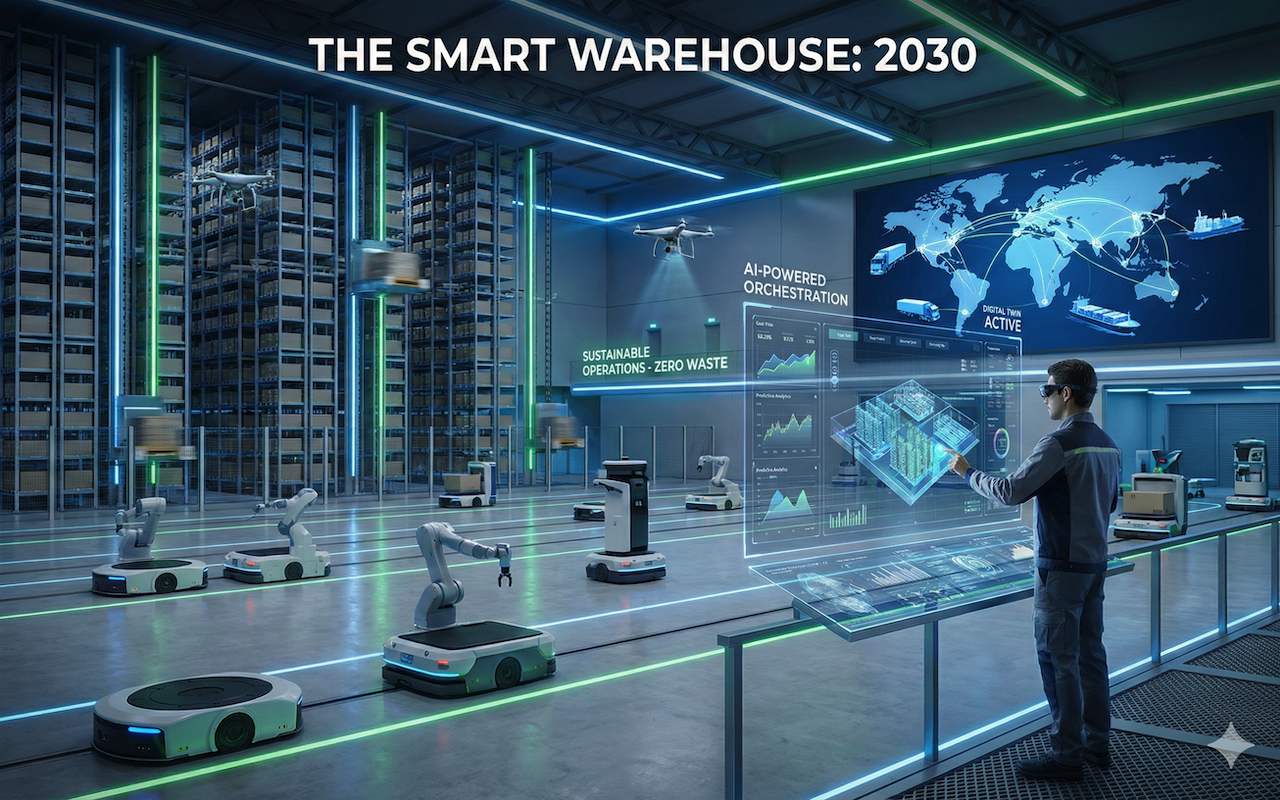
If the warehouse once symbolized the backbone of logistics, by 2030 it will represent something far more intelligent — a living, learning ecosystem where robots, data, and algorithms work in harmony to move goods with almost zero friction. The traditional warehouse, built for storage, is evolving into a nerve center of global commerce.
Automation, AI, and next-generation connectivity are reshaping every corner of the logistics world, but their most visible impact lies inside warehouse walls. The decade ahead promises more than incremental upgrades; it’s about entirely new ways of thinking about how space, data, and labor interact.
From autonomous fleets to self-healing systems, this is what the warehouse of 2030 will look like and how it will redefine supply chain intelligence across industries.
1. The Rise of Autonomous Warehouses
By 2030, most large-scale warehouses will be fully autonomous ecosystems. What began as a few robotic arms and mobile assistants will evolve into fleets of autonomous mobile robots (AMRs), guided vehicles, and robotic picking systems, all orchestrated by AI-powered control centers.
The core driver? Efficiency and safety at scale. These autonomous systems will adapt dynamically to demand surges, shifting layouts, and changing inventory types without requiring manual intervention. They’ll communicate in real time through advanced machine-to-machine (M2M) networks, optimizing every movement.
This autonomy won’t eliminate human workers but rather redefine their roles. Warehouse associates will become “systems conductors,” overseeing robotic operations, handling exceptions, and making strategic decisions, a shift similar to how pilots manage autonomous aircraft.
It’s a significant leap forward in human-machine collaboration, and companies that invest early in this transition are already reporting 30–50% faster order fulfillment and drastically reduced error rates.
2. WMS Becomes the Brain, Not the Tool
In the next five years, Warehouse Management Systems (WMS) will stop being viewed as software that “tracks inventory” and start being recognized as the cognitive core of warehouse operations.
Future WMS platforms will integrate predictive analytics, demand forecasting, digital twins, and AI-based orchestration. Rather than simply logging events, these systems will simulate outcomes, predict bottlenecks, and autonomously reroute workflows before problems arise.
The convergence of WMS and AI-driven decision engines means warehouses will think before they act. They’ll know which products are trending in specific regions, which shipments risk delays, and how to dynamically rearrange storage for optimal picking routes, all with minimal human oversight.
For logistics providers and manufacturers, this will translate into hyper-agile operations, responsive not just to current demand but also to future scenarios predicted by data.
3. The Era of Data-Driven Layouts and Digital Twins
Designing a warehouse used to involve static blueprints. By 2030, it will rely on digital twins, dynamic virtual replicas of physical environments that update in real time.
Digital twins will simulate every rack, robot, and forklift, allowing operators to model what-if scenarios before implementing physical changes. Need to test how a new layout affects throughput? Adjust it virtually first. Considering adding more automated guided vehicles (AGVs)? Run performance simulations before investing a single dollar.
These predictive models will integrate with IoT data streams, enabling organizations to monitor the warehouse as a living digital organism.
The result: data-driven design that continuously optimizes itself. Layouts won’t be “redesigned” once every five years; they’ll evolve continuously, driven by AI insights and real-time operational feedback.
4. Green Warehousing Moves from Compliance to Core Value
Sustainability won’t just be a checkbox by 2030; it will define competitiveness. Warehouses of the future will operate as energy-efficient, zero-waste ecosystems.
AI-driven energy management systems will optimize lighting, heating, and cooling based on activity and weather conditions. Drones and robots will be designed for energy reuse and recyclability. Predictive maintenance will minimize equipment waste, extend machinery lifespan, and reduce energy consumption.
More importantly, supply chains will adopt circular principles. Reverse logistics systems will integrate seamlessly with warehouse software to handle returns, refurbishments, and recycling.
Green warehousing won’t just attract eco-conscious clients; it will reduce operating costs and position businesses for regulatory compliance in an increasingly carbon-accountable world. By 2030, sustainability will be a metric of operational intelligence, not just environmental responsibility.
5. Seamless Integration Across the Supply Chain
In 2030, no warehouse will operate as an island. The future belongs to connected ecosystems, where data flows seamlessly from suppliers to carriers, from retailers to customers.
Warehouses will act as intelligent hubs within a broader network, integrated with transportation management systems (TMS), order management systems (OMS), and enterprise planning tools. Blockchain-like traceability will ensure end-to-end visibility, allowing stakeholders to track every product’s journey from factory to doorstep.
Here’s where 4PL and even emerging 5PL models come into play — logistics providers that oversee not just assets, but entire networks of suppliers, data, and systems. In that world, software integration becomes a competitive weapon.
Companies that invest in flexible, API-driven architectures will unlock faster coordination, predictive decision-making, and a seamless experience across the entire supply chain, transforming warehouses from passive storage to strategic orchestration nodes.
6. Human-Centric Automation Takes Center Stage
For years, automation was seen as the end of human labor. By 2030, it will be clear that the opposite is true. Automation amplifies human potential.
Future warehouses will be designed with human-in-the-loop automation principles. AI systems will handle repetitive, high-volume tasks, while humans focus on oversight, judgment, and innovation.
Augmented reality (AR) glasses will guide workers through picking routes, while AI assistants will predict safety hazards and suggest real-time optimizations. Training new employees will be faster thanks to immersive, game-like simulation environments.
And thanks to ergonomic robotics, heavy lifting will be reduced or eliminated, cutting injury rates and boosting retention.
This hybrid model, combining machine precision with human creativity, will define operational excellence in 2030. Warehouses that master it will see gains not only in productivity but also in worker satisfaction and long-term workforce stability.
7. Predictive Everything: From Inventory to Maintenance
By 2030, reactive management will be a relic. The new standard will be predictive of everything.
AI systems will forecast not only inventory demand but also maintenance needs, supplier delays, and even climate-related disruptions. IoT sensors embedded in racks, conveyors, and forklifts will continuously monitor conditions and alert operators before breakdowns occur.
Predictive maintenance will slash downtime by 40–60%, while predictive stocking will align perfectly with real-time sales and transportation data.
For instance, warehouses will anticipate order spikes from marketing campaigns or seasonal trends before they happen. Instead of scrambling to restock, systems will automatically pre-order from suppliers and reorganize shelf space based on forecasted demand patterns.
It’s a vision where insight replaces reaction and where every operational move is powered by foresight, not hindsight.
The Shape of the Smart Warehouse: 2030 Snapshot
To sum up, the smart warehouse of 2030 won’t simply automate existing tasks; it will redefine the logic of warehouse operations. It will be self-learning, self-adjusting, and seamlessly connected to the global supply chain.
Here’s what defines the next decade of warehousing innovation:
- Fully autonomous ecosystems of robots and AI-driven orchestration
- WMS platforms functioning as intelligent decision-makers
- Real-time digital twins for continuous optimization
- Energy-efficient, sustainable infrastructure
- End-to-end supply chain integration through connected systems
- Human-in-the-loop automation enhancing safety and productivity
- Predictive analytics governs every operational layer
These elements won’t emerge overnight, but the transformation is already in motion, accelerated by advances in AI, edge computing, and next-generation connectivity.
Final Thoughts
By 2030, the smartest warehouses on Earth will no longer be defined by how much they store but by how intelligently they operate.
The warehouse will evolve from a physical space into an intelligent network node, a digital ecosystem where data, automation, and human expertise converge. It will anticipate needs, self-optimize processes, and sustain itself with minimal waste.
And as logistics, manufacturing, and retail industries race toward more responsive, resilient supply chains, the warehouse will stand at the center — not as a cost center, but as a driver of innovation and strategic value.
The most innovative spaces on Earth won’t just move products. They’ll move entire industries forward.
Featured Image generated by Google Gemini.
Share this post
Leave a comment
All comments are moderated. Spammy and bot submitted comments are deleted. Please submit the comments that are helpful to others, and we'll approve your comments. A comment that includes outbound link will only be approved if the content is relevant to the topic, and has some value to our readers.
Comments (0)
No comment