
Understanding Stock Splits and Bonus Issues (With Singapore Examples)
You wake up one morning, log into your brokerage account, and notice something strange: you suddenly own more shares of a company than you did yesterday, but the price per share is lower. Your total portfolio value hasn’t changed. What just happened? You’ve probably been on the receiving end of a stock split or a bonus issue—two of the most common corporate actions across global markets. While the mechanics are universal, we’ll use examples from the Singapore stocks to illustrate how they work in practice. Both can confuse new investors, but they’re actually straightforward once you understand what each one is and why companies do them.
What Is a Stock Split?
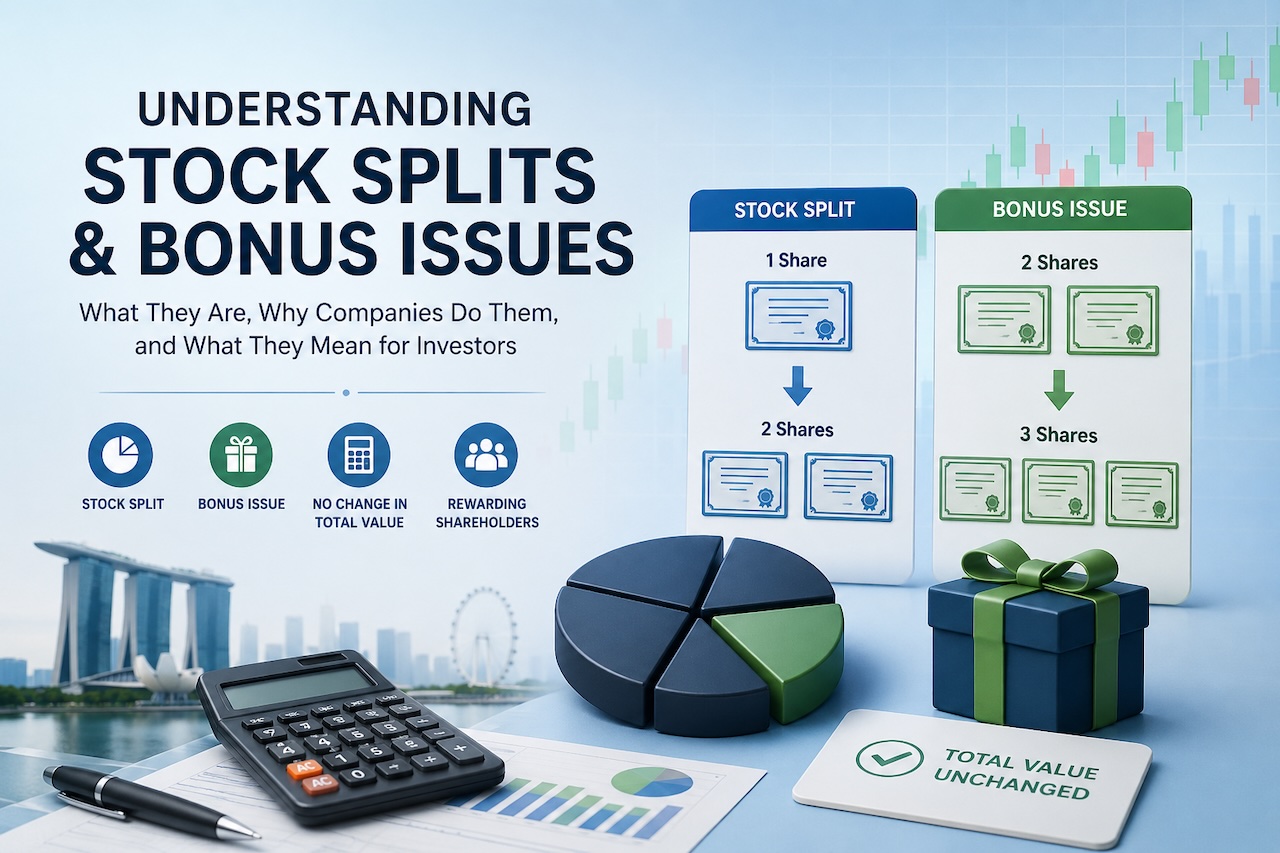
A stock split divides existing shares into multiple new shares. In a 2-for-1 split, every share you own becomes two shares, and the price per share is halved. If you owned 100 shares at $10 each before the split, you’d own 200 shares at $5 each after—the same total value of $1,000. The total market capitalisation of the company doesn’t change. The pie is the same; it’s just been cut into more slices.
The most common reason companies carry out stock splits is to make the share price more accessible to retail investors. A stock trading at a higher price may attract fewer small buyers than the same stock trading at a lower price after a split. Lower prices can also improve trading liquidity and reduce bid-ask spreads. Some companies split their shares to maintain a target price range that they believe is most attractive to long-term shareholders. While stock splits are more common in certain markets, they are less frequent among large-cap companies on the SGX, where firms often rely on dividends instead.
What Is a Bonus Issue?
A bonus issue—also called a bonus share or scrip issue—is when a company issues additional shares to existing shareholders for free, in proportion to their current holdings. A 1-for-2 bonus issue means you receive one new share for every two you already own. If you held 200 shares before the bonus issue, you’d hold 300 after. Like a stock split, the share price adjusts downward to reflect the increased share count, so the total value of your holding stays the same.
Bonus issues are often used to reward shareholders without spending cash. Instead of paying a special dividend, the company capitalises retained earnings and converts them into new shares. This allows the business to keep its cash while still providing shareholders with something tangible. It can also act as a signal of confidence, as companies that issue bonus shares typically have strong reserves and do not want to deplete them.
Stock Splits vs. Bonus Issues
Although stock splits and bonus issues may look similar on the surface, they come from different sources and have slightly different accounting effects. In a stock split, existing shares are simply divided, and there is no change to share capital or reserves. In contrast, a bonus issue creates new shares from retained earnings, increasing share capital while reducing reserves. In both cases, the share price adjusts proportionally, and the total value of your holdings remains unchanged. The key difference lies in how the shares are created and what it means for the company’s balance sheet.
| Feature | Stock Split | Bonus Issue |
|---|---|---|
| Source of New Shares | Existing shares divided | Issued from retained earnings |
| Effect on Share Capital | No change | Increases share capital |
| Effect on Reserves | No change | Reduces retained earnings |
| Effect on Share Price | Falls proportionally | Falls proportionally |
| Effect on Total Holding Value | Unchanged | Unchanged |
| Tax Implications (SG) | None | None |
| Common Use Case | Improve liquidity / accessibility | Reward shareholders without cash outflow |
Do These Corporate Actions Actually Add Value?
From a purely mathematical standpoint, the answer is no. Both stock splits and bonus issues are accounting adjustments that do not change the underlying value of a company. If a business is worth $10 billion before a split, it remains worth $10 billion afterward. Your slice of the pie may increase in number, but not in value.
In practice, however, share prices sometimes move after a split or bonus issue announcement. This is not because the company has become more valuable, but because the lower share price may attract additional investors, particularly retail buyers, which can increase demand and liquidity. Studies in larger markets have shown modest positive reactions following stock split announcements. Similar dynamics can occur in smaller markets, including the Singapore shares, although the effect is often less pronounced. The key takeaway is that these events do not fundamentally change value, even if short-term price movements occur.
What You Need to Do as a Shareholder
In most cases, the answer is nothing. Stock splits and bonus issues are processed automatically by your broker or custodian. Your share count and average cost per share will be updated to reflect the new totals, typically within a short period after the ex-date. Dividends going forward will be based on the updated number of shares.
The main detail to be aware of is the ex-date. If you hold shares before the ex-date, you are entitled to receive the additional shares from the split or bonus issue. Even if you sell on or after the ex-date, you will still receive those shares. Understanding this timing helps avoid confusion when transactions occur around corporate action announcements.
How These Show Up in Practice
While stock splits and bonus issues occur globally, their frequency and usage vary by market. On the SGX, stock splits are relatively uncommon among large, established companies, which often prioritize dividend payouts. Bonus issues, on the other hand, are more frequently observed among mid-cap companies, particularly those with strong retained earnings and limited need for immediate capital expenditure.
When a corporate action is announced, companies release official filings that include important dates such as the announcement date, ex-date, record date, and distribution date. These filings are publicly available through exchange websites and brokerage platforms, allowing investors to track upcoming changes to their holdings.
The Bigger Picture
Stock splits and bonus issues are routine corporate actions rather than transformative events. They do not change the intrinsic value of what you own; they simply change how that value is divided. Once you understand the mechanics, they become predictable and easy to interpret.
Investors who handle these events effectively are those who stay focused on the underlying business rather than the arithmetic of share counts. Over the long term, company fundamentals—not the number of shares you hold—are what drive investment outcomes.
Disclaimer
This article is for informational and educational purposes only and should not be considered financial, investment, or trading advice. Stock splits, bonus issues, and other corporate actions may affect securities differently depending on market conditions and company-specific factors. Investors should conduct their own research or consult a qualified financial advisor before making investment decisions. While efforts have been made to ensure accuracy, iplocation.net makes no guarantees regarding the completeness, reliability, or timeliness of the information presented and shall not be liable for any losses or damages arising from the use of this content.
Share this post
Leave a comment
All comments are moderated. Spammy and bot submitted comments are deleted. Please submit the comments that are helpful to others, and we'll approve your comments. A comment that includes outbound link will only be approved if the content is relevant to the topic, and has some value to our readers.
Comments (0)
No comment