
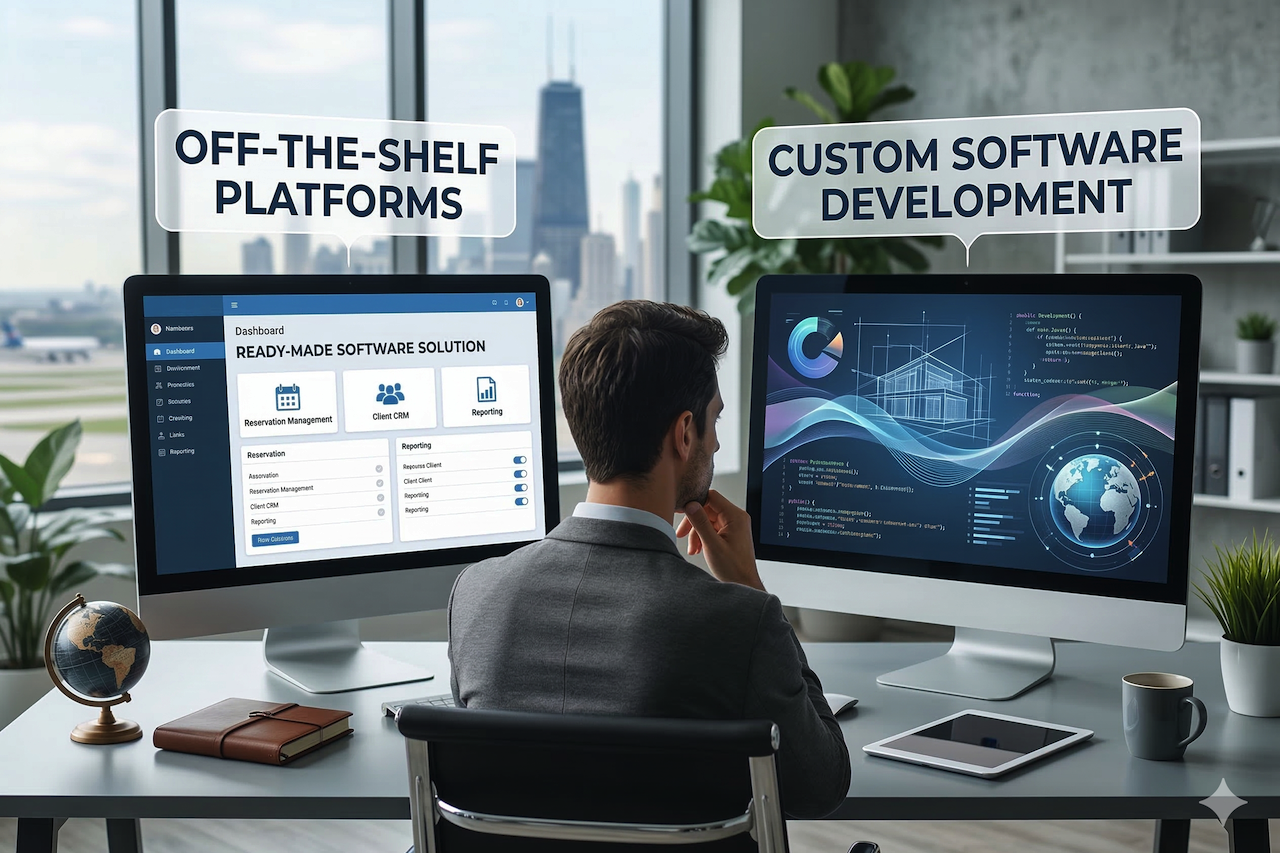
Modern travel agencies rely heavily on technology to manage operations efficiently. Software solutions have become essential tools for improving customer service and increasing profitability. Travel agencies, tour operators, and booking platforms require systems that help them operate effectively and scale their services. However, when choosing the right software, businesses often face a critical question: should you invest in custom travel software development services or rely on off-the-shelf solutions? This article examines the advantages and disadvantages of both approaches and their practical impact.
Understanding the Options
Off-The-Shelf Software
Off-the-shelf software refers to pre-built solutions that are ready to use immediately. The travel industry uses reservation management systems and customer relationship management (CRM) systems, which are designed to function as reservation engines and reservation management platforms. Business operations may be streamlined through those solutions because they offer a common platform that agencies already understand, thereby eliminating the need for custom-designed software development.
Advantages
- Quick deployment: The system will be operational within your organization in days or even weeks, as you can begin using it right after deployment.
- Lower upfront costs: Startups and small- to medium-sized companies have an advantage in accessing the system because they do not need to invest in the full development costs.
- Reliability: Your system remains secure and up to date because established providers offer ongoing security services, software updates, and technical support.
- Proven features: These solutions typically include enterprise-ready components such as booking engines, payment gateways, and reporting dashboards, which have been tested and refined over time.
Disadvantages
- Limited customization: You won't get precisely the workflow or capability you want, which may limit support for specific business processes or specialized services.
- Generic experience: It won't differentiate your brand from competitors, since many businesses use identical or similar platforms.
- Scalability constraints: Many businesses eventually outgrow these systems, facing challenges as they seek to expand or adapt to new markets.
- Hidden fees: Subscription fees, add-ons, or integration fees can accumulate over time, making the solution more expensive in the long run.
- Vendor dependency: Relying on third-party providers means you're subject to their roadmap, pricing changes, and support policies, which may affect your business flexibility.
Custom Travel Software
Custom travel software is built from the ground up to meet your business's specific needs. Your business can choose from unique travel software, which may include a full online booking system and a full travel management platform that fit your business's processes and customer experience. Through close collaboration with the development team, you can ensure that every software addition aligns with your branding requirements and business objectives.
Advantages
- Tailored functionality: Every feature is designed specifically for your business model, ensuring a perfect fit for your processes and customer needs. This degree of customization allows you to address specific pain points specific to your organization and provide a more intuitive experience for both employees and customers.
- Competitive edge: Custom software enables you to deliver unique services that off-the-shelf solutions can't, helping you stand out in a crowded marketplace. By building proprietary capabilities or workflows, you could create value propositions that are tough for the competition to imitate.
- Scalability and flexibility: Your software can evolve as your business grows, adapting to new markets, customer segments, or business services without major disruptions. As your goals change, you can easily add new modules or functionality, ensuring your technology keeps pace with your ambitions.
- Integration-ready: Seamlessly connect with third-party APIs, payment gateways, and analytics tools, allowing a unified technology ecosystem. This interoperability streamlines operations, reduces manual work, and enables you to leverage best-in-class solutions across your business.
- Enhanced security: Custom solutions can be built with advanced security protocols tailored to your business, reducing vulnerabilities and ensuring compliance with industry standards. You can implement strong data protection measures, protect sensitive data, and respond immediately to emerging threats, giving your organization and your customers greater peace of mind.
Disadvantages
- Higher upfront investment: Development costs are higher upfront compared to off-the-shelf solutions, requiring a broader commitment of resources. This includes not only monetary funding but also time spent gathering requirements, designing, and testing to ensure the final product meets your expectations.
- Longer deployment time: Building a custom solution takes weeks or months, which may also postpone your go-to-market plans. The process consists of more than one stage: discovery, development, rigorous testing, and customer training—each of which must be carefully managed to avoid costly setbacks.
- Maintenance responsibility: You are responsible for updates, bug fixes, and hosting until you partner with a reliable provider that can handle ongoing operational costs. Regular maintenance is critical to preserving the software's security, ensuring it is properly matched with evolving technologies, and aligning it with your company's goals.
- Resource demands: Managing a custom software task requires dedicated time and expertise, from initial planning through to post-launch support, which could stretch internal organizations if not properly managed.
- You may also want to hire or train specialized staff, coordinate with external developers, and allocate resources for continuous improvement, all of which can affect your organization's bandwidth.
When to Choose Off-the-Shelf Solutions
Off-the-shelf software makes sense if:
- Your business is small or just starting out.
- You need a quick solution with basic travel booking and management features.
- You have limited IT resources and prefer a ready-made, supported solution.
- Your operational needs are similar to those of other companies in the industry, so standard features are sufficient.
- You want to reduce risk by choosing a solution with a proven track record and an established customer base.
Some well-known off-the-shelf solutions include Travelport, Amadeus, and Sabre, which have been industry standards for decades. These platforms offer reliable performance, strong support services, regular updates, and integration capabilities. Because they are widely used, businesses can more easily find staff or consultants familiar with these systems, reducing onboarding time and training costs.
When to Opt for Custom Travel Software
Custom software is the smarter choice if:
- Your organization requires specialized workflows that go beyond standard operational procedures.
- You need to control every aspect of user experience and brand presentation.
- Your organization needs a scalable system that will support its upcoming rapid growth.
- Your organization requires connections to special third-party services that standard platforms do not support.
- You need to build a strong foundation to allow your business to evolve in response to market trends and customer demands.
For example, platforms like Klook and GetYourGuide use custom-built systems to create tailored itineraries and support multi-channel bookings with seamless mobile access. These custom solutions enable greater marketplace agility, allowing them to introduce new features faster and maintain a consistent brand experience across customer touchpoints. This approach highlights how custom tour software can help businesses unlock new revenue streams and strengthen customer loyalty.
The Bottom Line
There is no one-size-fits-all solution. Off-the-shelf software is often a good fit for small to mid-sized businesses that need a fast, reliable, and cost-effective option. These platforms allow you to get started quickly while keeping initial costs low. However, they may limit your ability to customize and scale over time.
Custom travel software offers greater flexibility and scalability, allowing businesses to build solutions tailored to their operations and customer needs. It supports deeper integrations, stronger branding, and long-term growth.
The right choice depends on your business goals, current resources, and long-term strategy. Consider whether your priority is speed and efficiency or building a scalable platform that supports future growth.
Featured Image generated by Google Gemini.
Share this post
Leave a comment
All comments are moderated. Spammy and bot submitted comments are deleted. Please submit the comments that are helpful to others, and we'll approve your comments. A comment that includes outbound link will only be approved if the content is relevant to the topic, and has some value to our readers.
Comments (0)
No comment