

Finding the right reseller hosting provider can determine whether your business builds predictable monthly recurring revenue or becomes overwhelmed by support tickets and shrinking margins. Freelancers, agencies, developers, and service providers often face the same decision.
The platform you choose can either improve profitability through automation and honest resource allocation or slowly drain margins through licensing fees, renewal spikes, and performance gaps that only become apparent after moving real client websites.
This comparison removes much of that guesswork. Every spec below comes directly from each provider’s official reseller page and was verified in May 2026. No recycled claims. No assumptions. Only what each company publishes about its own offering, along with the practical criteria many web professionals use when evaluating hosting solutions.
What Is Reseller Hosting?
Reseller hosting is a wholesale hosting account that lets you buy bulk server resources from an established provider, split them into individual cPanel or DirectAdmin accounts, and sell those packages to your own customers under your own brand at prices you control.
In practical terms, reseller hosting turns one-off project revenue into a recurring income stream. You buy server capacity at wholesale rates, then package it into tiers priced for your market. The provider handles hardware, network, and core systems. You handle customer relationships, billing, and day-to-day service.
Not every reseller platform works the same way. A host advertising “unlimited” resources while silently throttling accounts at 25% sustained CPU usage creates the same headaches as one charging a separate WHMCS license on top of the monthly package. The line between a profitable hosting business and a low-margin support treadmill often comes down to five or six spec details most comparison articles skip. The sections below cover those details.
Top 10 Reseller Hosting Providers: Verified Comparison Table
| Provider | Starting Price (Entry Plan) | Control Panel | Accounts/Domains Allowed | Storage | Bandwidth | Key Features and Notes |
|---|---|---|---|---|---|---|
| Bisup | ~$4.99/mo (₹468) | cPanel and DirectAdmin | 10 cPanel accounts | 100 GB NVMe SSD | Unlimited | Official cPanel Partner, integrated WHMCS |
| 20i | £39.99/mo (~$50) | StackCP (Proprietary) | 50 hosting accounts | Unlimited SSD | Unlimited | No LVE limits, autoscaling cloud, learning curve for users familiar with cPanel |
| InMotion Hosting | $35.99/mo (renewal rate) | cPanel | 25 cPanel accounts | 80 GB SSD | 1,000 GB | 90-day money-back guarantee, WHMCS and Enom domain reseller account included |
| Namecheap | $19.88/mo | cPanel | 25 cPanel accounts | 30 GB SSD | Unmetered | Transparent inode limits, strong domain reseller connection |
| GreenGeeks | $19.95/mo (renews at $34.95/mo) | cPanel | 25 cPanel accounts | 60 GB SSD | 600 GB | 300% green energy match, plants one tree per account, notable renewal increase |
| Brixly | £12.95/mo (~$16) | cPanel | 20 cPanel accounts | 50 GB NVMe | Not specified | High LVE limits, WHMCS is discounted |
| HostGator | $34.99/mo (renews at $53.99/mo) | Not specified | Not specified | 100 GB NVMe | Unmetered | Recognized brand, accounts using over 25% of system resources for 90+ seconds may face restrictions |
| Hosting.com (A2) | $24.50/mo | cPanel | 30 cPanel accounts | 100 GB NVMe | Unlimited | AMD EPYC processors, paid LiteSpeed Web Server licenses, and 12 global data centers |
| Hostwinds | $4.54/mo | cPanel | 1 domain | Unlimited SSD | Unlimited | Low entry price, single-domain limit means multi-customer reselling requires an upgrade |
| GoDaddy | $53.88/yr (~$4.49/mo) | White-label Storefront | 25 customers | N/A (Storefront) | N/A | GoDaddy manages infrastructure, billing, and support while you sell at a markup |
How to Choose the Right Reseller Hosting Provider
Before comparing platforms, you need a decision framework that goes beyond the sticker price. Several factors can determine whether a reseller hosting service grows with your business or becomes a limitation over time.
Which Control Panel Should Your Customers Use?
The control panel question shapes your entire reseller operation. cPanel remains the industry standard. Many end users have used cPanel before, major plugin ecosystems support it, and most online tutorials reference it. DirectAdmin consumes fewer server resources and usually carries lower licensing costs. Its user base is smaller, and the interface feels different, which can generate questions from customers accustomed to cPanel.
How the two compare across the metrics that matter:
- Market familiarity: cPanel is dominant and widely recognized; DirectAdmin is growing but still more niche.
- Server resource usage: cPanel is heavier per account; DirectAdmin is lighter and more efficient.
- License cost trend: cPanel pricing has risen steadily since 2019; DirectAdmin has stayed more stable with a lower baseline.
- Third-party integrations: cPanel has extensive support for tools such as Softaculous, LiteSpeed, and WHMCS; DirectAdmin has a narrower but usable ecosystem.
- Customer learning curve: cPanel is familiar for many users; DirectAdmin may require more orientation.
Detailed Provider Breakdown
1. Bisup — A White-Label Platform with cPanel Partnership and Dual-Panel Flexibility

Bisup focuses on addressing three common challenges faced by hosting resellers: control panel licensing overhead, billing automation gaps, and unpredictable resource contention. The platform runs on official cPanel Partner infrastructure, a credential signaling verified integration quality, and supports both cPanel and DirectAdmin from the same reseller package.
This provider integrates WHMCS directly into the reseller environment. Automated provisioning, invoicing, and customer management come without a separate license fee. Since some competitors charge $15–$28 extra each month for similar functionality, this can make a meaningful difference. White-label execution includes custom nameservers such as ns1.yourbrand.com, helping keep the upstream host invisible to end customers.
The plan page lists weekly backups, SSL, and dedicated IP options during checkout. As with any hosting provider, users should confirm current plan details directly before signing up.
Key Features
- Communication channels include WhatsApp and direct real-time assistance, while many hosting companies rely mostly on ticket queues. When a customer’s site goes down late, faster access to technical help can simplify the response process.
- As an official cPanel Partner, this platform includes cPanel and WHM licenses without line-item fees. Including those licenses directly reduces operating costs compared with hosts that pass through rising license expenses. The price shown on the plan page stays closer to what you pay over the long term.
- Some users may prefer smaller hosting companies because they often provide a more personalized support experience. Smaller hosting firms often place more emphasis on individual reseller relationships than enterprise-scale competitors, where users can feel like ticket numbers in a queue. That dynamic can influence how support and account management handle requests.
- According to the company, custom plan arrangements may be available upon request. If you need an intermediate number of cPanel accounts, such as 15 instead of jumping from 10 to 25, a conversation with support may make that possible. Rigidly tiered companies rarely offer this kind of accommodation, and the flexibility can prevent you from paying for capacity you do not yet need.
- This provider is positioned toward freelancers, developers, consultants, and small businesses seeking integrated billing and cPanel-based management.
2. 20i — Unlimited Resources Without License Fee Overhead
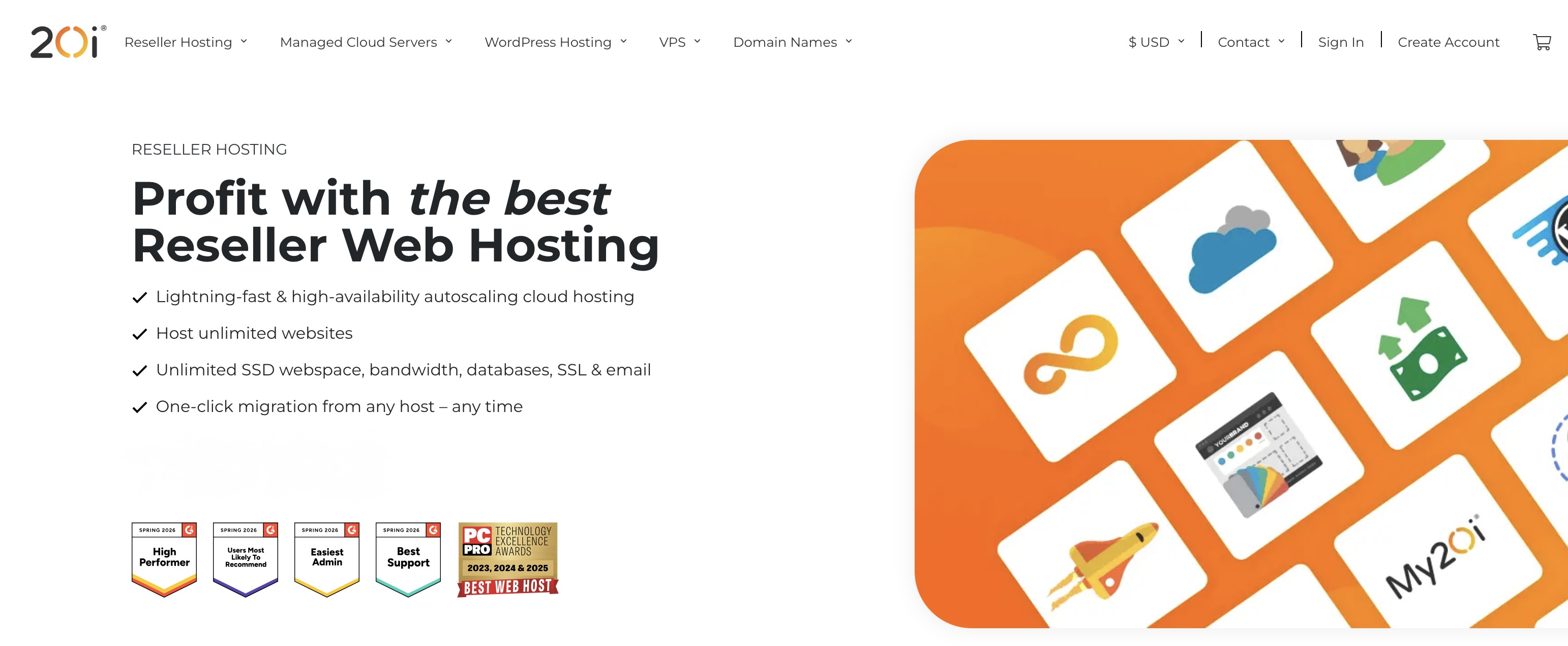
20i takes a different approach by leaving cPanel behind in favor of its own StackCP control panel. That decision eliminates per-account software licensing fees and allows autoscaling cloud infrastructure to spread workloads across multiple servers instead of tying accounts to a single machine. Reseller packages come with unlimited SSD disk space, unlimited bandwidth, unlimited SSL certificates, and unlimited 10 GB email accounts at every tier.
The Reseller 50 package starts at £39.99 per month after a £1 first-month trial and supports 50 hosting accounts. Reseller 500 (£69.99/month) scales to 500 accounts. Reseller Unlimited (£99.99/month) removes account caps entirely. WHMCS and HostShop billing are both included, along with a Reseller API for custom integrations. Global data centers span the UK, USA, and Singapore, and the Twentie AI assistant helps automate routine management tasks.
The trade-off is StackCP itself. The panel is functional and well-designed, but anyone with years of cPanel muscle memory, or customers accustomed to the cPanel interface, will need time to adapt. This provider does not offer a cPanel option. Training new users from scratch makes this less of a concern, but migrating existing cPanel users means budgeting for retraining time.
3. InMotion Hosting — The Low-Risk Launchpad with a 90-Day Guarantee
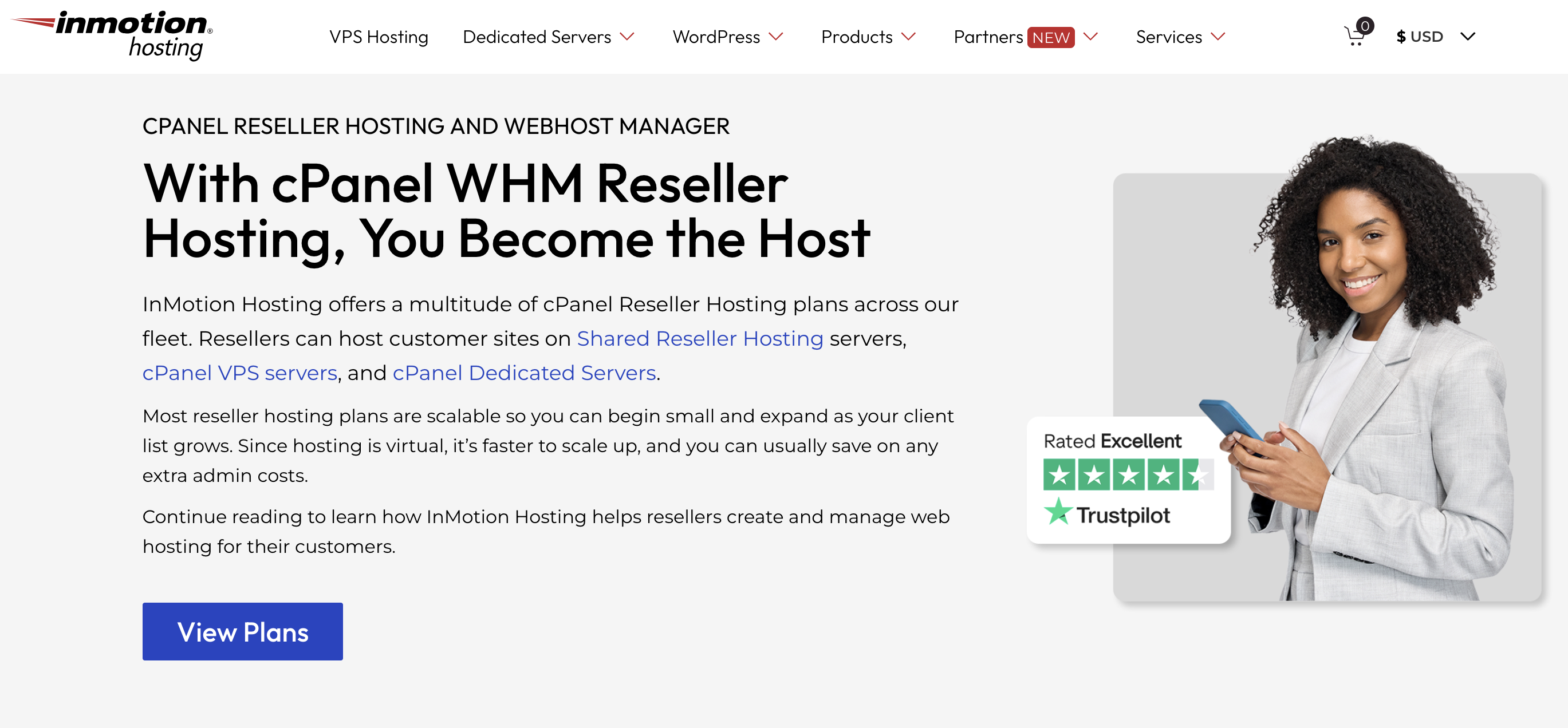
InMotion Hosting offers one of the longest safety nets in the industry: a 90-day full money-back guarantee on reseller packages with six-month or longer terms. Three months gives you enough time to move real customer sites, test workloads, and decide without taking on much financial risk.
The R-1000N package renews at $35.99 per month for 80 GB of SSD storage, 1,000 GB of bandwidth, and 25 cPanel licenses. R-2000N ($55.99/month renewal) upgrades to 160 GB of NVMe SSD, 2,000 GB bandwidth, and 50 cPanel accounts. R-3000N ($75.99/month renewal) delivers 200 GB NVMe, unlimited bandwidth, and 80 cPanel licenses. R-4000N ($109.99/month renewal) provides 300 GB NVMe, unlimited bandwidth, and 100 cPanel accounts. WHMCS is included on every tier, alongside a Enom domain reseller account. This combination can save roughly $200–$300 per year compared with services that charge separately for both.
InMotion’s Hosting Plus support for Python, Node.js, and Git expands the range of applications your customers can run. Data center choice spans US and EU locations. Packages from R-2000N upward include phone support alongside live chat.
4. Namecheap — The Domain Reseller’s Natural Home
Namecheap built its business on domains, and its reseller hosting packages extend that strength naturally. The Nebula package, priced at $19.88 per month, gives you 25 cPanel accounts with 30 GB of Pure SSD storage on Dell PowerEdge servers equipped with 56-core Xeon CPUs and RAID 6 protection. Galaxy Expert ($39.88/month) expands to 100 cPanel accounts and 90 GB of storage. Universe Pro ($58.88/month) reaches 150 cPanel accounts and 150 GB. Inode limits are published clearly: 600,000 for Nebula, 900,000 for Galaxy Expert, and 1,200,000 for Universe Pro. That level of transparency is rare among budget hosts.
cPanel/WHM, unmetered bandwidth, and Softaculous application installer come standard. For businesses selling domains alongside hosting, this provider's connection between the two product lines reduces administrative friction.
5. GreenGeeks — The Sustainability-Powered Platform

GreenGeeks offers a differentiator no other company on this list claims: 300% green energy matching and one tree planted for every hosting account created. For organizations that emphasize sustainability as part of their brand, this becomes a credible selling point rather than a superficial badge.
The RH-25 package starts at $19.95 per month, prepaid for 12 months and renewing at $34.95, and includes 60 GB SSD storage, 600 GB monthly transfer, and 25 cPanel accounts. RH-50 ($24.95 intro, $49.95 renewal) provides 80 GB SSD and 50 accounts. RH-80 ($34.95 intro, $69.95 renewal) scales to 160 GB SSD and 80 accounts. All packages include SSL certificates, cPanel migrations, managed support, and a 30-day money-back guarantee. The 75% renewal increase on the entry tier matters, so build your customer pricing accordingly.
6. Brixly — The UK Power-User’s Choice with Generous Resource Allocation
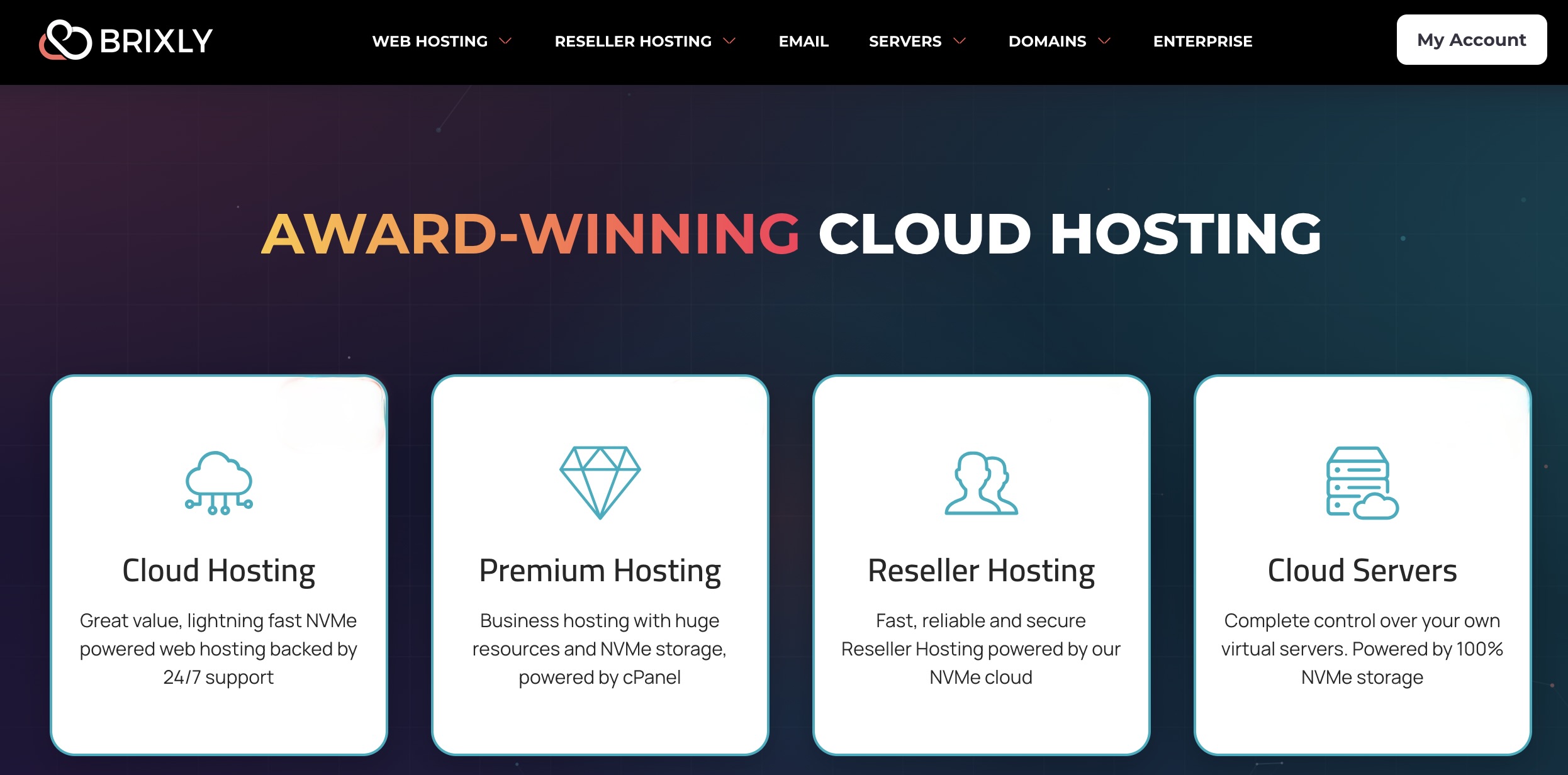
Brixly operates a fully redundant NVMe cloud platform tuned for reseller workloads. One feature that differentiates this provider from similarly priced alternatives is per-account LVE resource allocation. The Reseller Entry package (£12.95 per month after a £1 first-month trial) provides 2 CPU cores and 2 GB of RAM per cPanel account with 50 GB of NVMe storage. Reseller Pro (£24.95/month) keeps those LVE limits while expanding storage and account count. Premium Reseller (£44.98/month) jumps to 4 CPU cores and 4 GB RAM per account with six daily backups retained for 90 days.
Every package includes custom nameservers, 100% white-label branding, SSL certificates, and automated reseller migration. WHMCS licenses are discounted. This platform offers an Elite Reseller API with a WHMCS module for selling domains and VPS at wholesale rates. The platform caps accounts at 250 per server, so resellers approaching that ceiling need a secondary package.
7. HostGator — The Familiar Name for First-Time Resellers

HostGator’s brand recognition can smooth customer conversations. The Snappy 2000 package starts at $34.99 per month on the initial invoice, renews at $53.99, and gives you 100 GB of NVMe storage, 2 vCPU cores, and 4 GB of DDR5 RAM. Snappy 4000 ($53.99 intro, $83.99 renewal) doubles resources to 200 GB NVMe, 4 vCPU, and 8 GB RAM. Snappy 8000 ($82.99 intro, $128.99 renewal) reaches 450 GB NVMe, 8 vCPU, and 16 GB RAM. Each tier includes one dedicated IP and migration.
This platform explicitly warns that accounts exceeding 25% of system resources for longer than 90 seconds may face usage restrictions. This constraint matters for resource-intensive customer sites.
8. Hosting.com (formerly A2 Hosting) — Speed-Optimized for Developers
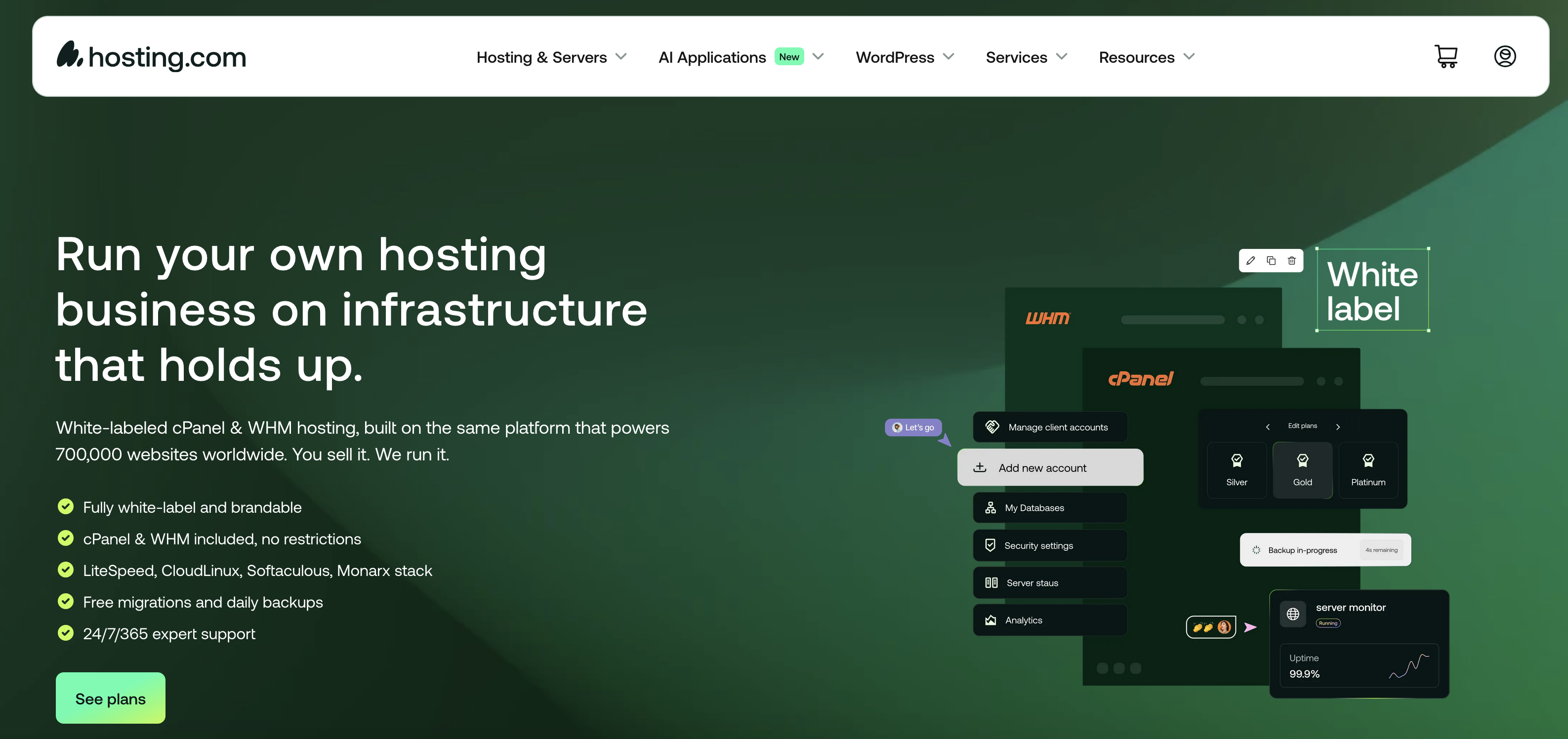
Hosting.com runs on AMD EPYC processors paired with NVMe SSD storage and paid LiteSpeed Web Server licenses. The Reseller 30 package starts at $24.50 per month for 30 cPanel accounts, 100 GB NVMe disk space, unlimited bandwidth, 1 GB LVE RAM, and 1,024 IOPS. Reseller 60 ($39.50/month), Reseller 120 ($64.50/month), and Reseller 150 ($79.50/month) scale resources progressively. All packages include daily backups, SSL, large-scale migrations, and 12 global data center locations. Promotional pricing roughly doubles at renewal, so plan accordingly.
9. Hostwinds — The Ultra-Low Budget Entry Point
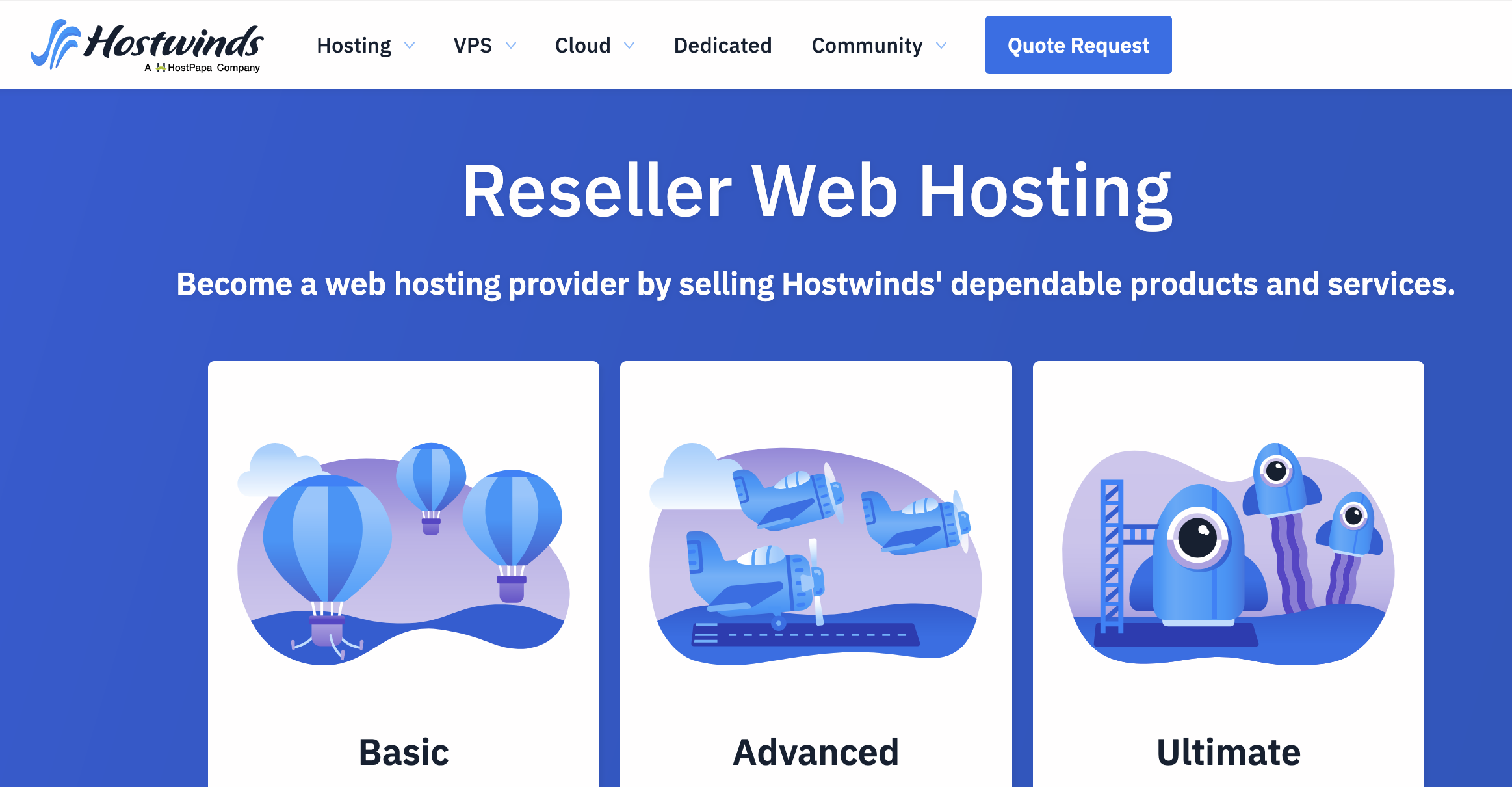
Hostwinds offers the lowest verified entry price: $4.54 per month for the Basic package, though that tier restricts you to a single domain. Advanced ($5.84/month) allows four domains. Ultimate ($7.14/month) unlocks unlimited domains with SSD storage, cPanel, Softaculous, SSL, and nightly backups. Bulk discounts scale up to 20% for 51 or more accounts. WHMCS is not included in standard reseller packages. You need the White Label Reseller upgrade, which raises the price.
10. GoDaddy — The Hands-Off Reseller Model

GoDaddy operates a different model. Instead of renting raw server space, this provider provides a white-label storefront where you sell GoDaddy products at prices you set. This platform handles billing, credit card processing, and white-label customer support. The Basic Reseller package costs $53.88 per year and supports up to 25 customers with discounts up to 20% off retail. The Pro package, around $499 per year, lifts the customer cap and extends discounts to 40%. This model suits non-technical entrepreneurs who want hosting revenue without server management. You never control the underlying environment.
Key Takeaways
- Bisup includes official cPanel Partner infrastructure, integrated WHMCS billing, and support for both cPanel and DirectAdmin within the same reseller package.
- 20i uses its proprietary StackCP control panel and autoscaling cloud architecture to offer unlimited disk space, bandwidth, SSL certificates, and databases across all reseller tiers.
- InMotion Hosting includes WHMCS and an Enom domain reseller account, along with a 90-day money-back guarantee on eligible reseller plans.
- Brixly provides up to 4 CPU cores and 4 GB of RAM per cPanel account on its Premium Reseller plan, offering some of the highest per-account resource allocations in this comparison.
- Hostwinds has one of the lowest entry prices in the group, although its Basic plan is limited to a single domain.
- Renewal pricing varies significantly between providers. GreenGeeks renews at a substantially higher rate than its introductory price, while HostGator also increases pricing after the initial term.
- When evaluating reseller hosting, pay close attention to renewal costs, resource limitations, included software licenses, and account management tools rather than introductory pricing alone.
Final Thoughts on Choosing the Best Reseller Hosting Provider
Ten providers span ₹468 per month to £99.99 per month, but the core decision comes down to six factors: control panel strategy, billing automation, resource isolation, data center geography, white-label depth, and renewal pricing reality.
It is also worth considering a company that offers a straightforward upgrade path to a managed VPS when your hosting business eventually outgrows shared reseller limits.
One theme stands out. The gap between what a company advertises and what you experience as a reseller is often largest at the budget end.
Bisup, 20i, InMotion, Brixly, and the other providers featured near the top of this comparison distinguish themselves by being specific about what they offer and transparent about cost. Every figure cited was verified against each provider’s official reseller page in May 2026.
Pricing and features change. Confirm details directly before purchasing. The best reseller hosting providers for your business are those whose published specifications match your actual customer requirements, not those with the flashiest introductory offer.
 FAQs
FAQs
Reseller hosting typically runs at 40–70% gross margins for many operators. Businesses that bundle hosting with ongoing services may see higher margins. The real risk is underpricing: charging $5 per month when customer requests consume unpaid hours. Define clear service boundaries and price packages to cover both your time and the wholesale cost.
Many end users do not know, or want to know, who the upstream provider is. They value convenience, trusted recommendations, and one person to contact when something breaks. White-label hosting hides the source. Many customers prefer paying a premium for managed service instead of navigating hosting dashboards themselves.
Renewal pricing is one of the biggest concerns in reseller hosting. Build your customer pricing around the renewal rate, not the introductory offer. If your wholesale cost is $35 per month on promo but renews at $55, price your packages against the $55 figure. Treat promotional pricing as temporary margin padding, not your permanent cost basis.
You can manually provision accounts and send invoices for 5–10 customers. Beyond that, WHMCS automation for signup, provisioning, invoicing, payment collection, and suspension on non-payment becomes highly useful. Check whether your provider includes WHMCS, as InMotion, 20i, and Bisup do, or charges $15–$28 per month separately.
cPanel is what many customers expect, with the largest ecosystem and documentation base. DirectAdmin uses fewer server resources and costs less in licensing. If your audience is non-technical, cPanel familiarity can reduce support requests. If you control training and want lower overhead, DirectAdmin works. Some providers support both, giving resellers more flexibility.
Yes, but latency matters. A website hosted in London may load slower for visitors in Mumbai than one hosted locally. If your customer base spans multiple regions, choose a company with data centers near those audiences or use a CDN. Providers with multiple global data center locations can help serve geographically diverse audiences more effectively.
Underpricing to win customers, then drowning in unpaid technical help. New resellers often match big-brand prices of $3–$5 per month without realizing those companies operate at massive scale. Smaller resellers need pricing that reflects personal service, reliability, and availability, often around $10–$25 minimum per customer account per month.
Featured Image generated by ChatGPT.
Share this post
Author

Leave a comment
All comments are moderated. Spammy and bot submitted comments are deleted. Please submit the comments that are helpful to others, and we'll approve your comments. A comment that includes outbound link will only be approved if the content is relevant to the topic, and has some value to our readers.
Comments (0)
No comment