
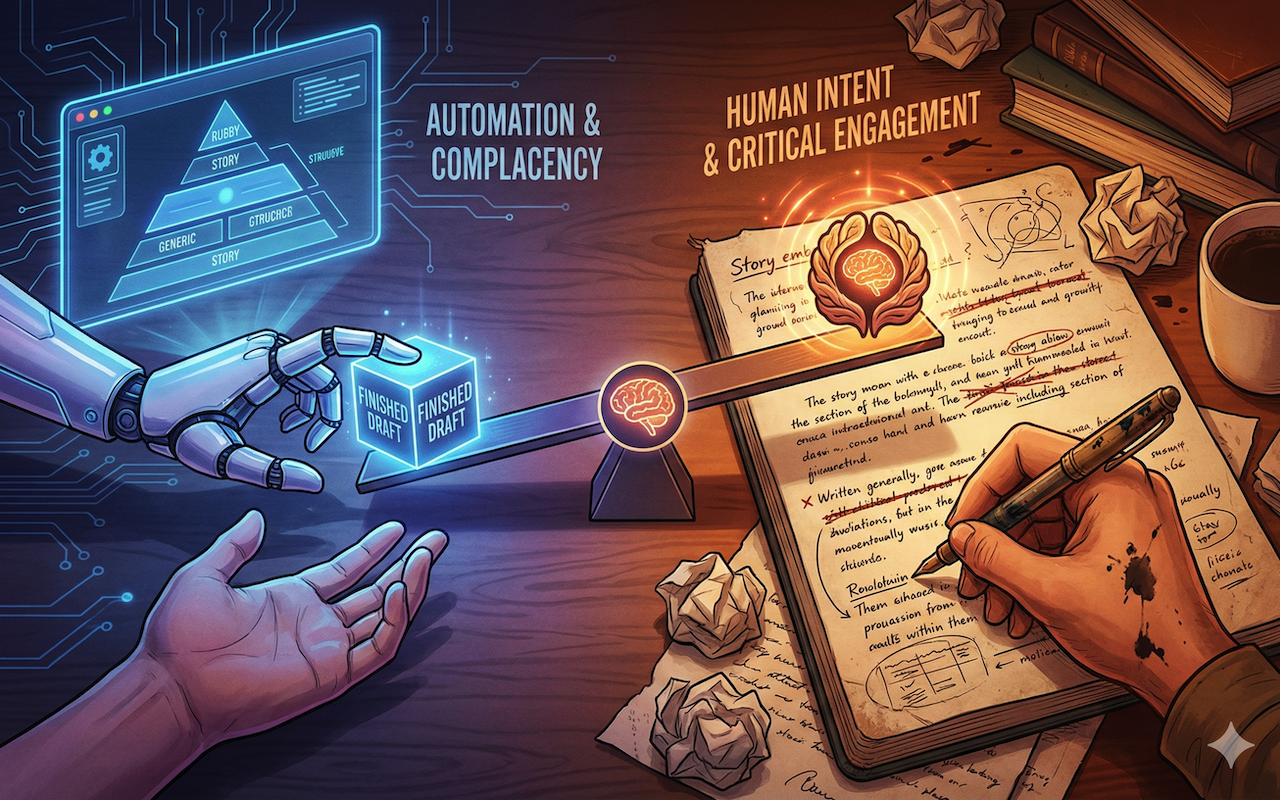
The conversation around AI and storytelling has become oddly polarized.
On one side, some claim AI will replace writers entirely. On the other hand, some insist it has no place in creative work at all. Both positions miss the point. The real risk isn’t that AI will automate creativity, it’s that writers will stop engaging critically with their own work.
Automation is easy to spot. Complacency is not.
As AI-assisted writing tools become more accessible, fluent, and persuasive, the challenge facing writers is no longer technological. It is psychological. The danger lies not in what machines can generate, but in what humans might stop doing.
The Illusion of Effortless Creativity
AI-generated text often feels impressive at first glance. It’s coherent, grammatically polished, and fast. For writers accustomed to struggling through first drafts, this can feel like relief.
But fluency is not creativity.
What makes storytelling meaningful is not surface-level polish, but intention — why a story exists, what it explores, and how it reflects human experience. These elements cannot be automated, yet they can be quietly abandoned when convenience replaces engagement.
When writers begin accepting outputs without interrogation, revision, or ownership, the craft erodes not because AI is too powerful, but because the writer has disengaged.
Why This Matters More Than Authorship Debates
Much of the public debate fixates on authorship and originality. Who “wrote” the story? Is it ethical? Is it authentic?
These are essential questions, but they distract from a deeper issue: how writers think while writing.
Storytelling has always been a cognitive act. It requires judgment, taste, restraint, and emotional intelligence. Tools have changed over time, but the mental work has remained essential.
The danger is not that AI removes this work, but that it allows writers to skip it.
Creativity Has Always Involved Tools
Historically, creative tools have been absorbed without eliminating creativity.
The typewriter did not eliminate prose style. Word processors did not eliminate the need for editing skills. Spellcheck did not eliminate language mastery. Each tool removed friction, not responsibility.
AI-assisted storytelling belongs in this lineage, but only if writers treat it as such.
An AI story generator can accelerate ideation and surface possibilities. What it cannot do is decide which ideas matter, which scenes earn emotion, or which themes resonate. Those decisions remain human, unless humans choose not to make them.
The Seduction of “Good Enough”
One of the most subtle risks is the temptation to settle for adequacy.
AI outputs are often “good enough” to pass casual scrutiny. They read well. They sound plausible. They don’t demand revision in the way messy drafts do.
This creates a new creative threshold, not excellence versus failure, but excellence versus convenience.
When writers stop pushing beyond “good enough,” the quality of storytelling declines gradually, invisibly, not through dramatic collapse, but through quiet stagnation.
Editorial Responsibility in the Age of AI
Editors, educators, and publishers face a similar challenge.
The question is no longer whether AI-generated text can meet minimum standards. It often can. The question is whether it reflects intention, depth, and perspective.
Editorial responsibility now includes evaluating processes, not just output. How was the story shaped? Where was the judgment applied? What choices were made and by whom?
This shift requires new literacy around AI use, not outright rejection.
The Difference Between Assistance and Abdication
There is a clear distinction between assistance and abdication.
Assistance
- Uses AI to explore alternatives
- Prompts revision and reflection
- Supports decision-making
Abdication
- Accepts output without challenge
- Avoids rewriting
- Defers judgment
The former strengthens craft. The latter weakens it.
The line between the two is not technical; it is intentional.
Why Experienced Writers Are Less at Risk
Interestingly, experienced writers tend to benefit more from AI tools than beginners.
This is not because they are more technically skilled, but because they possess stronger internal standards. They recognize weak scenes. They detect shallow emotion. They know when something feels false.
AI amplifies these instincts by offering contrast. Beginners, lacking these reference points, are more susceptible to accepting output at face value.
This suggests that AI does not flatten creativity universally. It exposes disparities in editorial judgment.
Platforms Reflect Philosophy
Not all AI storytelling platforms are built with the same values.
Some prioritize speed and volume. Others prioritize structure and guidance. This design philosophy matters because it shapes user behavior.
Tools like Hanostory reflect a growing recognition that narrative AI works best when it encourages exploration and choice rather than passive consumption. This approach aligns with long-term creative development rather than short-term output.
The Cultural Cost of Passive Creation
If complacency becomes widespread, the cultural cost will be subtle but significant.
Stories will feel smoother but emptier. Language will become more uniform. Emotional arcs will flatten. Not because AI lacks capability, but because human authorship recedes.
Culture does not decline because of a lack of tools. It declines through lack of engagement.
What Writers Must Defend
In the era of AI-assisted storytelling, writers must actively defend:
- Their right to decide
- Their obligation to revise
- Their responsibility to mean something
This does not require rejecting technology. It requires refusing to outsource judgment.
Algorithms will not decide the future of storytelling, but by how seriously humans take their role within the process.
A More Honest Framing
AI does not threaten creativity.
Indifference does.
When writers stop caring about how a story arrives on the page, creativity suffers. When they remain engaged — questioning, refining, shaping — tools become irrelevant to the outcome.
The conversation should move away from fear and toward responsibility.
Final Opinion
The real question is not whether AI can write stories.
It is whether writers will continue to think while writing them.
If they do, AI becomes just another instrument — powerful, imperfect, and subordinate to human intent. If they don’t, the loss will not be technological. It will be cultural.
Creativity has never been about who types the words.
It has always been about who decides what matters.
Featured Image generated by Google Gemini.
Share this post
Author

Read the latest articles from Joshua
How to View Public Tweets Without Logging Into an Account

March 13, 2026
In many situations, you might want to browse social media posts without signing in. Perhaps you want to read a public conversation, check a trending topic, or view a public profile without creating an account. Fortunately, it is still possible to explore many public posts even if you prefer not to log in. [...]
Learn morePersonalized Baby Books: A Better Alternative to Traditional Baby Books
January 20, 2026
Choosing the right reading material for a baby is one of the earliest decisions parents make and it’s more meaningful than it looks. Books introduced in the first year often shape how children experience stories, language, and bonding time. While traditional baby books have long been the default choice, many pa [...]
Learn moreLeave a comment
All comments are moderated. Spammy and bot submitted comments are deleted. Please submit the comments that are helpful to others, and we'll approve your comments. A comment that includes outbound link will only be approved if the content is relevant to the topic, and has some value to our readers.
Comments (0)
No comment