
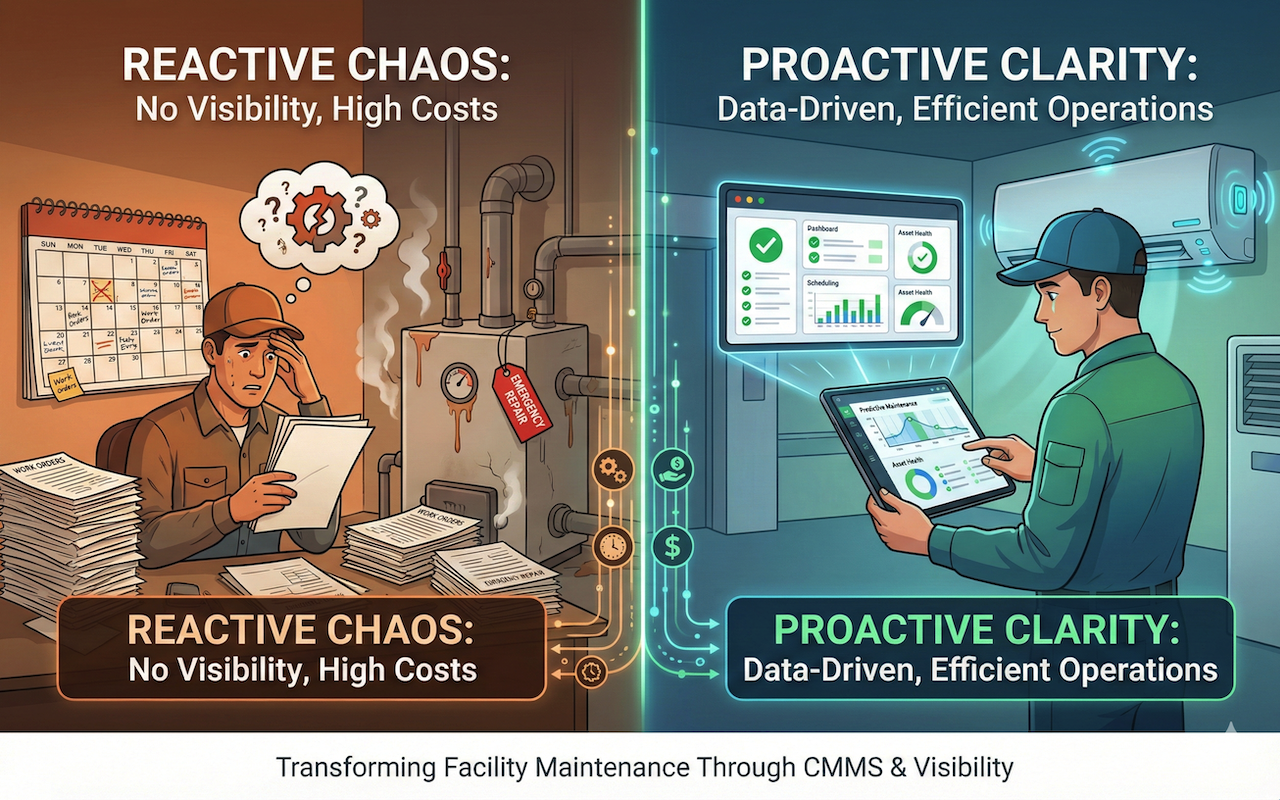
Facility maintenance teams face an uncomfortable reality: the buildings they manage are getting older, more complex, and more expensive to maintain. According to the International Facility Management Association, maintenance and operations typically account for 60% to 80% of a building's total lifecycle costs. Yet most facilities still operate without the visibility needed to strategically manage these costs.
The problem isn't effort. Maintenance teams work hard. The problem is information. When work orders live in spreadsheets, asset histories exist only in someone's memory, and preventive maintenance schedules depend on wall calendars, even the most dedicated teams end up fighting fires instead of preventing them.
This reactive cycle drains budgets, shortens equipment life, and frustrates everyone involved. Breaking free requires a fundamental shift in how facilities capture, organize, and act on maintenance data.
Why Reactive Maintenance Is So Expensive
Every facility manager understands that emergency repairs cost more than planned maintenance. But the true cost differential often surprises even experienced professionals.
Research from the U.S. Department of Energy suggests that reactive maintenance costs 2 to 5 times as much as preventive maintenance. That multiplier accounts for emergency labor rates, expedited parts shipping, and the productivity losses that cascade through a building when critical systems fail unexpectedly.
Consider a commercial HVAC failure on a Friday afternoon in July. The emergency service call alone might run $500 or more before anyone touches the equipment. Add weekend overtime rates, overnight parts delivery, and potential tenant complaints or credits, and a repair that might have cost $200 during a scheduled visit balloons into a $2,000 problem.
Now multiply that scenario across dozens of assets, hundreds of work orders, and years of accumulated neglect. The numbers become staggering.
The Visibility Problem
Why do so many facilities default to reactive maintenance despite these obvious costs? The answer usually comes down to visibility, or rather, the lack of it.
Without a centralized system tracking asset conditions, maintenance histories, and upcoming service needs, teams cannot see problems forming. They respond to what's broken because they have no reliable way to predict what's about to break.
This visibility gap creates a vicious cycle. Reactive work consumes all available labor hours, leaving no time for preventive tasks. Deferred maintenance accelerates equipment degradation. More failures occur, resulting in additional emergency work orders. The cycle continues until something forces a change, usually a catastrophic failure or a budget crisis.
What Modern Facility Maintenance Looks Like
Forward-thinking facilities have broken this cycle by implementing computerized maintenance management systems (CMMS) that centralize asset information and automate maintenance workflows. The shift from spreadsheets and paper to integrated software platforms has transformed how high-performing facilities operate.
A modern CMMS serves as the single source of truth for everything maintenance-related. Asset records, work order histories, parts inventory, vendor contacts, warranty information, and preventive maintenance schedules all reside in a single, accessible location. This centralization creates the visibility that reactive operations lack.
Core Capabilities That Drive Results
Effective facility maintenance software delivers value through several interconnected capabilities.
Automated Preventive Maintenance Scheduling
Automated preventive maintenance scheduling eliminates the calendar-watching and manual tracking that cause tasks to slip through the cracks. The system generates work orders automatically based on time intervals, meter readings, or condition triggers. Technicians receive assignments directly, and managers gain real-time visibility into schedule compliance.
Mobile Access
Mobile access meets technicians where they work. Instead of returning to an office to check assignments, retrieve asset information, or close out work orders, staff complete these tasks from smartphones or tablets while standing next to the equipment. This mobility reduces administrative overhead and improves data accuracy since technicians document findings immediately rather than relying on memory hours later.
Asset History Tracking
Asset history tracking transforms isolated repair records into actionable intelligence. When every work order, parts replacement, and inspection finding links to a specific asset, patterns emerge. Managers can identify problem equipment, compare maintenance costs across similar assets, and make informed decisions about repair versus replacement.
Inventory Mangagement
Inventory management prevents delays when technicians discover they lack necessary parts mid-repair. Integrated inventory tracking monitors stock levels, automates reorder points, and associates parts with specific equipment. Some facilities report reducing parts-related delays by 25% or more after implementing automated inventory controls.
Implementing CMMS in Facility Operations
Selecting and deploying facility maintenance software requires careful planning. The technology itself is straightforward, but organizational change management often determines success or failure.
Start With Clear Objectives
Before evaluating vendors, facility managers should define what success looks like for their organization. Common objectives include:
- Reducing emergency work orders by a specific percentage
- Improving preventive maintenance completion rates
- Extending average equipment lifespan
- Decreasing maintenance labor costs per square foot
- Achieving compliance with regulatory inspection requirements
These objectives shape software selection, implementation priorities, and how teams measure results. A hospital focused on Joint Commission compliance will configure its system differently from a manufacturing facility primarily concerned with production uptime.
Building Your Asset Database
The asset database serves as the foundation for any CMMS implementation. This step often takes longer than organizations expect, but shortcuts here undermine everything that follows.
Adequate asset records include location information, manufacturer and model details, installation dates, warranty terms, and associated documentation. For critical equipment, records might also capture nameplate data, operating parameters, and links to maintenance manuals.
Cloud-based facility maintenance solutions, such as MPulse Software, simplify this process by providing structured templates and mobile data-collection tools. Technicians can photograph equipment nameplates and capture model, serial, and operating information directly during routine rounds, building the asset database incrementally without requiring large, dedicated data entry projects.
Prioritizing Preventive Maintenance Programs
Not every asset warrants the same maintenance attention. Adequate facilities are prioritized based on criticality, failure consequences, and maintenance cost-effectiveness.
A criticality assessment ranks assets by their impact on operations, safety, and costs in the event of failure. Life safety systems, production-critical equipment, and assets with long replacement lead times typically rank highest. Lower-criticality items might receive less frequent attention or even be run to failure if replacement costs less than prevention.
This prioritization ensures maintenance resources flow toward the highest-value activities rather than spreading effort evenly across all equipment regardless of importance.
Measuring What Matters
CMMS implementation succeeds when organizations track the right metrics and use data to drive continuous improvement. Several key performance indicators help facility managers assess maintenance effectiveness.
Planned Maintenance Percentage
This metric calculates the ratio of planned work orders to total work orders. Higher percentages indicate proactive operations, while lower numbers suggest reactive firefighting. World-class facilities typically achieve planned maintenance percentages above 80%, meaning fewer than 20% of work orders result from unexpected failures.
Tracking this metric over time reveals whether CMMS implementation is shifting the balance from reactive to preventive work.
Mean Time Between Failures
Mean time between failures (MTBF) measures the average reliability of equipment. Increasing MTBF indicates that preventive maintenance programs are working, while declining numbers signal problems requiring investigation.
Comparing MTBF across similar assets can identify units that need additional attention or replacement. If one rooftop unit fails three times as often as identical units elsewhere in a portfolio, something about that specific installation warrants examination.
Work Order Completion Time
How long does it take from work order creation to completion? This metric captures maintenance responsiveness and efficiency. Breakdowns by technician, asset type, or location can reveal bottlenecks and opportunities for improvement.
Reducing average completion time improves tenant satisfaction, minimizes equipment downtime, and allows teams to handle more work with existing staff.
Maintenance Cost Per Square Foot
This benchmark enables comparison across facilities and against industry standards. Tracking over time shows whether efficiency initiatives are delivering financial results.
Context matters when interpreting this metric. Older buildings typically cost more to maintain than newer construction. Specialized facilities such as laboratories, manufacturing plants, or data centers often require additional life safety and ventilation systems beyond those found in general office space. For example, assets like smoke vents and roof ventilation systems require regular inspection, testing, and maintenance to ensure code compliance and occupant safety. These additional system requirements naturally increase maintenance costs per square foot.
When benchmarking facilities, it is important to compare buildings with similar safety infrastructure, regulatory obligations, and operational demands. Significant cost variations within comparable building types may indicate inefficiencies, deferred maintenance, or opportunities for strategic improvement.
Common Implementation Mistakes to Avoid
Experience across thousands of CMMS deployments reveals several recurring pitfalls that undermine otherwise well-planned implementations.
Overcomplicating the Initial Setup
Organizations sometimes attempt to implement every possible feature at once. This approach can overwhelm users and delay time to value. Better results typically come from starting with core work order and preventive maintenance functionality, then adding capabilities as teams gain proficiency.
Neglecting User Training
Software only delivers value when it is used consistently. Investing in thorough training, especially for frontline technicians who interact with the system daily, often leads to higher adoption rates and improved data quality.
Failing to Clean Up Legacy Data
Importing years of disorganized spreadsheet data into a new CMMS can create organized chaos. Implementation is an opportunity to establish clean, consistent data standards going forward rather than carrying over past inconsistencies.
Ignoring Change Management
While technical implementation is relatively straightforward, changing established habits is more challenging. Encouraging maintenance teams to adopt new workflows requires leadership support, clear communication about benefits, and patience during the transition.
The ROI Question
Facility managers evaluating CMMS investments inevitably face questions about return on investment. While specific results vary by organization, documented benefits typically include:
- Reduced emergency maintenance costs through prevention rather than reaction. Facilities commonly report decreases of 15% to 30% in overall maintenance spending after implementing effective preventive programs.
- Extended equipment lifespan from better care and earlier problem detection. Even modest lifespan improvements yield significant savings given the costs of equipment replacement.
- Labor efficiency gains from streamlined workflows, mobile access, and reduced administrative burden. Technicians spend more time maintaining equipment and less time on paperwork.
- Improved compliance documentation for regulatory requirements, insurance purposes, and audit preparation. Automated record-keeping reduces the scramble that accompanies inspections.
- Better capital planning based on accurate asset condition data rather than guesswork. Facilities can strategically time replacements rather than react to failures.
Taking the First Step
Transforming facility maintenance from reactive to proactive doesn't happen overnight. But organizations that commit to the journey consistently report improved asset performance, lower costs, and less stressful work environments for maintenance teams.
The starting point is honest assessment. How much visibility does your organization have into asset conditions, maintenance histories, and upcoming service needs? How often do emergency repairs disrupt planned work? What percentage of equipment failures could have been prevented with better information?
If the answers to these questions reveal gaps, exploring modern CMMS solutions makes sense. The technology has matured significantly, implementation has become more straightforward, and the benefits are well-documented across industries ranging from healthcare and education to manufacturing and commercial real estate.
Facility maintenance will always involve some degree of unpredictability. Equipment fails, emergencies happen, and plans change. But organizations with robust maintenance management systems handle these challenges from a position of strength rather than chaos. They see problems forming before they become crises, allocate resources strategically, and continuously improve based on data rather than intuition.
That visibility transforms maintenance from a cost center everyone wants to minimize into a strategic function that protects assets, controls expenses, and supports organizational success.
Featured Image generated by Google Gemini.
Share this post
Leave a comment
All comments are moderated. Spammy and bot submitted comments are deleted. Please submit the comments that are helpful to others, and we'll approve your comments. A comment that includes outbound link will only be approved if the content is relevant to the topic, and has some value to our readers.
Comments (0)
No comment