
Many businesses view AI as their secret weapon. It makes all processes and campaigns run more smoothly, supports intelligent decision-making, and sparks new ideas. AI really lets companies set aside tedious tasks, catch valuable data, and adapt to market changes fast. Plus, you'll stay secure and compliant.
But the AI journey isn't all that easy. Although most businesses prepare over 50 AI projects, only 18% execute more than 20 of them. There's a gap between planning and execution.
AI-based projects generally take 6 to 18 months to set up, and some never launch. These delays can lead to slow returns on investment, disappointed stakeholders, and fading trust in AI processes. Plus, companies regularly face challenges such as chaotic data, complex technology, a shortage of AI experts, and security issues.
And getting past these burdens is key to succeeding with AI. In this article, we'll check out common AI failure patterns and how to fix them.
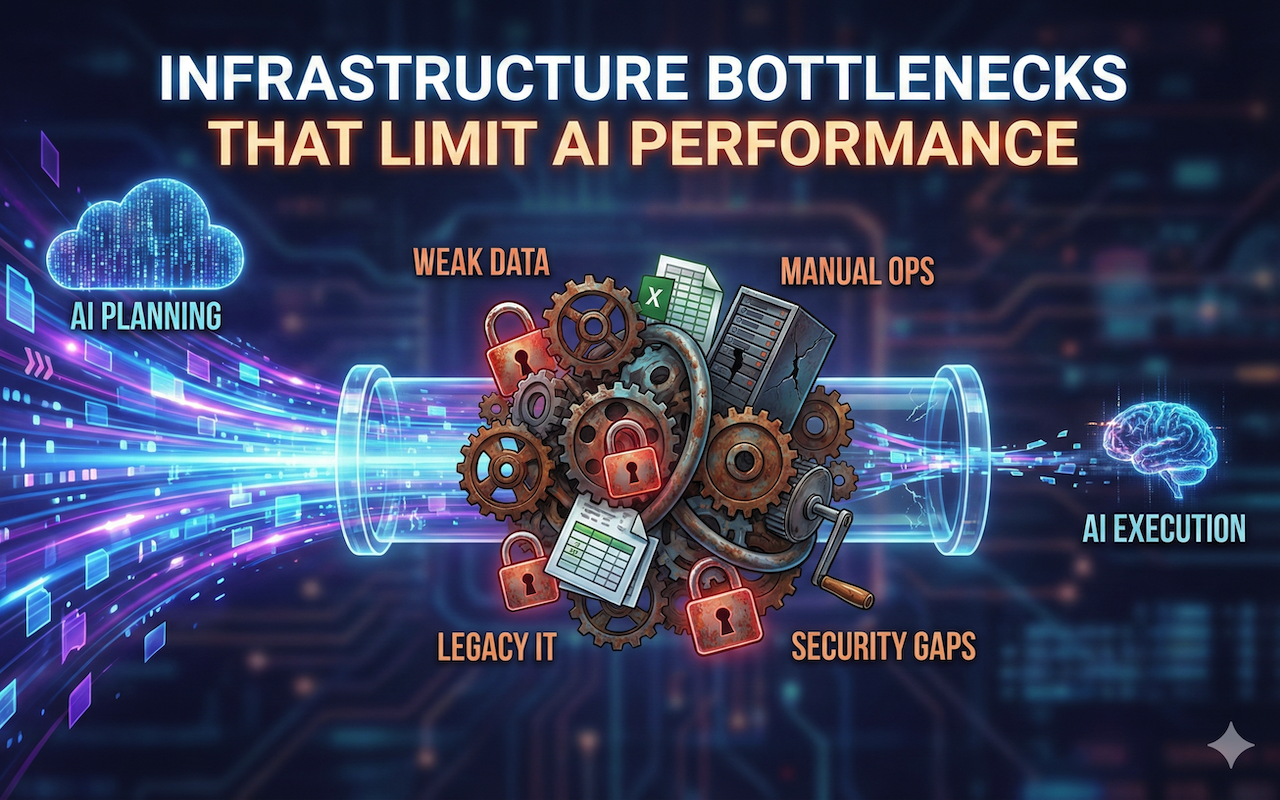
Infrastructure Bottlenecks That Limit AI Performance
By 2028, businesses could spend an astounding $631 billion on artificial intelligence. While CEOs are making these investments, many companies are still trying to figure out how to put AI to more practical use. It’s essential to identify any hidden obstacles that might be blocking AI performance and find ways to overcome them.
Weak Data Foundations
The biggest hurdle for successful enterprise AI is weak data. Many companies claim to be "data-driven," but fall short because AI needs neat, consistent data (not messy spreadsheets and incompatible databases). Around 85% of AI projects fail due to inadequate or irrelevant data.
What can we do then?
Companies should clean up their data mess by developing a solid strategy. This means cleaning and integrating the data, and following consistent data rules.
Businesses also need to set up a central data "lake" or warehouse to keep it all in proper condition and ready for AI training.
Misaligned Architecture and Infrastructure
Many organizations have outdated or incompatible IT systems that can't run AI workloads. Besides, delaying IT upgrades can lead to technical debt. At long last, you could pay more than you'd done in the first place.
The solution?
Businesses should move to a modern cloud system that uses GPU and TPU power and can grow with them. Also, use hybrid clouds for flexibility and room to grow.
Lack of Automation in MLOps
Manually handling machine learning operations (MLOps) can put the brakes on AI deployment and scaling. Manual tasks often lead to errors in activities such as data preparation, feature engineering, or model setup. These errors can lead to poor models or even system crashes, which might undermine the quality and reliability of AI development services.
The way out?
An AI development company should use automation tools at every stage of the AI process, from data collection to model deployment. This will speed up operations, reduce mistakes, and improve model reliability. For example, one financial services firm cut its production time in half and resolved issues 80% faster by using automated governance.
Compliance and Security Gaps
AI needs data, a lot of data. This can make people worried about the privacy of their sensitive information. Of course, there are regulations like GDPR and CCPA that help keep data in check. Yet, if something goes wrong, companies could face severe fines.
How do we avoid security gaps?
Establish clear rules that comply with industry regulations. Businesses must frequently check AI models to ensure they're following the rules and add strong security to protect data and models.
Vendor Lock-In That Limits Scalability
Leaning too much on a single AI vendor can sometimes trap businesses. This might leave them with limited options as their needs grow.
What do we do?
Using multiple cloud providers can help avoid being tied to a single tech provider. Businesses should also focus on open-source tools and platforms for better flexibility and easier integration.
How to Build a Smart AI System That Works
Designing an AI system that's easy to use, reliable, and goes with people's values is the perfect combination. Its components are the right technology, talented people, and a well-thought-out strategy. Here are several tips to help you start:
- Build a Strong Data Foundation: Set up robust data management systems to keep your data top-notch, well-organized, and easy to access. Set up some rules to keep things safe and ensure your AI always gets accurate information.
- Grow an Innovative Business Culture: Create a work environment that loves innovation and teamwork. Encourage teams to break their routines by working together on AI projects and sharing their successes and lessons with all.
- Use Technology That Evolves: Choose flexible cloud platforms that can grow with you and offer many AI software development services. Go for open-source tools with user-friendly interfaces to build AI solutions that run with the latest technology trends.
- Strengthen Fair Governance and Ethics: Establish rules to keep your AI integral. Aim for transparency and accountability, and try to reduce bias across all AI projects.
To Sum It Up
AI's potential is immense. Still, businesses must overcome crucial challenges to capitalize on it truly. Companies that manage to close the AI scalability gap can quickly roll out AI solutions, scale them, and ensure a smoother experience for everyone involved.
Meanwhile, those clinging to manual work might fall behind their more organized rivals. Being operationally excellent isn't just about efficiency. It's about growth.
Featured Image generated by Google Gemini.
Share this post
Leave a comment
All comments are moderated. Spammy and bot submitted comments are deleted. Please submit the comments that are helpful to others, and we'll approve your comments. A comment that includes outbound link will only be approved if the content is relevant to the topic, and has some value to our readers.
Comments (0)
No comment